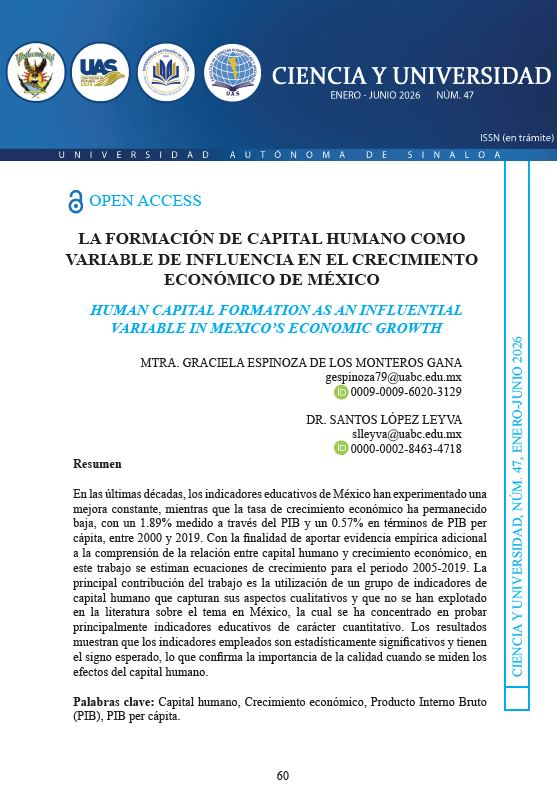
Human Capital Formation as an Influential Variable in Mexico's Economic Growth
Keywords:
Human capital, Economic growth, GDP, GDP per cápitaAbstract
During the last decades, Mexico's educational indicators have been constantly improving, while the growth rate has remained low, being 1.89% measured through GDP and 0.57% with respect to GDP per capita, between 2000 and 2019. In order to provide additional empirical evidence to the understanding of the relationship between human capital and economic growth, this paper estimates growth equations for the period 2005-2019. The main contribution of the paper is the use of a group of human capital indicators that capture its qualitative aspects and that have not been exploited in the literature on the subject in Mexico, which has concentrated on testing mainly quantitative educational indicators. The results show that the indicators used are statistically significant and have the expected sign, which confirms the importance of quality when measuring the effects of human capital.
Downloads
References
Arana, A. R. (2016). Crecimiento económico y capital humano: Metodología para la simulación de una variante del modelo de Lucas con aplicación en México. SciELO.
Banco Mundial. (2021, octubre 22). Educación. Obtenido de https://www. bancomundial.org/es/topic/education/overview#1
Barro, R. (1991). Economic growth in a cross section of countries. Quarterly Journal of Economics.
Baumol, W. S. (1989). Productivity and American Leadership: The Long View. MIT Press.
Becker, G. (1964). Human Capital: A Theoretical and Empirical Analysis with Special Reference to Education. National Bureau of Economic Research.
Cardona Acevedo, M., Montes Gutiérrez, I., Vásquez Maya, J., Villegas González, M., & Brito Mejía, M. (2007). Capital humano: Una mirada desde la educación y la experiencia laboral. Cuadernos de Investigación, Universidad EAFIT, 12-17.
De la Fuente, Á. (2004). Educación y crecimiento: Un panorama. Instituto de Análisis Económico, CSIC. Obtenido de https://dialnet.unirioja.es/servlet/articulo?codigo=2304789
Easterly, W. (2001). En busca del crecimiento (p. 88). Antoni Bosch Editor, S.A.
Fuentes, D. I., & Loaiza, J. L. (2016). Capital humano, teorías y métodos: Importancia de la variable salud. SciELO.
Kyriacou, G. (1991). Level and growth effects of human capital: A cross-country study of the convergence hypothesis. Mimeo, NYU.
Landau, D. (1983). Government expenditure and economic growth: A cross-country study. Southern Economic Journal, 92.
Langelett, G. (2002). Human Capital: A Summary of the 20th Century Research. Journal of Education Finance.
Langelett, G. (2002). Journal of Education Finance. Obtenido de University of Illinois Press: https://www.jstor.org/stable/40704155#metadata_info_tab_contents
López Leyva, S., Carrillo Montoya, T., Mungaray Moctezuma, A., Escobar Chávez, A., & Audelo López, C. (2021). Economía de la educación: Enfoques teóricos y temáticas emergentes. Ediciones de la Noche.
Lucas, R. E. (1988). On the mechanics of economic development. Journal of Monetary Economics, 22(1), 3-42.
Mankiw, N. G., Romer, D., & Weil, D. N. (1992). A contribution to the empirics of economic growth. Quarterly Journal of Economics, 407-437.
Mankiw, N. G., Romer, D., & Weil, D. N. (1992). A contribution to the empirics of economic growth. Quarterly Journal of Economics, 407-437.
Mincer, J. (1974). Investment in human capital and personal income. Journal of Political Economy, 281-302.
Mulligan, C., & Sala-i-Martin, X. (1995). A labor-income-based measure of the value of human capital: An application to the states of the United States. National Bureau of Economic Research.
Nelson, R. R., & Phelps, E. S. (1966). Investment in humans, technological diffusion, and economic growth. JSTOR, 1-2.
Ros, J. (2013). Algunos hechos estilizados del desarrollo económico. En J. Ros, Rethinking Economic Development, Growth and Institutions (págs. 18-36). New York: Oxford University Press.
Shultz, T. (1961). Investment in human capital. The American Economic Review, 1-17.
Smith, A. (1776). La riqueza de las naciones. Escocia.
Varela Llamas, R., Ocegueda Hernández, J. M., Castillo Ponce, R. A., & Huber Bernal, G. (2010). Determinantes de los ingresos salariales en México: Una perspectiva de capital humano. Región y Sociedad, 2.
Mincer, J. (1974). Investment in human capital and personal income. Journal of Political Economy, 281-302.
Mulligan, C., & Sala-i-Martin, X. (1995). A labor-income-based measure of the value of human capital: An application to the states of the United States. National Bureau of Economic Research.
Nelson, R. R., & Phelps, E. S. (1966). Investment in humans, technological diffusion, and economic growth. JSTOR, 1-2.
Ros, J. (2013). Algunos hechos estilizados del desarrollo económico. En J. Ros, Rethinking Economic Development, Growth and Institutions (pp. 18-36). New York: Oxford University Press.
Shultz, T. (1961). Investment in human capital. The American Economic Review, 1-17.
Smith, A. (1776). La riqueza de las naciones. Escocia. Varela Llamas, R., Ocegueda Hernández, J. M., Castillo Ponce, R. A., & Huber Bernal,
G. (2010). Determinantes de los ingresos salariales en México: Una perspectiva de capital humano. Región y Sociedad, 2. Government and Economic Growth in the Less Developed Countries: An Empirical Study for 1960-80. (1986). Economic Development and Cultural Change, 35, 35-75.
Downloads
Published
Issue
Section
License
Copyright (c) 2026 CIENCIA Y UNIVERSIDAD

This work is licensed under a Creative Commons Attribution-NoDerivatives 4.0 International License.