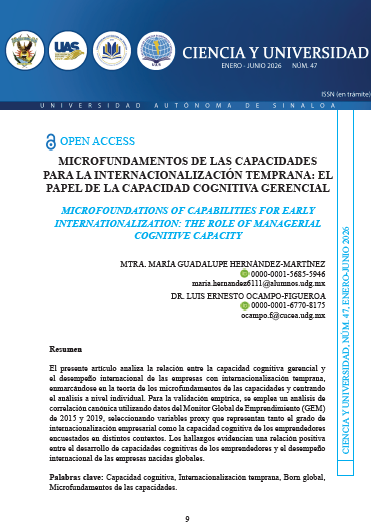
Microfundamentos de las capacidades para la internacionalización temprana: el papel de la capacidad cognitiva directiva
Palabras clave:
Capacidad cognitiva, Internacionalización temprana, Microfundamentos de las capacidadesResumen
El presente artículo estudia la relación de la capacidad cognitiva gerencial y el desempeño internacional de las empresas con internacionalización temprana, bajo el marco teórico de los microfundamentos de las capacidades, enfatizando el análisis llega al nivel de individuo. Para la contrastación empírica, se realiza un análisis de correlación canónica con información de la base de datos Monitor Global de Emprendimiento (GEM) 2015 y 2019, de donde se seleccionaron variables proxy tanto del grado de internacionalización empresarial como de la capacidad cognitiva de los emprendedores encuestados, en contextos distintos. Los resultados arrojan evidencia de la existencia de una relación positiva entre el desarrollo de capacidades cognitivas del emprendedor y el desempeño internacional de las empresas nacidas globales.
Descargas
Referencias
Andersson, S., & Wictor, I. (2003). Innovative internationalization in new firms: Born globals - the Swedish case. Journal of International Entrepreneurship, 1(3), 249–275. https://doi.org/10.xxxx/yyyy
Andersson, S., & Evers, N. (2015). International opportunity recognition in international new ventures: A dynamic managerial capabilities perspective. Journal of International Entrepreneurship, 13(3), 260–276. https://doi.org/10.xxxx/ yyyy
Azorín, J. F. M. (2016). La dinámica empresarial desde la integración de los microfundamentos y las capacidades dinámicas de la dirección estratégica. Economía Industrial, 399, 33–41.
Badii, M., Castillo, J., Cortez, K., Wong, A., & Villalpando, P. (2007). Análisis de correlación canónica (ACC) e investigación científica. Innovaciones de Negocios, 4(2), 405–422.
Baker, T., Gedajlovic, E., & Lubatkin, M. (2005). A framework for comparing entrepreneurship processes across nations. Journal of International Business Studies, 36, 492–504. https://doi.org/10.xxxx/yyyy
Barney, J., & Felin, T. (2013). What are microfoundations? The Academy of Management Perspectives, 27(2), 138–155. https://doi.org/10.xxxx/yyyy
Cardozo, P., Chavarro, A., & Ramírez, C. (2007). Teorías de la internacionalización. Panorama, 3, 4–23.
Escandón-Barbosa, D., Rialp-Criado, J., Fuerst, S., Rodríguez-Orejuela, A., &
Castro-Aristizábal, G. (2019). Born global: The influence of international orientation on export performance. Heliyon, 5(11), e02688. https://doi.org/10.1016/j.heliyon.2019.e02688
Fallon-Byrne, L., & Harney, B. (2017). Microfoundations of dynamic capabilities for innovation: A review and research agenda. The Irish Journal of Management, 36(1), 21–31. https://doi.org/10.xxxx/yyyy
Felin, T., Foss, N. J., Heimeriks, K. H., & Madsen, T. L. (2012). Microfoundations of routines and capabilities: Individuals, processes, and structure. Journal of Management Studies, 49(8), 1351-1374.
Fernhaber, S., Gilbert, B., & McDougall, P. (2008). Entrepreneurship and geographic location: An empirical examination of new venture internationalization. Journal of International Business Studies, 39, 267-290.
Fong, C., & Ocampo, L. (2011). La pyme en México, modelos de creación de em presas exitosas: El caso de las nacidas globales, las gacelas y las spin-off. Red Internacional de Investigadores en Competitividad. Recuperado de http://www.riico.org/memoria/quinto/RIICO-12304.pdf
Furrer, O., Thomas, H., & Goussevskaia, A. (2008). The structure and evolution of the strategic management field: A content analysis of 26 years of strategic management research. International Journal of Management Reviews, 10, 1-23. https://doi.org/10.1111/j.1468-2370.2007.00217.x
García-Navas, B., Donate-Manzanares, M., & Guadamillas-Gómez, F. (2017). Ab sorptive capacity: Critical review and proposition of a theoretical model. Revista Internacional de Gestión del Conocimiento y la Tecnología, 5(2), 24. Recuperado de ProQuest base de datos.
GEM. (2019). MISSION. Recuperado el 31 de octubre de 2019, de Global Entrepreneurship Monitor (GEM): https://gemconsortium.org/about/gem/5
GEM. (2024). Entrepreneurial behaviour and attitudes. Recuperado el 23 de febrero de 2024, de Global Entrepreneurship Monitor (GEM): https://www.gemconsortium.org/data/sets?id=aps
Helfat, C. E., & Peteraf, M. A. (2015). Managerial cognitive capabilities and the microfoundations of dynamic capabilities. Strategic Management Journal, 36(6), 831.
Hennart, J.-F., Majocchi, A., & Hagen, B. (2021). What’s so special about born globals, their entrepreneurs or their business model? Journal of International Business Studies, 52(9), 1-30. https://doi.org/10.1057/S41267-021-00427-0
Heubeck, T., & Meckl, R. (2023). Microfoundations of innovation: A dynamic CEO capabilities perspective. Managerial and Decision Economics. https://doi.org/10.1002/mde.3866
INEGI. (2019). Perfil de las Empresas Manufactureras de Exportación. Recuperado el 21 de abril de 2020, de Instituto Nacional de Estadística y Geografía: https://www.inegi.org.mx/programas/peme/default.html#Tabulados
Knight, G. A., & Cavusgil, S. T. (1996). The born global firm: A challenge to traditional internationalization theory. Advances in International Marketing, 8, 11-26.
Mahringer, C. A., & Renzl, B. (2018). Entrepreneurial initiatives as a microfoundation of dynamic capabilities. Journal of Accounting & Organizational Change, 14(1), 61-79.
Newbert, S. (2007). Empirical research on the resource-based view of the firm: An assessment and suggestions for future research. Strategic Management Journal, 28, 121-146. https://doi.org/10.1002/smj.573
Ocampo, L. (2017). Capítulo: Internacionalización y ventaja competitiva de la PyME. En C. Fong (Ed.), Competitividad e internacionalización de la PYME en México (pp. 123-145). México: Universidad de Guadalajara. Recuperado de http://www.cucea.udg.mx/administra/publicaciones/portadas/pdf/Competitividad-e-internacionalizacion-EBOOK.pdf
Oviatt, B. M., & McDougall, P. P. (1994). Toward a theory of international new ventures. Journal of International Business Studies, 25(1), 45–64.
Paunović, Z., & Prebežac, D. (2010). Internationalization of small and medium-sized enterprises. Pregledni Rad Review, 22(1), 57-76.
Rialp, A., Rialp, J., & Knight, G. (2010). La vocación global de los nuevos modelos de pymes: El caso de las empresas born globals. Economía Industrial, 375, 171-190.
Sánchez, R., Contreras, R., & López, A. (2018). Las Mipymes y su competitividadsustentable: Retos ante un nuevo ordenamiento económico mundial. México: Asociación Internacional de Investigadores sobre Emprendimiento y Mipymes AC. Recuperado de: cathi.uacj.mx/.../Las%20Mipymes%20y%20su%20Competitividad%20Sustentable%3AE
Stephan, U., & Lorraine, M. (2010). Performance-based vs socially supportive culture: A cross-national study of descriptive norms and entrepreneurship. Journal of International Business Studies, 41, 1347-1364.
Steverson, H., & Jarrillo, J. C. (1990). A paradigm of entrepreneurship: Entrepreneurial management. Strategic Management Journal, 11, 17-27.
Teece, D. J. (2007). Explicating dynamic capabilities: The nature and microfoundations of (sustainable) enterprise performance. Strategic Management Journal, 28(13), 1319-1350.
Wadeson, N. (2020). Internationalisation theory and born globals. The Multinational Business Review, 28(4), 447-461. https://doi.org/10.1108/MBR-10-2019-0123
Zhou, L., Barnes, B., & Lu, Y. (2010). Entrepreneurial proclivity, capability upgrading, and performance advantage of newness among international new ventures. Journal of International Business Studies, 41, 882-905.
Descargas
Publicado
Número
Sección
Licencia
Derechos de autor 2026 CIENCIA Y UNIVERSIDAD

Esta obra está bajo una licencia internacional Creative Commons Atribución-SinDerivadas 4.0.