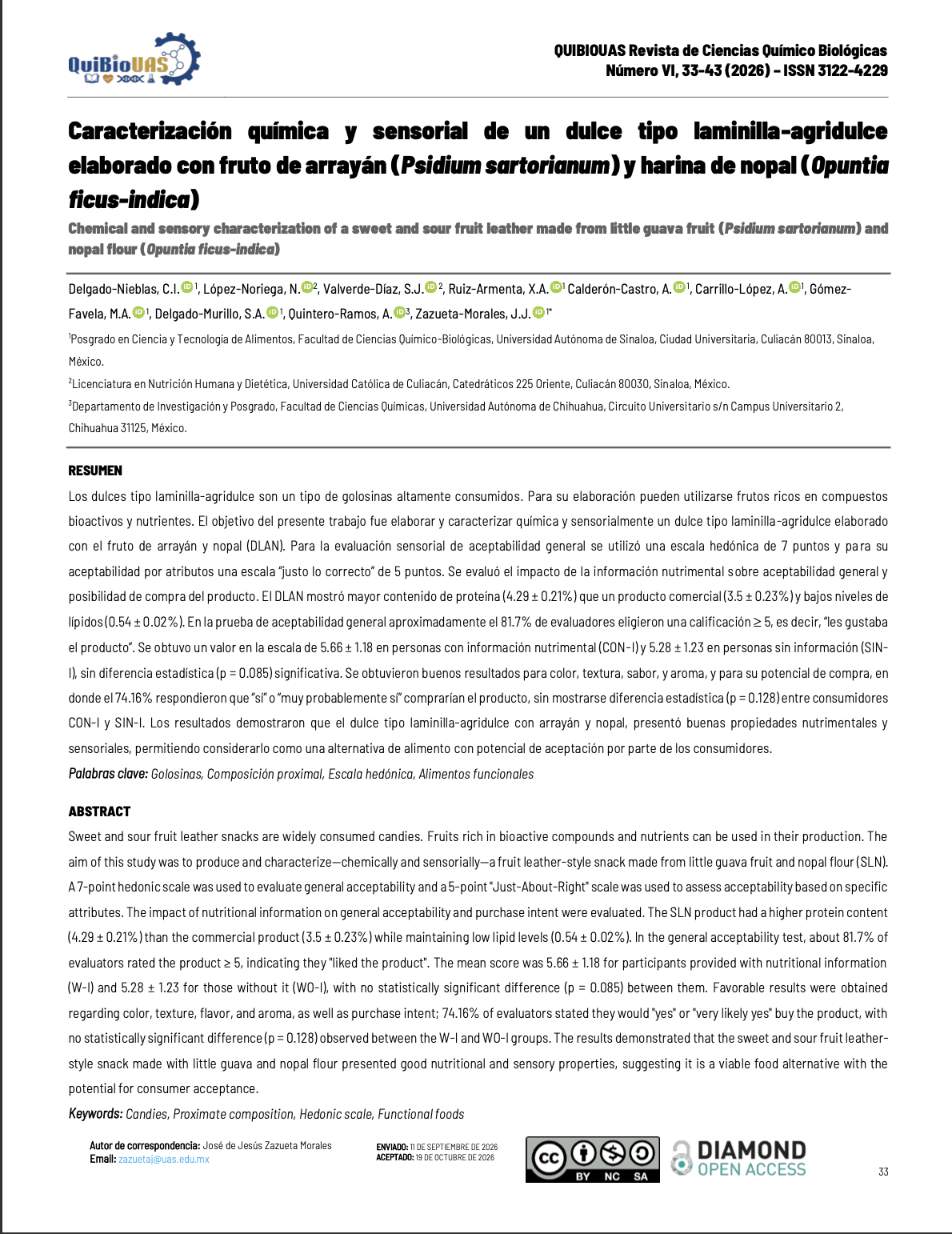
Chemical and sensory characterization of a sweet and sour fruit leather made from little guava fruit (Psidium sartorianum) and nopal flour (Opuntia ficus-indica)
Keywords:
Candies, Proximate composition, Hedonic scale, Functional foodsAbstract
Sweet and sour fruit leather snacks are widely consumed candies. Fruits rich in bioactive compounds and nutrients can be used in their production. The objective of this study was to produce and characterize—both chemically and sensorially—a fruit leather-style snack made from little guava fruit and nopal flour (SLN). A 7-point hedonic scale was used to evaluate general acceptability, while a 5-point "Just-About-Right" scale was used to assess acceptability based on specific attributes. The Student's t-test was used to evaluate the impact of nutritional information on general acceptability and purchase intent. The SLN product had a higher protein content than the commercial product while maintaining low lipid levels. In the general acceptability test, about 81.7 % of evaluators rated the product ≥ 5, indicating they "liked the product". The mean score was 5.66 ± 1.18 for participants provided with nutritional information (W-I) and 5.28 ± 1.23 for those without it (WO-I), with no statistically significant difference (p = 0.085) between them. Favorable results were obtained regarding color, texture, flavor, and aroma, as well as purchase intent; 74.16 % of evaluators stated they would "yes" or "very likely yes" buy the product, with no statistically significant difference (p = 0.128) observed between the W-I and WO-I groups. The results demonstrate that the sweet and sour fruit leather-style snack made with little guava and nopal flour presented good nutritional and sensory properties, and its consumption could potentially offer health benefits.
Downloads
References
Aranda-González, I., Tamayo-Dzul, Ó., Barbosa-Martín, E., Segura-Campos, M., Moguel-Ordoñez, Y., & Betancur-Ancona, D. (2015). Desarrollo de una golosina tipo" gomita" reducida en calorías mediante la sustitución de azúcares con Stevia rebaudiana B. Nutrición Hospitalaria, 31(1), 334-340. https://doi.org/10.3305/nh.2015.31.1.8013
Association of Official Analytical Chemists (AOAC). (2005). Official methods of analysis of AOAC International (18th ed.). AOAC International.
Biel, W., Kazimierska, K., & Bashutska, U. (2020). Nutritional value of wheat, triticale, barley and oat grains. Acta Scientiarum Polonorum Zootechnica, 19(2), 19-28. https://doi.org/10.21005/asp.2020.19.2.03
Castro-Montoya, Y. A., Jacobo-Valenzuela, N., Delgado-Nieblas, C. I., Ruiz-Armenta, X. A., Heredia, J. B., Delgado-Murillo, S. A. &, Zazueta-Morales, J. J. (2024). Effect of the extrusion process on phytochemical, antioxidant, and cooking properties of gluten-free pasta made from broken rice and nopal. Revista Mexicana de Ingeniería Química, 23(1), 2395-8472. http://dx.doi.org/10.24275/rmiq/alim24149
Cosme, F., Aires, A., Pinto, T., Oliveira, I., Vilela, A., & Gonçalves, B. (2025). A comprehensive review of bioactive tannins in foods and beverages: Functional properties, health benefits, and sensory qualities. Molecules, 30(4), 800. https://doi.org/10.3390/molecules30040800
Delgado-Murillo, S. A., Zazueta-Morales, J. D. J., Quintero-Ramos, A., Castro-Montoya, Y. A., Ruiz-Armenta, X. A., Limón-Valenzuela, V., & Delgado-Nieblas, C. I. (2024). Effect of the extrusion process on the physicochemical, phytochemical, and cooking properties of gluten-free pasta made from broken rice and chickpea flours. Biotecnia, 26. https://doi.org/10.18633/biotecnia.v26.2142
Delgado-Nieblas, C. I., Zazueta-Morales, J. J., Aguilar-Palazuelos, E., Jacobo-Valenzuela, N., Aguirre-Tostado, F. S., Carrillo-López, A., Ruiz-Armenta, X. A., & Telis-Romero, J. (2018). Physical, microstructural and sensory characteristics of extruded and microwave-expanded snacks added with dehydrated squash. Revista Mexicana de Ingeniería Química, 17(3), 805-821. https://doi.org/10.24275/uam/izt/dcbi/revmexingquim/2018v17n3/Delgado
Delgado-Vargas, F., Díaz-Camacho, S. P., Salazar-Zamora, G., Uribe-Beltrán, M. J., & Vega-Aviña, R. (2005). Psidium sartorianum (O. Berg) Nied., an Indigenous plant to México, from biology to biological activity. JN Govil, VK Singh, C Arunachalam. In search for natural drugs, 13.
Diamante, L. M., Bai, X., & Busch, J. (2014). Fruit leathers: method of preparation and effect of different conditions on qualities. International Journal of Food Science, 2014(1), 139890. https://doi.org/10.1155/2014/139890
Fogelholm, M., Anderssen, S., Gunnarsdottir, I., & Lahti-Koski, M. (2012). Dietary macronutrients and food consumption as determinants of long-term weight change in adult populations: a systematic literature review. Food & Nutrition Research, 56(1), 19103. https://doi.org/10.3402/fnr.v56i0.19103
Frydrych, A., Kulita, K., Jurowski, K., & Piekoszewski, W. (2025). Lipids in clinical nutrition and health: narrative review and dietary recommendations. Foods, 14(3), 473.
García-Flores, A., Valle-Marquina, R., Ruenes-Morales, M. D. R., & Román-Montes de Oca, E. (2022). Ciruela mexicana: de Mesoamérica para el mundo. Inventio, 18(44), 1-13. https://doi.org/10.30973/inventio/2022.18.44/1
Grunert, K. G. (2010). European consumers' acceptance of functional foods. Annals of the New York Academy of Sciences, 1190(1), 166-173. https://doi.org/10.1111/j.1749-6632.2009.05260.x
Gumul, D., Ivanišová, E., Oracz, J., Sabat, R., Wywrocka-Gurgul, A., & Ziobro, R. (2024). Red Potato Pulp and Cherry Pomace for Pasta Enrichment: Health-Promoting Compounds, Physical Properties and Quality. Applied Sciences, 14(11), 4873. https://doi.org/10.3390/app14114873
Incedayi, B., Dogan, N., & Copur, O. U. (2022). Assessment of cactus pear leather (pestil) as a new snack food. Journal of Food Science and Technology, 59(8), 3158-3166. https://doi.org/10.1007/s13197-022-05366-8
Khandelwal, A., & Bhasker, S. (2022). A review-based study on fortification of fruit leather with protein enriched products. The Pharma Innovation Journal, 11(5), 1378-1382.
Navarro-González, I., Periago., M. J., & García-Alonso, F. J. (2017). Estudio de nuevas fórmulas de golosinas de bajo índice glucémico. Revista Española de Nutrición Humana y Dietética, 23(4).
Montes-Ávila, J., Díaz-Camacho, S. P., Willms, K., de la Cruz-Otero, M. D. C., Robert, L., Rivero, I. A., & Delgado-Vargas, F. (2017). Bioguided study of the in vitro parasitocidal effect on adult Hymenolepis nana of the Psidium sartorianum fruit methanol extract. Medicinal Chemistry Research, 26, 2845–2852. https://doi.org/10.1007/s00044-017-1983-x
Pérez-Cabrera, L. E., Reyes-Bernal, K., Godines-Hoyos, A., & Casillas-Peñuelas, R. (2012). Desarrollo y caracterización de golosinas con ingredientes de interés nutrimental. CienciaUAT, 6(3), 50-55.
Sáenz, C., García, N., Abraján, M., Fabry, A. M., & Robert, P. (2016). El nopal, una especie de zonas áridas productora de hidrocoloides naturales. La Alimentación Latinoamericana, 50(322), 60-68.
Secretaría de Agricultura y Desarrollo Rural. (2025, 13 de agosto). La grandeza y el sabor del nopal. https://www.gob.mx/agricultura/es/articulos/la-grandeza-y-el-sabor-del-nopal-405353
Sigurdson, G. T., Tang, P., & Giusti, M. M. (2017). Natural Colorants: Food Colorants from Natural Sources. Annual Review of Food Science and Technology, 8, 261–280. https://doi.org/10.1146/annurev-food-030216-025923
Soria, R. B. H., Bernal, S. S., & Burgos, R. (2020). Contenido de grasas, sodio, azúcares y edulcorantes declarados en etiquetado nutricional de golosinas, snacks salados y en bebidas dulces no alcohólicas seleccionadas. Pediatría (Asunción): Órgano Oficial de la Sociedad Paraguaya de Pediatría, 47(1), 30-38. https://doi.org/10.31698/ped.47012020006
Torres-Moreno, M., Tarrega, A., Torrescasana, E., & Blanch, C. (2012). Influence of label information on dark chocolate acceptability. Appetite, 58(2), 665-671. https://doi.org/10.1016/J.APPET.2011.12.005
Valenzuela, L. A., Ortiz, B. L., & Pérez, C. E. (2013). Estudio comparativo del efecto metabólico de arepas enriquecidas con pectina extraída de guayaba (Psidium guajava L.) o pectina cítrica comercial. Revista Colombiana de Química, 43(3), 5-10.
Valera-Montero, L. L., Enríquez-Nava, S., Silos-Espino, H., Padilla-Ramírez, J. S., Perales Segovia, C., & Flores-Benítez, S. (2018). Propiedades fisicoquímicas de guayabilla (Psidium guineense), arrayán (Psidium sartorianum) y guayaba (Psidium guajava). Revista Mexicana de Ciencias Agrícolas, 9(6), 1099-1108. https://doi.org/10.29312/remexca.v9i6.1576
Vargas-Meza, J., Jáuregui, A., Contreras-Manzano, A., Nieto, C., & Barquera, S. (2019). Acceptability and understanding of front-of-pack nutritional labels: an experimental study in Mexican consumers. BMC Public Health, 19(1), 1751. https://doi.org/10.1186/s12889-019-8108-z
Whitlark, D.B., Geurts, M.D. and Swenson, M.J. (1993). New product forecasting with a purchase intention survey. Journal of Business Forecasting, 12, 18-21.
Zamora-Morales, B.P., Báez-Pérez, A., Bonilla-Valencia, L., Zegbe-Domínguez, J. A.,
Zamora-Martínez, M. C., & Quevedo-Nolasco, A. (2025). Efecto de las propiedades físicas y químicas del suelo en el estado nutrimental del nopal-verdura (Opuntia ficus-indica (L.) Mill variedad Milpa Alta. Polibotánica, 60. https://doi.org/10.18387/polibotanica.60.18
Zazueta-Morales, J.J. 2003. Extrusión de maíz (Zea mays L.) azul: efecto del hidróxido de calcio sobre las propiedades fisicoquímicas y funcionales [Tesis de Doctorado, Universidad Autónoma de Querétaro]. Repositorio Institucional.
Downloads
Published
Data Availability Statement
The data supporting the findings of this research are available in the present manuscript. Any additional information may be requested from the corresponding author.
Issue
Section
Categories
License
Copyright (c) 2026 QUIBIOUAS Revista de Ciencias Químico Biológicas

This work is licensed under a Creative Commons Attribution-NonCommercial-ShareAlike 4.0 International License.