Impact of extrusion conditions on the physical properties of amaranth–oat blends for the production of third-generation snacks with functional value
Keywords:
Food extrusion, Amaranth, Oat, Expansion, Screw speedAbstract
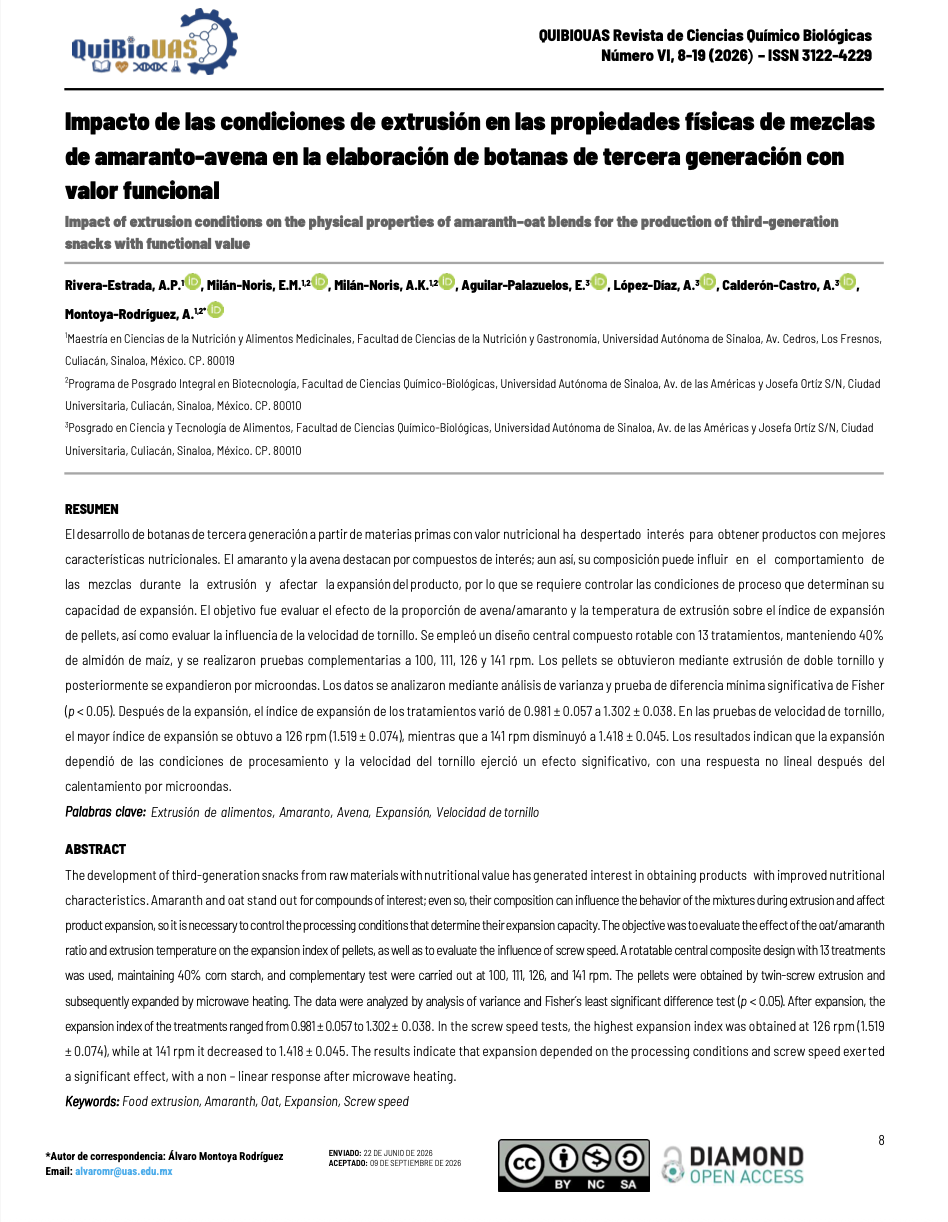
The development of third-generation snacks from raw materials with nutritional value has generated interest in obtaining products with improved nutritional characteristics. Amaranth and oat stand out for compounds of interest; even so, their composition can influence the behavior of the mixtures during extrusion and affect product expansion, so it is necessary to control the processing conditions that determine their expansion capacity. The objective was to evaluate the effect of the oat/amaranth ratio and extrusion temperature on the expansion index of pellets, as well as to evaluate the influence of screw speed. A rotatable central composite design with 13 treatments was used, maintaining 40% corn starch, and complementary test were carried out at 100, 111, 126, and 141 rpm. The pellets were obtained by twin-screw extrusion and subsequently expanded by microwave heating. The data were analyzed by analysis of variance and Fisher´s least significant difference test (p < 0.05). After expansion, the expansion index of the treatments ranged from 0.981 ± 0.057 to 1.302 ± 0.038. In the screw speed tests, the highest expansion index was obtained at 126 rpm (1.519 ± 0.074), while at 141 rpm it decreased to 1.418 ± 0.045. The results indicate that expansion depended on the processing conditions and screw speed exerted a significant effect, with a non – linear response after microwave heating.
Downloads
References
Allen, K. E., Carpenter, C. E., & Walsh, M. K. (2007). Influence of protein level and starch type on an extrusion-expanded whey product. International Journal of Food Science & Technology, 42(8), 953-960. https://doi.org/10.1111/j.1365-2621.2006.01316.x
Brahma, S., Weier, S. A., & Rose, D. J. (2016). Effects of selected extrusion parameters on physicochemical properties and in vitro starch digestibility and β-glucan extractability of whole grain oats. Journal of Cereal Science, 70, 85–90. https://doi.org/10.1016/j.jcs.2016.05.001
Brennan, M. A., Monro, J. A., & Brennan, C. S. (2008). Effect of inclusion of soluble and insoluble fibres into extruded breakfast cereal products made with reverse screw configuration. International Journal of Food Science & Technology, 43(12), 2278–2288. https://doi.org/10.1111/j.1365-2621.2008.01867.x
Caselato-Sousa, V. M., & Amaya-Farfán, J. (2012). State of knowledge on amaranth grain: A comprehensive review. Journal of Food Science, 77(4), R93–R104. https://doi.org/10.1111/j.1750-3841.2012.02645.x
Day, L., & Swanson, B. G. (2013). Functionality of protein-fortified extrudates. Comprehensive Reviews in Food Science and Food Safety, 12(5), 546– 558. https://doi.org/10.1111/1541-4337.12023
Dey, D., Richter, J. K., Ek, P., Gu, B. J., & Ganjyal, G. M. (2021). Utilization of food processing by-products in extrusion processing: A review. Frontiers in Sustainable Food Systems, 4, 603751. https://doi.org/10.3389/fsufs.2020.603751
Ding, Q. B., Ainsworth, P., Plunkett, A., Tucker, G., & Marson, H. (2006). The effect of extrusion conditions on the functional and physical properties of wheat-based expanded snacks. Journal of Food Engineering, 73(2), 142– 148. https://doi.org/10.1016/j.jfoodeng.2005.01.013
Gu, B. J., Wolcott, M. P., & Ganjyal, G. M. (2020). Optimized screw profile design proved to inhibit re-agglomeration that occurs during extrusion of fine- milled forest residuals for producing fermentable sugars. Industrial Crops and Products, 154, 112730. https://doi.org/10.1016/j.indcrop.2020.112730
Gujska, E., & Khan, K. (1990). Effect of temperature on properties of extrudates from high starch fractions of navy, pinto and garbanzo beans. Journal of Food Science, 55, 466-469. https://doi.org/10.1111/j.1365-2621.1990.tb06788.x
Huang, Y., Liu, L., Sun, B., Zhu, Y., Lv, M., Li, Y., & Zhu, X. (2024). A comprehensive review on harnessing soy proteins in the manufacture of healthy foods through extrusion. Foods, 13(14), 2215. https://doi.org/10.3390/foods13142215
Ilo, S., Liu, Y., & Berghofer, E. (1999). Extrusion cooking of rice flour and amaranth blends. LWT – Food Science and Technology, 32(2), 79–88. https://doi.org/10.1006/fstl.1998.0497
Ilo, S., Schoenlechner, R., & Berghofer, E. (2000). Role of lipids in the extrusion cooking processes. Grasas y Aceites, 51(1–2), 97–110. https://doi.org/10.3989/gya.2000.v51.i1-2.410
Limón-Valenzuela, V., Aguilar-Palazuelos, E., Zazueta-Morales, J. de J., & Martínez-Bustos, F. (2017). Propiedades microestructurales y de formación de pasta de pellets extrudidos elaborados a partir de almidón de maíz enriquecidos con MCP y concentrado proteínico de leche. Revista Mexicana de Ingeniería Química, 16(1), 193-205.
Liu, Y., Hsieh, F., & Heymann, H. (2000). Effect of process conditions on the physical and sensory properties of extruded oat-corn puff. Journal of Food Science, 65(7), 1253–1259. https://doi.org/10.1111/j.13652621.2000.tb10274.x
Mohamed, I. O. (2023). Interaction of starch with some food macromolecules during the extrusion process and its effect on modulating physicochemical and digestible properties: A review. Carbohydrate Polymer Technologies and Applications, 5, 100294. https://doi.org/10.1016/j.carpta.2023.100294
Moisio, T., Forssell, P., Partanen, R., Damerau, A., & Hill, S. E. (2015). Reorganization of starch, proteins and lipids in extrusion of oats. Journal of Cereal Science, 64, 48–54. https://doi.org/10.1016/j.jcs.2015.04.001
Montoya-Rodríguez, A., Gómez-Favela, M. A., Reyes-Moreno, C., Milán-Carrillo, J., & González de Mejía, E. (2015). Identification of bioactive peptide sequences from amaranth (Amaranthus hypochondriacus) seed proteins and their potential role in the prevention of chronic diseases. Comprehensive Reviews in Food Science and Food Safety, 14(2), 139–158. https://doi.org/10.1111/1541-4337.12125
Moraru, C. L., & Kokini, J. L. (2003). Nucleation and expansion during extrusion and microwave heating of cereal foods. Comprehensive Reviews in Food Science and Food Safety, 2(4), 120–138. https://doi.org/10.1111/j.1541-4337.2003.tb00020.x
Neder-Suárez, D., Quintero-Ramos, A., Meléndez-Pizarro, C. O., Zazueta-Morales, J. J., Paraguay-Delgado, F., & Ruiz-Gutiérrez, M. G. (2021). Evaluation of the physicochemical properties of third-generation snacks made from blue corn, black beans, and sweet chard produced by extrusion. LWT – Food Science and Technology, 146, 111414. https://doi.org/10.1016/j.lwt.2021.111414
Nikinmaa, M., Zehnder-Wyss, O., Nyström, L., & Sozer, N. (2023). Effect of extrusion processing parameters on structure, texture and dietary fibre composition of directly expanded wholegrain oat-based matrices. LWT – Food Science and Technology, 184, 114972. https://doi.org/10.1016/j.lwt.2023.114972
Offiah, V., Kontogiorgos, V., & Falade, K. O. (2019). Extrusion processing of raw food materials and by-products: A review. Critical Reviews in Food Science and Nutrition, 59(18), 2979–2998. https://doi.org/10.1080/10408398.2018.1480007
Pizarro, S., Ronco, A. M., & Gotteland, M. (2014). ß- glucanos: ¿qué tipos existen y cuáles son sus beneficios en la salud? Revista Chilena de Nutrición, 41(4), 439-446. https://dx.doi.org/10.4067/S071775182014000400014
Qiu, C., Hu, H., Chen, B., Lin, Q., Ji, H., & Jin, Z. (2024). Research progress on the physicochemical properties of starch-based foods by extrusion processing. Foods, 13(22), 3677. https://doi.org/10.3390/foods13223677
Quevedo, M., Karbstein, H. P., & Emin, M. A. (2021). Influence of thermomechanical treatment and pH on the denaturation kinetics of highly concentrated whey protein isolate. Journal of Food Engineering, 292, 110294. https://doi.org/10.1016/j.jfoodeng.2020.110294
Segura-Jiménez, M. E., & Jacobo-Velázquez, D. A. (2025). Amaranthus spp.: A multifunctional crop at the nexus of nutrition, health, and sustainable innovation. Journal of Agriculture and Food Research, 24, 102322. https://doi.org/10.1016/j.jafr.2025.102322
Shah, A., Zhang, G., Hamaker, B. R., & Campanella, O. H. (2011). Rheological properties of a soluble self-assembled complex from starch, protein and free fatty acids. Journal of Food Engineering, 105(3), 499–506. https://doi.org/10.1016/j.jfoodeng.2011.02.048
Singha, P., Singh, S. K., Muthukumarappan, K., & Krishnan, P. (2018). Physicochemical and nutritional properties of extrudates from food-grade distiller's dried grains, garbanzo flour, and corn grits. Food Science & Nutrition, 6(7), 1918–1929. https://doi.org/10.1002/fsn3.769
Wang, J. M., Xia, S., Wang, B., Ali, F., & Li, X. (2019). Effect of twin-screw extrusion on gelatinization characteristics of oat powder. Journal of Food Process Engineering, 42(2), e13014. https://doi.org/10.1111/jfpe.13014
Ye, J., Hu, X., Luo, S. J., Liu, W., Chen, J., Zeng, Z., & Liu, C. M. (2018). Properties of starch after extrusion: A review. Starch/Stärke, 70(11–12), 1700110. https://doi.org/10.1002/star.201700110
Zambrano, Y., Mariotti-Celis, M. S., & Bouchon, P. (2024). 3G extruded snacks enriched with catechin for high antioxidant capacity. LWT – Food Science and Technology, 192, 115674. https://doi.org/10.1016/j.lwt.2023.115674
Zurbau, A., Noronha, J. C., Khan, T. A., Sievenpiper, J. L., & Wolever, T. M. S. (2021). The effect of oat β-glucan on postprandial blood glucose and insulin responses: a systematic review and meta-analysis. European Journal of Clinical Nutrition, 75(11), 1540–1554. https://doi.org/10.1038/s41430-021-00875-9
Downloads
Published
Data Availability Statement
All data derived from this research are included in the present manuscript.
Issue
Section
Categories
License
Copyright (c) 2026 QUIBIOUAS Revista de Ciencias Químico Biológicas

This work is licensed under a Creative Commons Attribution-NonCommercial-ShareAlike 4.0 International License.