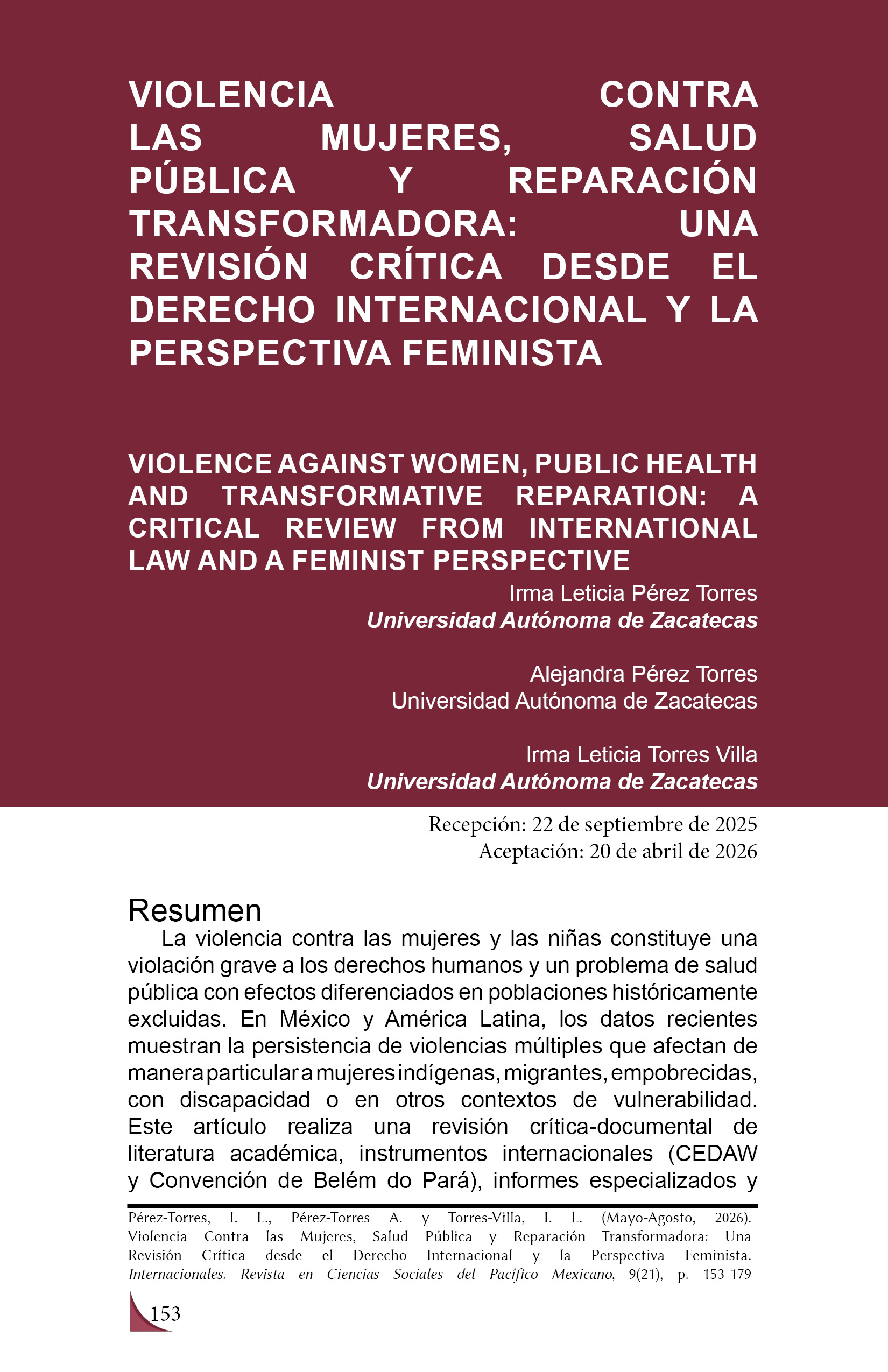
Violence Against Women, Public Health and Transformative Reparation: A Critical Review from International Law and a Feminist Perspective
Violence Against Women, Public Health and Transformative Reparation: A Critical Review from International Law and a Feminist Perspective
Keywords:
Gender-based violence, Patriarchy, JusticeAbstract
Violence against women and girls constitutes a serious human rights violation and a public health problem with differentiated effects on historically excluded populations. In Mexico and Latin America, recent data show the persistence of multiple forms of violence that particularly affect Indigenous, migrant, impoverished, disabled, and otherwise vulnerable women. This article presents a critical documentary review of academic literature, international instruments (CEDAW and the Belém do Pará Convention), specialized reports, and relevant Inter-American Court case law, particularly Campo Algodonero, Atenco, Manuela, and Rosendo Cantú. The analysis identifies persistent structural patterns of inequality, the limitations of state responses, and international standards regarding truth, justice, reparation, and health. It argues that reparation measures must move beyond compensation and be directed toward prevention, comprehensive rehabilitation, guarantees of non-repetition, and the transformation of the social, institutional, and cultural conditions that reproduce gender-based violence.
Downloads
References
ACNUR. (2022). Mujeres desplazadas por la fuerza en alto riesgo de violencia de género en América Latina, según estudio de ACNUR e HIAS, https://www.acnur.org/noticias/news-releases/mujeres-desplazadas-por-la-fuerza-en-alto-riesgo-de-violencia-de-genero-en
Bourdieu, P. (2000). La dominación masculina. Anagrama.
CEDAW. (2015). Recomendación general núm. 33 sobre el acceso de las mujeres a la justicia (CEDAW/C/GC/33). Organización de las Naciones Unidas. https://www.acnur.org/fileadmin/Documentos/BDL/2016/10710.pdf
CEDAW. (2017). Recomendación general núm. 35 sobre la violencia por razón de género contra la mujer (CEDAW/C/GC/35). Organización de las Naciones Unidas. https://www.acnur.org/fileadmin/Documentos/BDL/2017/11405.pdf
Cohen, M., Dwek, L., Siegel, E., y Teubal, R. (2001). “Historia de tres mujeres: la experiencia desde una ONG”. En R. Teubal (Coord.), Violencia familiar, trabajo social e instituciones. Paidós.
Comisión Económica para América Latina y el Caribe (CEPAL). (2022, 24 de noviembre). CEPAL: Al menos 4.473 mujeres fueron víctimas de feminicidio en América Latina y el Caribe en 2021. https://www.cepal.org/es/comunicados/cepal-al-menos-4473-mujeres-fueron-victimas-feminicidio-america-latina-caribe-2021
Corte Interamericana de Derechos Humanos. (2009). Caso González y otras (“Campo Algodonero”) vs. México. Sentencia de 16 de noviembre de 2009. https://www.corteidh.or.cr/docs/casos/articulos/seriec_205_esp.pdf
Corte Interamericana de Derechos Humanos. (2010). Caso Rosendo Cantú y otra vs. México. Sentencia de 31 de agosto de 2010. https://www.corteidh.or.cr/docs/casos/articulos/seriec_216_esp.pdf
Corte Interamericana de Derechos Humanos. (2010). Caso Vélez Loor vs. Panamá. Sentencia de 23 de noviembre de 2010. https://www.corteidh.or.cr/docs/casos/articulos/seriec_218_esp.pdf
Corte Interamericana de Derechos Humanos. (2018). Caso Mujeres Víctimas de Tortura Sexual en Atenco vs. México. Sentencia de 28 de noviembre de 2018. https://www.corteidh.or.cr/docs/casos/articulos/seriec_371_esp.pdf
Corte Interamericana de Derechos Humanos. (2021). Caso Manuela y otros vs. El Salvador. Sentencia de 2 de noviembre de 2021. https://www.corteidh.or.cr/docs/casos/articulos/seriec_252_esp.pdf
Crenshaw, K. (1989). Demarginalizing the Intersection of Race and Sex: A Black Feminist Critique of Antidiscrimination Doctrine, Feminist Theory and Antiracist Politics. University of Chicago Legal Forum, 1989(1), 139–167. https://chicagounbound.uchicago.edu/uclf/vol1989/iss1/8
Girardi, M. (2008). “Mujeres migrantes en la frontera sur. Víctimas y transgresoras, entre la autonomía y la trata-tráfico”. En M. Belausteguigoitia & L. Melgar (Coords.), Fronteras, violencia, justicia: nuevos discursos (pp. 137–152). UNAM-UNIFEM.
Heise, L., Greene, M., Opper, N., y Stavropoulou, M. (2019). Gender inequality and restrictive gender norms: framing the challenges to health. The Lancet, 393(10189), 2440–2454. https://doi.org/10.1016/S0140-6736(19)30652-X
INEGI. (2022). Encuesta Nacional sobre la Dinámica de las Relaciones en los Hogares (ENDIREH) 2021. Instituto Nacional de Estadística y Geografía. https://www.inegi.org.mx/programas/endireh/2021/
Lagarde, M. (2008). “Identidad femenina”. En Compilación sobre género y violencia. Instituto Aguascalentense de las Mujeres. http://cedoc.inmujeres.gob.mx/insp/compilacion_genero.pdf
Lamas, M. (2008). “La perspectiva de género”. En Compilación sobre género y violencia. Instituto Aguascalentense de las Mujeres. http://cedoc.inmujeres.gob.mx/insp/compilacion_genero.pdf
Miyares, A. (2021). Distopías patriarcales: Análisis feminista del «generismo queer». Ediciones Cátedra.
ONU General Assembly. (2006). Principios y directrices básicos sobre el derecho a un recurso y Reparación para las Víctimas de Violaciones Graves de los Derechos Humanos Derecho internacional de los derechos humanos y violaciones graves del Derecho Internacional Humanitario (A/RES/60/147). ONU. https://www.refworld.org/docid/4721cb942.html
ONU Mujeres. (2023). The gender snapshot 2023: Progress on the Sustainable Development Goals. ONU Mujeres. https://www.unwomen.org/en/digital-library/publications/2023/09/progress-on-the-sustainable-development-goals-the-gender-snapshot-2023
Organización de Estados Americanos, MESECVI. (2025). Informe hemisférico de implementación de la Convención de Belém do Pará. OEA. https://www.oas.org/en/mesecvi/docs/Informe%20Hemisférico%20-%20Capítulo%20LA.pdf
Organización Mundial de la Salud (OMS). (2021). Violence against women prevalence estimates, 2018. OMS. https://www.who.int/publications/i/item/9789240022256
Rubio-Marín, R., & Sandoval, C. (2011). Engendering the reparations jurisprudence of the Inter-American Court of Human Rights: The promise of the Cotton Field judgment. Human Rights Quarterly, 33(4), 1062–1091. https://www.corteidh.or.cr/tablas/r27271.pdf
Secretaría Ejecutiva del Sistema Nacional de Seguridad Pública (SESNSP). (2024). Información sobre violencia contra las mujeres, diciembre 2023. Gobierno de México. https://www.gob.mx/sesnsp
Segato, R. L. (2016). La guerra contra las mujeres. Traficantes de Sueños.
Solyszko Gomes, I. (2023). Femicidio y feminicidio: Avances para nombrar la expresión letal de la violencia de género contra las mujeres. GénEroos, 20(13), 23–42. Recuperado a partir de https://revistasacademicas.ucol.mx/index.php/generos/article/view/1278
Uprimny, R., & Saffon, M. P. (2009). Reparaciones transformadoras, justicia distributiva y profundización democrática. En C. Díaz, N. C. Sánchez, & R. Uprimny (Eds.), Reparar en Colombia: Los dilemas en contextos de conflicto, pobreza y exclusión (pp. [coloca aquí las páginas del capítulo si las tienes]). Centro Internacional para la Justicia Transicional (ICTJ) y Dejusticia. https://www.dejusticia.org/publication/reparar-en-colombia-los-dilemas-en-contextos-de-conflicto-pobreza-y-exclusion/
Valcárcel, A. (1997). La política de las mujeres. Cátedra.
Downloads
Published
Issue
Section
Categories
License
Copyright (c) 2026 Internacionales. Revista en Ciencias Sociales del Pacífico Mexicano

This work is licensed under a Creative Commons Attribution-NonCommercial-ShareAlike 4.0 International License.