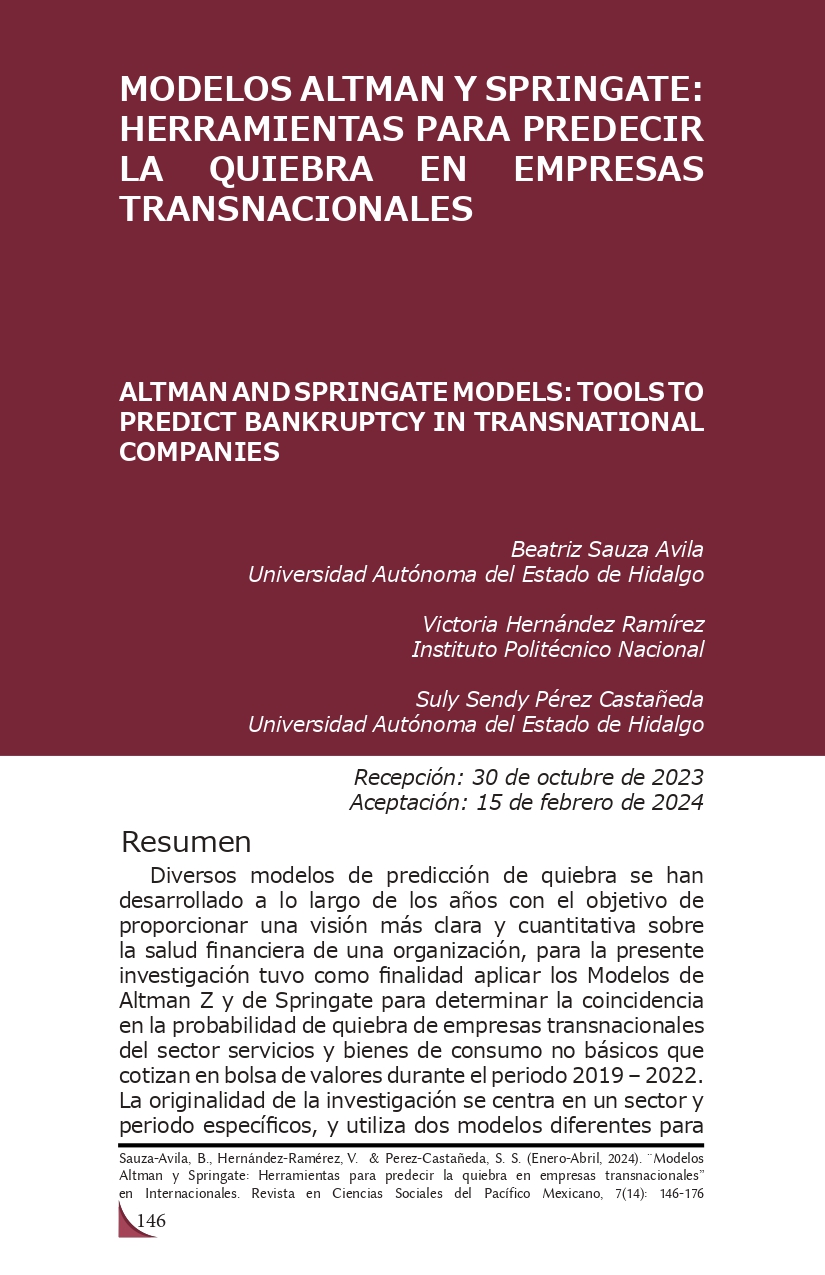
Altman and Springgate Models: Tools to Predict Bankruptcy in Transnational Companies
Altman and Springgate Models: Tools to Predict Bankruptcy in Transnational Companies
Keywords:
Bankruptcy models, Transnational companies, Financial reasonsAbstract
Various bankruptcy prediction models have been developed over the years with the aim of providing a clearer and more quantitative view of the financial health of an organization. The purpose of this research was to apply the Altman Z and Springate Models. to determine the coincidence in the probability of bankruptcy of transnational companies in the services sector and non-basic consumer goods that are listed on the stock exchange during the period 2019 – 2022. The originality of the research focuses on a specific sector and period, and uses two different models to compare the results. However, this research also has its limitations, since only four years could be analyzed due to having free access financial information, such as the Yahoo! platform. finance. Additionally, as with any predictive model, there is always the possibility of error and 100% accuracy cannot be guaranteed. The results of the research show that 80% of the companies analyzed agree on the same bankruptcy prediction.
Downloads
References
Altman, Edwar I. (1968). “Financial ratios, discriminant análisis and the prediction of corporate bankruptcy”. J. Financ. 23 (4), 589-609.
Barbuta, N. & Madaleno M. (2020). “Assessment of Bankruptcy Risk of Large Companies: European Countries Evolution Analysis”, Journal of Risk and Financial Management,13(3), https://doi.org/10.3390/jrfm13030058
Beaver, W. H. (1966). Financial ratios as predictors of failure. Journal of Accounting Research, 4, 71-111. https://doi.org/10.2307/2490171
Ceylan I. E. (2021). “The impact of firm-specific and macroeconomic factors on financial distress risk: A case study from Turkey”. Universal Journal of Accounting and Finance, 9(3): 506-517. https://doi.org/10.13189/ujaf.2021.090325
Challco, R. E. (2018). Aplicación del modelo Altman y Springate para la predicción de quiebra empresarial en las empresas del sector minero comprendido en el periodo del 2010 al 2015 (trabajo de suficiencia profesional para optar el título profesional de Economista). Universidad de Lima.
CEPAL. (2020, September 2). COVID-19: Impactos inmediatos en el transporte aéreo y en el mediano plazo en la industria aeronáutica. Retrieved from https://www.cepal.org/es/notas/ covid-19-impactos-inmediatos-transporte-aereo-mediano- plazo-la-industria-aeronautica
CNN. (2020, June 29). Cirque du Soleil se declara en bancarrota y elimina 3.500 empleos. Retrieved from https://cnnespanol. cnn.com/2020/06/29/cirque-du-soleil-se-declara-en- bancarrota-y-elimina-3-500-empleos/
El Informador. (2022). Aeroméxico sale de la bancarrota en Estados Unidos. Retrieved from https://www.informador.mx/economia/Aeromexico-sale-de-la-bancarrota-en-Estados-Unidos-20220317-0002.htm
Díaz, M. (2020, 7 de julio). La cadena de calzado Aldo radica quiebra. Negocios https://www.elnuevodia.com/negocios/ consumo/notas/la-cadena-de-calzado-aldo-radica-quiebra/
Fitzpatrick, P. J. (1932). “A comparison of ratios of successful industrial enterprises with those of failed firms”. Certified Public Accountant, 12(10), 597-605.
Forbes México. (2020, July 7). Covid-19 detona interés de pymes por el comercio electrónico. Retrieved from https://www.forbes.com.mx/negocios-covid-19-interes-pymes- ecommerce/
Goh, E., Mat, S. & Bannigidadmath D. (2022). “Thomas Cook(ed): using Altman’s z-score analysis to examine predictors of financial bankruptcy in tourism and hospitality businesses”. Asia Pacific Journal of Marketing and Logistics. 34(3). https://doi.org/475-487.10.1108/APJML-02-2021-0126
Habermann, F. & Fischer, F.B. (2023). “Corporate Social Performance and the Likelihood of Bankruptcy: Evidence from a Period of Economic Upswing”, Journal of Business Ethics, 182(1): 243-259. https://doi.org/10.1007/s10551-021-04956-4
Hernández, R., Fernández, C., & Baptista, P. (2014). Metodología de la investigación (6th ed.). McGraw-Hill Education.
Infobae. (2020, March 19). El impacto del coronavirus, sector por sector: cuál es la perspectiva para comercio, industria, turismo, servicios y construcción. Retrieved from
Kaufmann D. (2020, February 6). Coronavirus: ¿Qué industrias han sido afectadas? Retrieved from https://www.dw.com/es/coronavirus-qu%C3%A9-industrias- han-sido-afectadas/g-52279206
Legault, J. (1987). “La prévision de la faillite: une analyse comparative des modèles logit et discriminant”. Revue des Sciences de Gestion, 22(2): 59-68.
López, R. (2006). “Análisis financiero para la determinación de quiebra”. Encuentro, 74(1): 80-96.
Mucko, P., & Adamczyk, A. (2023). “Does the bankrupt cheat? Impact of accounting manipulations on the effectiveness of a bankruptcy prediction”. Plos one, 18(1), e0280384. https://doi.org/10.1371/journal.pone.0280384
Merwin, C. L. (1942). “inancing small corporations in five manufacturing industries, 1926-36”. National Bureau of Economic Research Bulletin, 65.
Miranda, R. (2012), ¿Cómo saber si la empresa está en riesgo de quebrar o de insolvencia?, PAF, 606, 78-81.
Ohlson, J. A. (1980). “Financial ratios and the probabilistic prediction of bankruptcy”. Journal of Accounting Research, 18(1): 109-131. https://doi.org/10.2307/2490395
Paredes Benavides, K. L. (2023). “Lineamientos de análisis para la predicción de quiebra en las empresas manufactureras del Ecuador”. Ciencia Latina Revista Científica Multidisciplinar, 7(1): 10371-10395.
Parrado, J.S. (2020). Comprobación de la capacidad de predicción de quiebra del modelo Altman para las empresas del sector construcción en el periodo de 2015 a 2017. Tesis de grado, Universidad La Salle, Colombia.
Pop I.D. & Coroiu A.M. (2022). “Predicting Bankruptcy in Romania Using Artificial Neural Network”, Asia Pacific Journal of Marketing and Logistics.14 (3): 211-218. https://doi.org/211-218.10.54684/ijmmt.2022.14z.3.211
Rahmi A., Lu, H. Y., Liang D., Novitasari D. & Tsai C.-F. (2022). Role of Comprehensive Income in Predicting Bankruptcy. Computational Economics. https://doi.org/10.1007/s10614-022-10328-5
Rincón, C. C. & Rodriguez, E. O. (2019). “Análisis financiero para la predicción de quiebra empresarial, en el sector de la Construcción en Colombia”. Revista Encuentro, 74(1): 80-96.
Ringeling, E. A. (2004). Análisis comparativo de modelos de predicción de quiebra y la probabilidad de bancarrota (Tesis de pregrado). Universidad de Chile, Santiago, Chile.
Rivadeneira, J., Santos, R., Rivera, M. & Carpio, R. (2022). “Predicción de quiebra empresarial en el sector agroindustrial de Machala”. Avances en Ciencias e Ingenierías, 14(2): 1-24
Rodríguez, C.J., Rondán F.J. & Macías J.A. (2016). “Estudio longitudinal del fracaso del franquiciador en España a través del Modelo Z de Springate”. Espacios, 37(38): 11. Disponible en: https://www.revistaespacios.com/a16v37n38/16373811.html
Rodríguez, J.A. (2021). Precisión de modelos de predictibilidad de quiebra aplicados al sector transporte de Colombia. Tesis de grado. Colegio de Estudios Superiores de Administración, Colombia.
Sawitri N.N. (2019). “FDPM after the global price crisis in the coal industry”. International Journal of Monetary Economics and Finance, 12(1): 59-74. https://doi.org/10.1504/IJMEF.2019.098699
Shi, Y. & Li, X. (2019). “A bibliometric study on intelligent techniques of bankruptcy prediction for corporate firms”. Heliyon, 5(12): 1-12 https://doi.org/10.1016/j.heliyon.2019.e02997
Springate, G. L.V. (1978) Predicting the Possibility of Failure in a Canadian Firm: A Discriminant Analysis. Simon Fraser University, 164. (Predicting the possibility of failure in a company. Journal of the Institute of Actuaries, 105(2), 331- 351)
Springate, G. L. V. (1978). Predicting the possibility of failure in a Canadian firm. Unpublished MBA Research Project, Simon Fraser University.
Spiler, M.; Matejic, T., Knezevic, S., Milasinovic, M., Mitrovic, A., Arsic, V.B., Obradovic, T., Simonovi ́c, D., Despotovic, V.; Milojevic, S., Adamovic, M., Resimic, M. & Milosevic, P. (2023). “Assessment of the Bankruptcy Risk in the Hotel Industry as a Condition of the COVID-19 Crisis Using Time-Delay Neural Networks”. Sustainability, 15(1), 272. https://doi.org/10.3390/su15010272
Winakor, A., & Smith, R. (1935). Changes in the financial structure of unsuccessful industrial corporations. Bureau of Business Research Bulletin, 51.
Zmijewski, M.E. (1984). “Methodological issues related to the estimation of financial distress prediction models”. Journal of Accounting Research, 22(Supplement), 59-82.
Downloads
Published
Issue
Section
License
Copyright (c) 2024 Internacionales. Revista en Ciencias Sociales del Pacifico Mexicano

This work is licensed under a Creative Commons Attribution-NoDerivatives 4.0 International License.