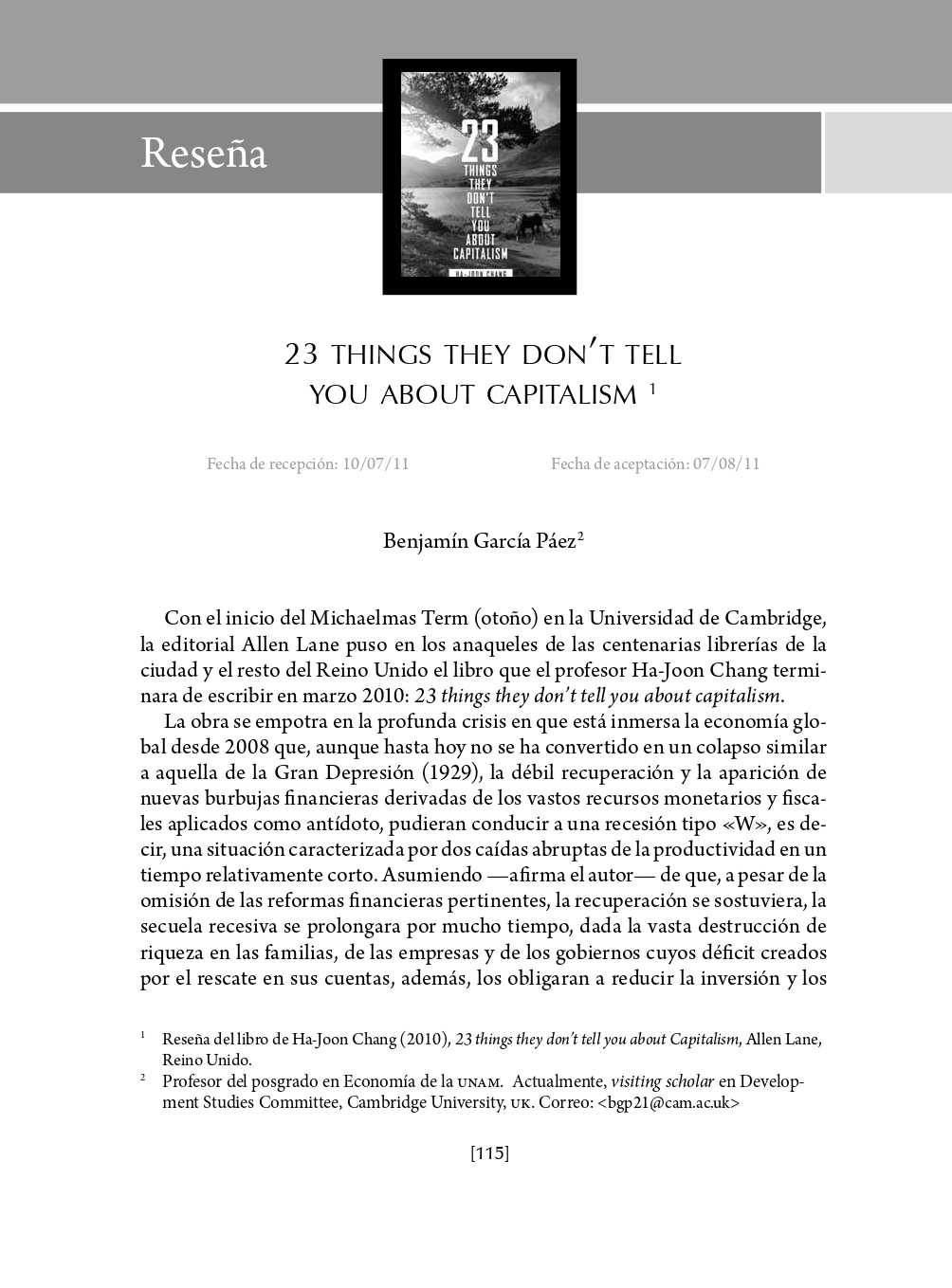
23 Things They Don’t Tell You About Capitalism
Keywords:
global economic crisis, recession, wealth destructionAbstract
The profound crisis in which the global economy has been immersed since 2008, although it has not yet turned into a collapse similar to that of the Great Depression (1929), shows a weak recovery and the emergence of new financial bubbles derived from the vast monetary and fiscal resources applied as an antidote. These factors could lead to a “W-type” recession, that is, a situation characterized by two abrupt drops in productivity within a relatively short period of time. Assuming —the author states— that, despite the omission of the pertinent financial reforms, the recovery were to hold, the recessionary aftermath will be prolonged for a long time, given the vast destruction of wealth among households, companies, and governments, whose deficits created by the bailout measures will also force them to reduce investment and the benefits granted through their welfare systems to strengthen income, thus affecting growth, poverty, and social stability.
Downloads
Downloads
Published
Issue
Section
License
Copyright (c) 2026 Research in Administrative Sciences

This work is licensed under a Creative Commons Attribution-NoDerivatives 4.0 International License.