Analysis of the impact of technology use on university students through data processing with Python
Keywords:
Technology Use,University Students, Academic Performance, Emotional Well-being,Data Analysis,Python.Abstract
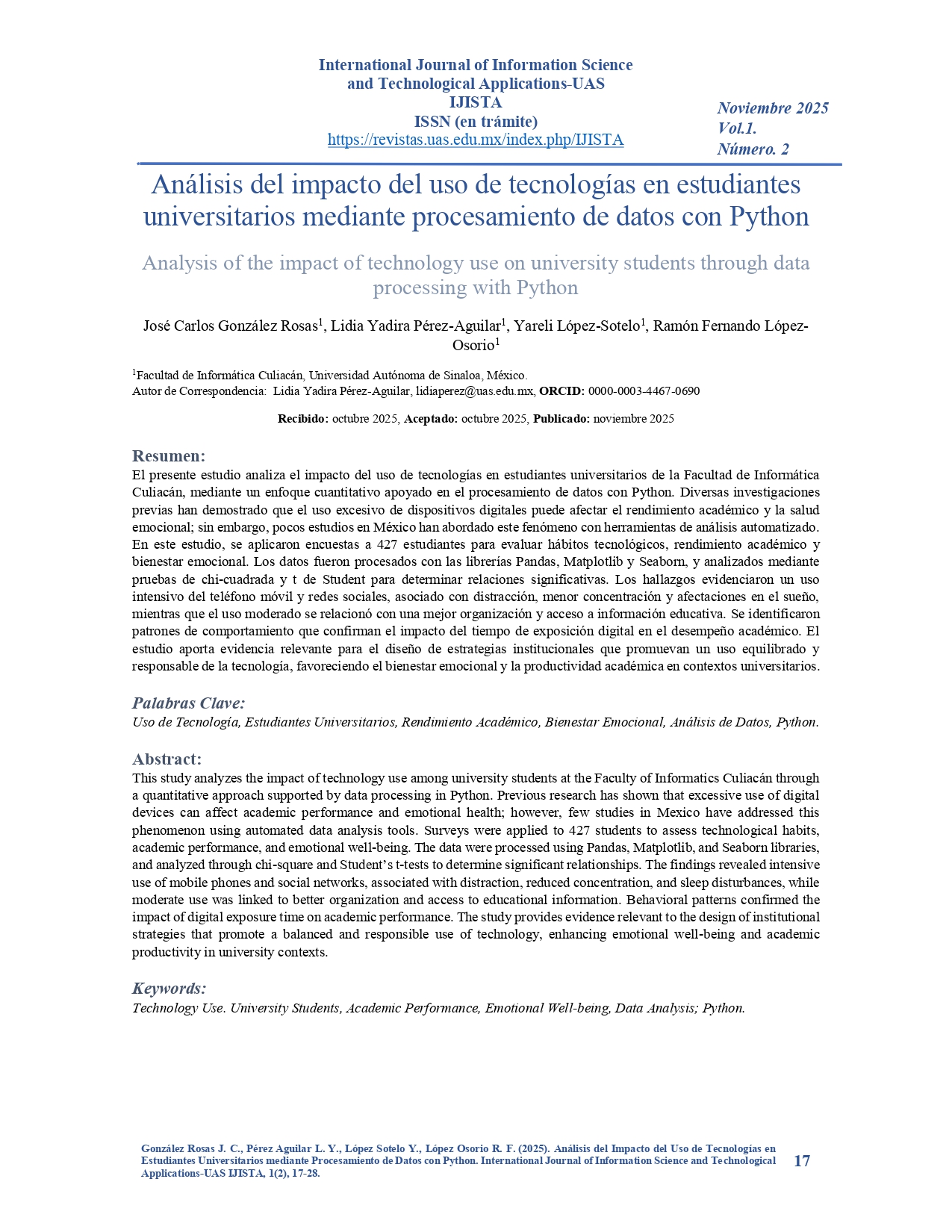
This study analyzes the impact of technology use among university students at the Faculty of Informatics Culiacán through a quantitative approach supported by data processing in Python. Previous research has shown that excessive use of digital devices can affect academic performance and emotional health; however, few studies in Mexico have addressed this phenomenon using automated data analysis tools.Surveys were applied to 427 students to assess technological habits, academic performance, and emotional well-being. The data were processed using Pandas, Matplotlib, and Seabornlibraries, and analyzed through chi-squareand Student’s t-teststo determine significant relationships.The findings revealed intensive use of mobile phones and social networks, associated with distraction, reduced concentration, and sleep disturbances, while moderate use was linked to better organization and access to educational information.Behavioral patterns confirmed the impact of digital exposure time on academic performance. The study provides evidence relevant to the design of institutional strategies that promote a balanced and responsible use of technology, enhancing emotional well-being and academic productivity in university contexts.
Downloads
References
E. E. Gallardo Echenique, L. Marqués Molías, y M. Bullen, «Usos académicos y sociales de las tecnologías digitales del estudiante universitario de primer año», Tend. Pedagógicas, n.o 23, pp. 191-204, 2014, Accedido: 26 de octubre de 2025. [En línea]. Disponible en: https://dialnet.unirioja.es/servlet/articulo?codigo=4665909
M. E. Carrillo Lencina, «El efecto de las redes sociales en niños/as de educación primaria», FACULTAD DE CIENCIAS DE LA EDUCACIÓN, Universidad de Almerria, 2020. [En línea]. Disponible en: https://repositorio.ual.es/bitstream/handle/10835/10160/CARRILLO%20LENCINA%2C%20MARIA%20ELENA.pdf?sequence=1&isAllowed=y
S. Gallego Trijueque, «Redes sociales y desarrollo humano», Barataria Rev. Castell.-Manchega Cienc. Soc., n.o 12, pp. 113-121, abr. 2016, doi: 10.20932/barataria.v0i12.142.
Francisco Javier Rocha Estrada y Jessica Alejandra Ruiz Ramírez, «La transformación digital y los hábitos de estudio mediados por la tecnología», Observatorio / Instituto para el Futuro de la Educación. Accedido: 24 de septiembre de 2025. [En línea]. Disponible en: https://observatorio.tec.mx/edu-bits-blog/la-transformacion-digital-y-los-habitos-de-estudio-mediados-por-la-tecnologia/
I. A. Lainez Santistevan y E. J. Domínguez Cruz, «Tecnología emergente e innovación comunicacional en los hábitos de estudios y comunicación de los estudiantes de la carrera de Audiencias Digitales», ene. 2025, Accedido: 26 de octubre de 2025. [En línea]. Disponible en: https://repositorio.upse.edu.ec/handle/46000/12589
M. Mayorga Ases, S. Martínez Pérez, J. Cosquillo Chida, y R. Altamirano Carrasco, «El uso de plataformas de aprendizaje online: ventajas y desafíos para los Docentes», 593 Digit. Publ. CEIT, vol. 10, n.o Extra 1, pp. 369-388, 2025, Accedido: 26 de octubre de 2025. [En línea]. Disponible en: https://dialnet.unirioja.es/servlet/articulo?codigo=9988555
S. Giménez, «Informe OBS: Redes Sociales, estado actual y tendencias 2023», OBS Business School. Accedido: 26 de octubre de 2025. [En línea]. Disponible en: https://www.obsbusiness.school/actualidad/informes-de-investigacion/informe-obs-redes-sociales-estado-actual-y-tendencias-2023
S. Gallego Trijueque, «Redes sociales y desarrollo humano», Barataria Rev. Castell.-Manchega Cienc. Soc., n.o 12, pp. 113-121, 2011, doi: 10.20932/barataria.v0i12.142.
F. J. Rocha Estrada y E. G. Rincón Flores, «Docentes universitarios frente al confinamiento académico: un análisis exploratorio», Texto Livre, vol. 15, p. e38234, 2022, doi: https://doi.org/10.35699/1983-3652.2022.38234.
N. Y. Pinos Paredes, S. N. Hurtado Pantoja, y D. M. Rebolledo Malpica, «Uso del teléfono celular como distractor del proceso enseñanza – aprendizaje», Enferm. Investiga Investig. Vincul. Docencia Gest., vol. 3, n.o 4, pp. 166-171, 2018, Accedido: 26 de octubre de 2025. [En línea]. Disponible en: https://dialnet.unirioja.es/servlet/articulo?codigo=6726068
Aldo Alvarez Risco, «Influence of Technostress on Academic Performance of University Medicine Students in Peru during the COVID-19 Pandemic». Accedido: 17 de julio de 2025. [En línea]. Disponible en: https://www.mdpi.com/2071-1050/13/16/8949
P. Upadhyaya y Vrinda, «Impact of Technostress on Academic Productivity of University Students», Educ. Inf. Technol., vol. 26, n.o 2, pp. 1647-1664, mar. 2021, doi: 10.1007/s10639-020-10319-9.
A. Abojedi, A. S. Alsheikh Ali, y J. Basmaji, «Assessing the Impact of Technology Use, Social Engagement, Emotional Regulation, and Sleep Quality Among Undergraduate Students in Jordan: Examining the Mediating Effect of Perceived and Academic Stress», Health Psychol. Res., vol. 11, p. 73348, 2023, doi: 10.52965/001c.73348.
J. M. Lukose y A. O. Agbeyangi, «Is social media hindering or helping Academic Performance? A case study of Walter Sisulu University Buffalo City Campus», 7 de enero de 2025, arXiv: arXiv:2501.03611. doi: 10.48550/arXiv.2501.03611.
National Library of Medicine, «analysis of the impact of technology». Accedido: 17 de julio de 2025. [En línea]. Disponible en: https://pubmed.ncbi.nlm.nih.gov/40070897/
R. Casado Vara, «Introducción a HTML», p. 228, 2019, [En línea]. Disponible en: https://gredos.usal.es/bitstream/handle/10366/139647/BISITE_CasadoVaraR_HTML.pdf;jsessionid=4BA894AA64A1773AB095D0313C30F6E2?sequence=1
E. E. Condor Tinoco y M. A. De La Cruz Rocca, Algoritmos resueltos con python. EDITORIAL EIDEC, 2020. doi: 10.34893/6KBN-5A63.
Observatorio, «Home», Observatorio / Instituto para el Futuro de la Educación. Accedido: 26 de octubre de 2025. [En línea]. Disponible en: https://observatorio.tec.mx/
L. A. A. Cedrón, «Prueba chi-cuadrado en la estadística no paramétrica», Ciencias, vol. 1, n.o 1, pp. 13-17, 2017, doi: 10.33326/27066320.2017.1.829.
D. Lastre, M. Páez Santana, y O. López Tumbaco, «Análisis estadístico de tablas de contingencia y chi cuadrado para medir el flujo migratorio en Ecuador en 2018». Accedido: 26 de octubre de 2025. [En línea]. Disponible en: https://journals.gdeon.org/index.php/esj/article/view/24
C. F. Collado, «Metodología de la investigación». 2014. [En línea]. Disponible en: https://apiperiodico.jalisco.gob.mx/api/sites/periodicooficial.jalisco.gob.mx/files/metodologia_de_la_investigacion_-_roberto_hernandez_sampieri.pd
Downloads
Published
Data Availability Statement
The collected data is available upon request from the author or through the institutional repository of the Culiacán Faculty of Computer Science.
Issue
Section
License
Copyright (c) 2025 International Journal of Information Science and Technological Applications-UAS IJISTA

This work is licensed under a Creative Commons Attribution-NonCommercial-ShareAlike 4.0 International License.