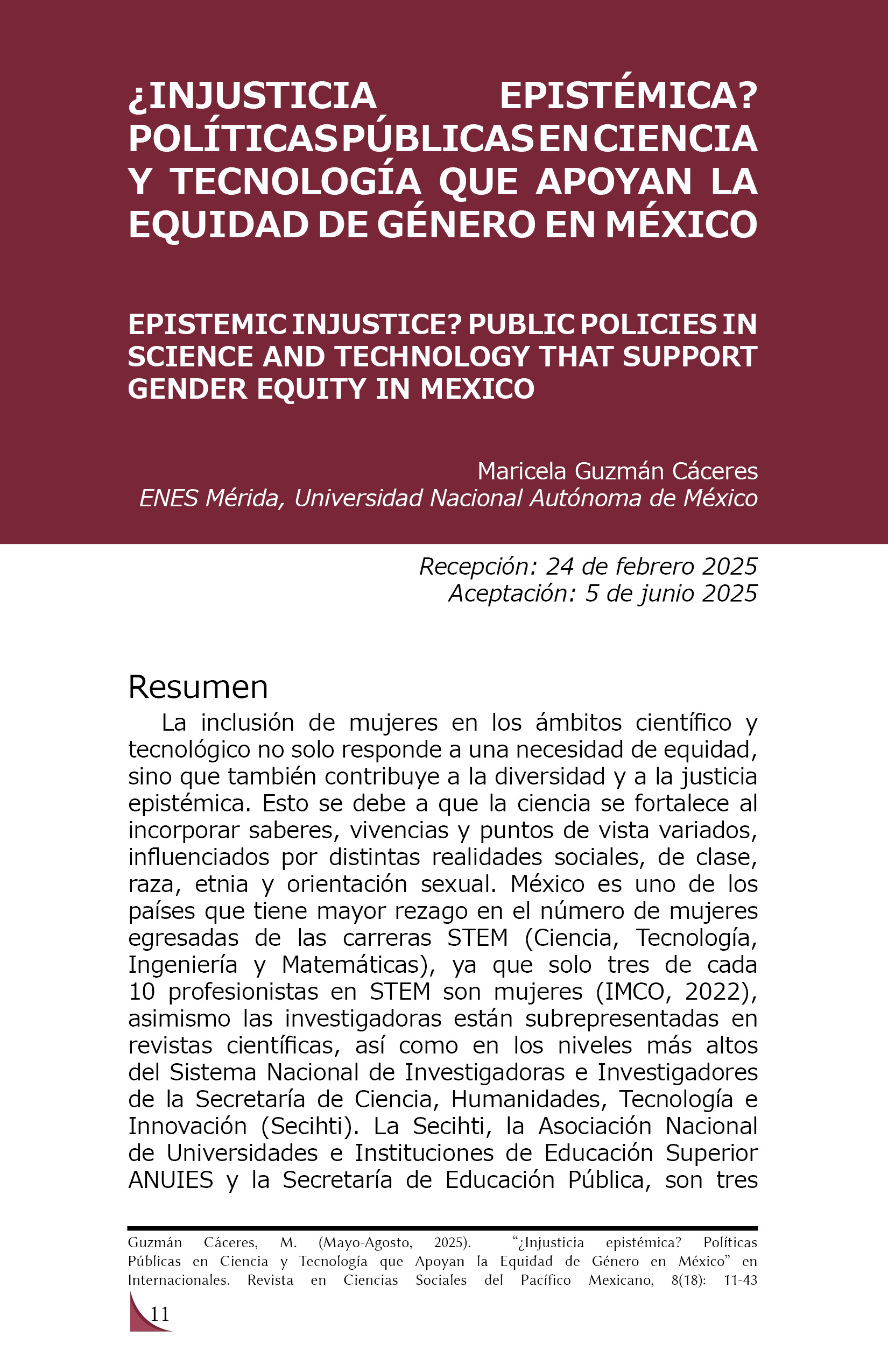
Epistemic Injustice? Public Policies in Science and Technology that Support Gender Equity in Mexico
Epistemic Injustice? Public Policies in Science and Technology that Support Gender Equity in Mexico
Keywords:
STEM, Gender, Public policiesAbstract
The inclusion of women in the scientific and technological fields not only responds to a need for equity but also contributes to diversity and epistemic justice. This is because science is strengthened by incorporating diverse knowledge, experiences, and points of view influenced by different social realities, class, race, ethnicity, and sexual orientation. Mexico is one of the countries with the greatest lag in the number of women graduating from STEM (Science, Technology, Engineering, and Mathematics) programs, with only three out of every 10 STEM professionals being women. Furthermore, female researchers are underrepresented in scientific journals and at the highest levels of the National System of Researchers of the Ministry of Science, Humanities, Technology, and Innovation (Secihti). Secihti, the National Association of Universities and Higher Education Institutions (ANUIES), and the Ministry of Public Education are three institutions that influence public policy in Mexico regarding science and technology. The programs at these institutions are liberal in nature and benefit a small number of students and academics, yet they have been successful. Although women's cognitive abilities were underestimated for centuries, today, society must recognize their talent in science and technology, providing them with greater and better leadership opportunities that promote plurality, epistemic justice, and scientific progress.
Downloads
References
ANUIES. (2021). Propuesta de Plan de Igualdad de Género en las IES. https://bit.ly/3sZrVYb
ANUIES. (2023). Acerca de la ANUIES. http://www.anuies.mx/anuies/acerca-de-la-anuies
Arévalo, D. (2022). Creciente el porcentaje de científicas mexicanas en el SNI. https://bit.ly/3rlprCT
Avolio, B., Pardo E. & Prados-Peña, M.B. (2024). Factors that contribute to the underrepresentation of women academics worldwide: A literature review. Social Psychology Education 27: 261–281 https://doi.org/10.1007/s11218-023-09838-3
BBC News Mundo. (2019). Elena Cornaro Piscopia: la historia de la filósofa italiana que se convirtió en la primera mujer con un doctorado. https://www.bbc.com/mundo/noticias-48527338
Campos Mondragón, I. (2025). Casi 33% de los investigadores en el mundo son mujeres: Unesco. https://bit.ly/3Hg0yAk
Cano, G. (2000). Género y construcción cultural de las profesiones en el porfiriato: Magisterio, medicina, jurisprudencia y odontología. Historia y
Grafía (14): 207243. http://ces.colmex.mx/pdfs/gabriela/g_cano_10.pdf.
Ceci, S.J. & Williams, W.M. (2011). Understanding current causes of women’s underrepresentation in science, Psychological
Conacyt. (2021a). Reflexionan sobre los derechos de las mujeres trabajadoras en la ciencia. https://bit.ly/4dEihxt
Conacyt. (2021b). Programa de Incorporación de Mujeres Indígenas a posgrados para el Fortalecimiento Regional. https://bit.ly/3RrasCa
Conacyt. (2022). El Consejo General del SNI aprueba el ingreso de 183 investigadoras e investigadores Eméritos. https://secihti.mx/wp-content/uploads/comunicados/Comunicado%20287_18032022.pdf
Conahcyt. (2024a). Programa de Becas de Posgrado para indígenas (PROBEPI) Convocatoria 2024. https://becasindigenas.ciesas.edu.mx/wp-content/uploads/2024/06/Convocatoria-PROBEPI-2024-1.pdf
Conahcyt. (2024b). Apoyos complementarios para maternidad y paternidad. https://bit.ly/4jnCtEW
Conkey, M. W. & Gero, J. (1997). Programme to Practice: Gender and Feminism in Archaeology, Annual Review of Anthropology, 26, 411-437.
Crenshaw, K. (1989). Demarginalizing the Intersection of Race and Sex: A Black Feminist Critique of Antidiscrimination Doctrine, Feminist Theory and Antiracist Politics, University of Chicago Legal Forum: 1(8). http://chicagounbound.uchicago.edu/uclf/vol1989/iss1/8
Donoso Fuentes, A. (2024). Dra. Eloísa Díaz Insunza (1866- 1950) y la salud integral de los escolares chilenos, Andes Pediátrica. Revista Chilena de Pediatría, 95(3): 319-324. https://www.scielo.cl/pdf/andesped/v95n3/2452-6053-vandesped-andespediatr-v95i3-5207.pdf
ENES Mérida. (2025). Programa de vocaciones científicas en niñas de Yucatán, Escuela Nacional de Estudios Superiores Unidad Mérida, https://www.facebook.com/vocacionescientificasyucatan
García-Holgado, A. & García-Peñalvo, F.J. (2023). Atracción de mujeres a programas STEM: una adaptación en tiempos de pandemia en A. Domínguez, F.J. García-Peñalvo, G. Zavala, García-Holgado, A. y H. Alarcón, (coords.) Mujeres en la educación universitaria de ciencia, ingeniería, tecnología y matemáticas: Atracción, acceso y acompañamiento para reducir la brecha de género en Hispanoamérica, Octaedro.
Gay, P. (1992) La experiencia burguesa. De Victoria a Freud, Tomos I y II, México, Editorial Fondo de Cultura Económica.
Gobierno del Estado de México. (2022). Igualdad de género. Libro de las niñas y los niños. https://bit.ly/43E2QR1
Guzmán Cáceres, M. (2022). Teoría feminista, teoría de género. Lecturas de iniciación, Universidad Autónoma de Sinaloa.
Guzmán Cáceres, M. & Guzmán Tovar, C. (2025). Vocaciones científicas en jóvenes mayas de Yucatán, México: el desafío de la marginalidad y la ausencia de referentes. Trilogía Ciencia Tecnología Sociedad, 17(35), 1-23. https://doi.org/10.22430/21457778.3361
Guzmán Cáceres, M. & Pérez Mayo, A.R. (2005). Epistemologías feministas. Hacia una reconciliación política de la ciencia a través de la filosofía y la teoría de género en N. Blazquez Graf y J. Flores (editores), Ciencia, tecnología y género en Iberoamérica, Universidad Nacional Autónoma de México.
Harding, S. (1996). Ciencia y feminismo. Morata.
Howe -Walsh, L. & Turnbull, S. (2014). Barriers to women leaders in academia: tales from science and technology. Studies in Higher Education, 41(3): 415–428. https://doi.org/10.1080/03075079.2014.929102
Huerta Mata, R.M. (2017). Ingreso y presencia de las mujeres en la matrícula universitaria en México. Revista de El Colegio de San Luis, 7 (14): 281-306
IMCO. (2022). ¿Dónde están las científicas? Brechas de género en carreras STEM. IMCO. Centro de investigación en política pública. https://imco.org.mx/en-mexico-solo-3-de-cada-10-profesionistas-stem-son-mujeres/
IMCO. (2023). Mujeres STEM en los estados.
Instituto Nacional de las Mujeres [INMUJERES]. (2020). Programa Nacional para la Igualdad entre Mujeres y Hombres 2020-2024. https://dof.gob.mx/nota_detalle.php?codigo=5608467&fecha=22/12/2020#gsc.tab=0
King, M.L. (2009). Elena Lucrezia Cornaro Piscopia (1646-1684). The first woman in the world to earn a university degree . The catholic Historical Review 95(2), 355-357.
Kukula. (2021). Science is also “Girl Stuff”. https://kukula.it/en/science-is-also-girl-stuff/
Lamas, M. (2021). Acoso: ¿Denuncia legítima o victimización?, Centzontle.
Latova Santamaría, D. (2023). Injusticia epistémica. Eunomía. Revista en Cultura de la Legalidad 24, 274-299. https://doi.org/10.20318/eunomia.2023.7667
Longino, H. (1993): Subjects, power and knowledge: Description and prescription in feminist philosophies of science en L. Alcoff y E. Potter (eds.): Feminist Epistemology. Routledge,101-120
Muñoz Rojas, C. (2021). Políticas públicas para la igualdad de género en ciencia, tecnología, ingeniería y matemáticas (CTIM): desafíos para la autonomía económica de las mujeres y la recuperación transformadora en América Latina. Asuntos de género 47565, Naciones Unidas Comisión Económica para América Latina y el Caribe (CEPAL).
Naciones Unidas. (2023). Más participación de mujeres y niñas = mejor ciencia, tecnología, ingeniería y matemáticas. https://news.un.org/es/story/2023/02/1518507
Palermo, A.I. (2006) El acceso de las mujeres a la educación universitaria, Revista Argentina de Sociología. 4(7): 11-46.
Lunnemann, P., Jensen, Mo. & Jauffrd, L. (2019). Gender bias in Nobel prizes, Palgrave Commun 5(46). https://doi.org/10.1057/s41599-019-0256-3
Roper, R. (2019). Does Gender Bias Still Affect Women in Science?, Microbiology and molecular biology reviews. 83(3), https://doi.org/10.1128/mmbr.00018-19
Rueda Romero, X. (2022). Hacia una equidad y justicia epistémica en el reconocimiento de mujeres en la producción de conocimiento. EN-CLAVES del pensamiento, 0(31), e521. DOI: https://doi.org/10.46530/ecdp.v0i31.521
Ruelas, A. L. & Montoya Zavala E.C. (2024). Científicas sinaloenses. Autonomía y empoderamiento acotado en A.L. Ruelas & S.E. Ward Bringas, Mujeres sinaloenses. Identidades sociales en construcción. México: UPES/Tirant lo blanch.
Schiebinger L. & Schraudner, M. (2012). Innovaciones de género en ciencia, medicina e ingeniería: enfoques interdisciplinares para su consecución en I Perdomo Reyes & A. Puy Rodríguez (editores), Género, conocimiento e investigación, México: Plaza y Valdés Editores.
Secihti. (2024a). Becas y apoyos complementarios para la inclusión Convocatoria 2024. https://bit.ly/3SULkDb
Secihti. (2025b). Programas de Fortalecimiento Académico para Indígenas. https://secihti.mx/becas_posgrados/fortalecimiento-academico-para-indigenas/
Secihti. (2025c). Fundamental impulsar la participación de las mujeres en ciencia, humanidades, tecnología e innovación: Secihti. https://bit.ly/4kdILbk
Tabak. (2005). Como ampliar la masa crítica en ciencia y tecnología: la contribución de las mujeres en N. Blazquez Graf & J. Flores (editores), Ciencia, tecnología y género en Iberoamérica, Universidad Nacional Autónoma de México.
The Nobel Prize. (2023a). Women who change the world. https://bit.ly/3RmFESP
The Nobel Prize. (2023b). All Nobel Prizes. https://www.nobelprize.org/prizes/lists/all-nobel-prizes/
Tringham, R. (2000). Southeastern Europe in the Transition to Agriculture in Europe: Bridge, Buffer or Mosaic en Douglas Price, Europe’s First Farmers, pp. 19-56. Cambridge University Press.
UNESCO. (2023). Educación de niñas y mujeres en ciencia, tecnología, ingeniería y matemáticas (STEM). https://www.unesco.org/es/gender-equality/education/stem
Vásquez Soto, C. Marín-Raventós, G., De Lemos Medina, L. & Romero, R.M. (2023). La brecha de género en carreras STEM: ¿cómo afrontarla? en A. Domínguez, F.J. García-Peñalvo, G. Zavala, García-Holgado, A. y H.
Alarcón, (coords.) Mujeres en la educación universitaria de ciencia, ingeniería, tecnología y matemáticas: Atracción, acceso y acompañamiento para reducir la brecha de género en Hispanoamérica, Octaedro.
World Economic Forum. (2020). The future of job report 2020. https://www.weforum.org/reports/the-future-of-jobs-report-2020/
Downloads
Published
Issue
Section
Categories
License
Copyright (c) 2025 Internacionales. Revista en Ciencias Sociales del Pacífico Mexicano

This work is licensed under a Creative Commons Attribution-NoDerivatives 4.0 International License.