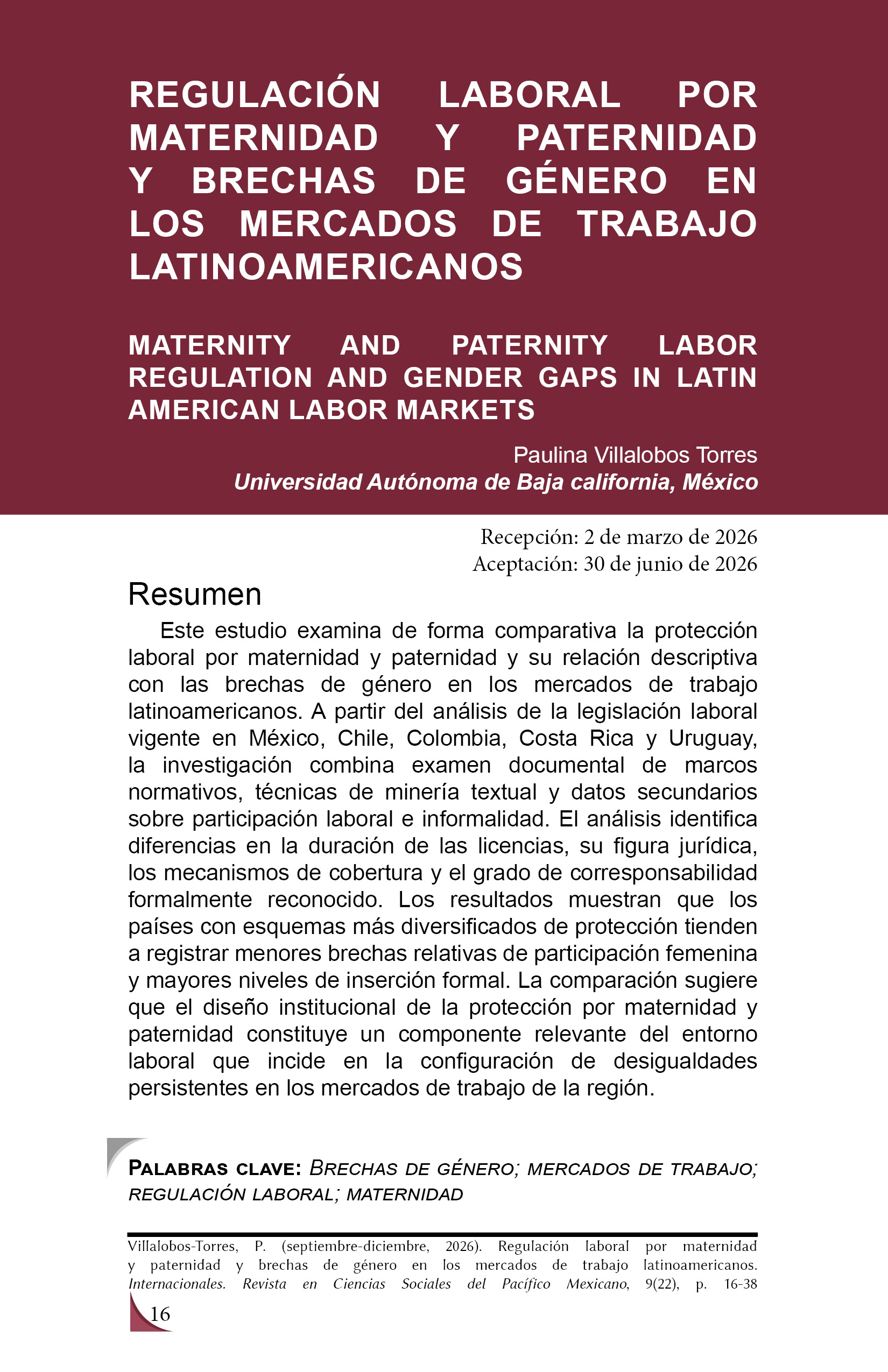
Maternity and paternity labor regulation and gender gaps in Latin American labor markets
Keywords:
Gender gaps, Labor markets, Labor regulation, MaternityAbstract
This study comparatively examines labor protection for maternity and paternity and its descriptive relationship with gender gaps in Latin American labor markets. Based on an analysis of current labor legislation in Mexico, Chile, Colombia, Costa Rica, and Uruguay, the research combines documentary examination of normative frameworks, text mining techniques, and secondary data on labor force participation and informality. The analysis identifies differences in the duration of leave, legal design, coverage mechanisms, and the degree of formally recognized co-responsibility. The findings indicate that countries with more diversified protection schemes tend to exhibit smaller relative gender gaps in labor force participation and higher levels of formal female employment. The comparative evidence suggests that the institutional design of maternity and paternity labor protection constitutes a relevant component of the labor market environment shaping persistent gender inequalities in the region.
Downloads
References
Albanesi, S., y Kim, J. (2021). Effects of the COVID-19 recession on the US labor market: Occupation, family, and gender. Journal of Economic Perspectives, 35(3), 3–24. https://doi.org/10.1257/jep.35.3.3
Alon, T., Coskun, S., Doepke, M., Koll, D., y Tertilt, M. (2022). From mancession to shecession: Women’s employment in regular and pandemic recessions. NBER Macroeconomics Annual, 36(1), 83–151. https://doi.org/10.1086/718660
Asamblea Legislativa de la República de Costa Rica. (2014). Ley N.º 9220. Ley de la Red Nacional de Cuido y Desarrollo Infantil. https://redcuidoinfantil.go.cr/documento/ley-9220-red-nacional-de-cuido-y-desarrollo-infatil/
Berniell, I., Berniell, L., de la Mata, D., Edo, M., y Marchionni, M. (2021). Gender gaps in labor informality: The motherhood effect. Journal of Development Economics, 150, 102599. https://doi.org/10.1016/j.jdeveco.2020.102599
Bowen, G. A. (2009). Document analysis as a qualitative research method. Qualitative Research Journal, 9(2), 27–40. https://doi.org/10.3316/QRJ0902027
Budig, M. J., y England, P. (2001). The wage penalty for motherhood. American Sociological Review, 66(2), 204–225. https://doi.org/10.2307/3088906
Congreso de la República de Colombia. (2023). Código Sustantivo del Trabajo. https://www.funcionpublica.gov.co/eva/gestornormativo/norma.php?i=162554
Congreso de la Unión. (2024). Ley Federal del Trabajo. Diario Oficial de la Federación. https://www.diputados.gob.mx/LeyesBiblio/pdf/LFT.pdf
Congreso Nacional de Chile. (2024). Código del Trabajo. Biblioteca del Congreso Nacional de Chile. https://www.bcn.cl/leychile/navegar?idNorma=242302
Ferragina, E. (2020). Family policy and women’s employment outcomes in 45 high-income countries: A systematic qualitative review of 238 comparative and national studies. Social Policy & Administration, 54(6), 944–961. https://doi.org/10.1111/spol.12584
Gasparini, L. C., y Marchionni, M. (2015). Bridging gender gaps? The rise and deceleration of female labor force participation in Latin America (Documento de trabajo CEDLAS No. 185). CEDLAS, Universidad Nacional de La Plata. https://cedlas.econo.unlp.edu.ar/wp/wp-content/uploads/doc_cedlas185.pdf
Gentzkow, M., Kelly, B., y Taddy, M. (2019). Text as data. Journal of Economic Literature, 57(3), 535–574. https://doi.org/10.1257/jel.20181020
Goldin, C. (2014). A grand gender convergence: Its last chapter. American Economic Review, 104(4), 1091–1119. https://doi.org/10.1257/aer.104.4.1091
Grimmer, J., y Stewart, B. M. (2013). Text as data: The promise and pitfalls of automatic content analysis methods for political texts. Political Analysis, 21(3), 267–297. https://doi.org/10.1093/pan/mps028
Olivetti, C., y Petrongolo, B. (2017). The economic consequences of family policies: Lessons from a century of legislation in high-income countries. Journal of Economic Perspectives, 31(1), 205–230. https://doi.org/10.1257/jep.31.1.205
Organización Internacional del Trabajo. (2024). Panorama Laboral 2024: América Latina y el Caribe. Oficina Regional para América Latina y el Caribe. https://www.ilo.org/es/publications/panorama-laboral-2024-de-america-latina-y-el-caribe
República Oriental del Uruguay. (2013). Ley N.º 19.161, subsidios por maternidad, paternidad y cuidados del recién nacido. https://www.impo.com.uy/bases/leyes/19161-2013
Rodríguez Enríquez, C. (2015). Economía feminista y economía del cuidado: Aportes conceptuales para el estudio de la desigualdad. Nueva Sociedad, (256), 30–44. https://static.nuso.org/media/articles/downloads/4102_1.pdf
Waldfogel, J. (1998). Understanding the “family gap” in pay for women with children. Journal of Economic Perspectives, 12(1), 137–156. https://doi.org/10.1257/jep.12.1.137
World Bank. (2024a). Labor force participation rate, female (% of female population ages 15 and older). World Bank Open Data. https://data.worldbank.org/indicator/SL.TLF.CACT.FE.ZS
World Bank. (2024b). Labor force participation rate, male (% of male population ages 15 and older). World Bank Open Data. https://data.worldbank.org/indicator/SL.TLF.CACT.MA.ZS
World Bank. (2024c). Women, Business and the Law 2024. World Bank. https://openknowledge.worldbank.org/server/api/core/bitstreams/2682c448-558b-44a2-974c-239eea51218e/content
Downloads
Published
Issue
Section
Categories
License
Copyright (c) 2026 Internacionales. Revista en Ciencias Sociales del Pacífico Mexicano

This work is licensed under a Creative Commons Attribution-NonCommercial-ShareAlike 4.0 International License.