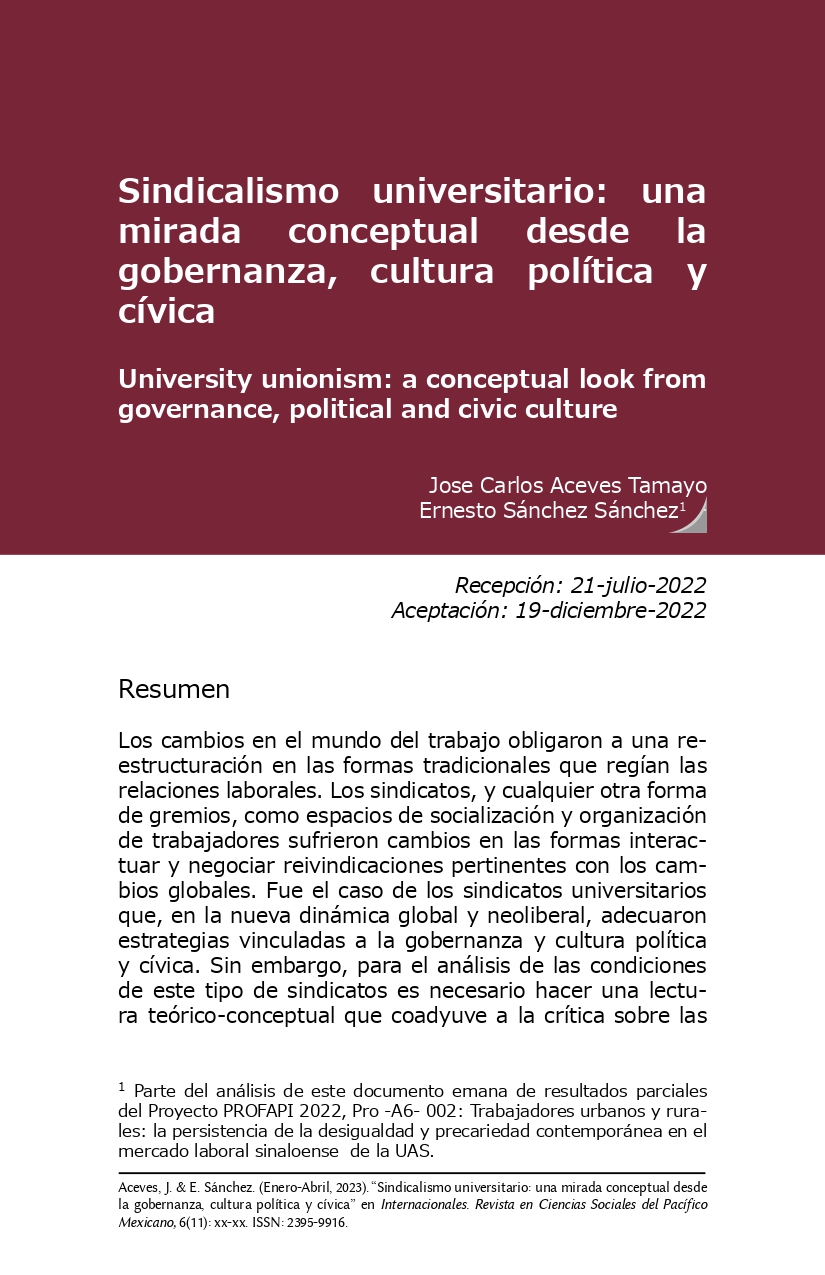
University Unionism: A Conceptual Look from Governance, Political and Civic Culture
University Unionism: A Conceptual Look from Governance, Political and Civic Culture
Keywords:
Unionism, Governance, Political culture, Civic cultureAbstract
Changes in the world of work forced a restructuring of the traditional forms governing labor relations. Unions, and any other form of guilds, as spaces of socialization and organization of workers underwent changes in the ways of interacting and negotiating demands relevant to the global changes. This was the case of university unions which, in the new global and neoliberal dynamics, adapted strategies linked to governance and political and civic culture. However, for the analysis of the conditions of this type of unions, it is necessary to make a theoreticalconceptual reading that contributes to the critique of the particular and qualitative conditions of these forms of labor relations in educational spaces, which share a differentiated dynamic in the forms of sociability and conflict resolution.
Downloads
References
Acosta-Silva, A., Ganga-Contreras, F., & Rama-Vitale, C. (2021). Gobernanza universitaria: enfoques y alcances conceptuales. Revista iberoamericana de educación superior, 12(33): 3-17.
Addison, J. (2020). Consecuencias del desgaste del poder de los sindicatos en IZA World of Labor: 68 Vol. 2. pp. 1-11. Recuperado en doi: 10.15185/izawol.68.v2
Aguilar, L. F. (2006). Gobernanza y gestión pública. Fondo de Cultura Económica: México.
Almond, Gabriel A. & S. Verba. (1992). “La Cultura política”, en Almond, Dahl, et al, Diez textos de ciencia política, Ariel: Madrid.
Brunner, J. J. & F. G. Contreras. (2016). Dinámicas de transformación en la educación superior latinoamericana: Desafíos para la gobernanza. Opción: Revista de Ciencias Humanas y Sociales, (80): 12-35.
Covarrubias, Valdenebro A. & A. Bouzas, Ortiz. (2016). Empleo y políticas sindicales en la industria automotriz de México, Análisis, Friedich Ebert Stiftung, (7):1-20, México. Disponible en; https:// library.fes.de/pdf-files/bueros/mexiko/13017.pdf
Gilly, A. (2014). El tiempo del despojo. Poder y territorio. Conferencia en el Foro El Poder Hoy, Cátedra Alain Touraine. Universidad Iberoamericana: Puebla, México.
De la Garza, E. (2014). El Sindicalismo, el empleo formal y su relación con el Estado en América Latina. I Coloquio internacional de Políticas y derechos de las personas trabajadoras: Quito, Ecuador.
De la Garza, E. (2011). Trabajo no clásico, organización y acción colectiva. En Trabajo no clásico, organización y acción colectiva Tomo II. UAM-Plaza y Valdés editores: México.
Denk, T., Ch., H. S., & Bergh, D. (2015). The composition of political culture—A study of 25 European democracies. Studies in Comparative International Development, 50(3): 358-377. Disponible en: DOI 10.1007/s12116-015-9174-6
El Ghaziri, M., Simons, S., Lipscomb, J., Storr, C. L., McPhaul, K., London, M., & Johnson, J. V. (2020). Understanding the impact of bullying in a unionized US public sector workforce. Workplace Health & Safety, 68(3): 139-153. Disponible en: https://doi. org/10.1177/2165079919883286
Emil, O. (2019). A comparative analysis of theoretical and methodological foundations of political culture. Wisdom, 1(12):38-48.
Handayani, N. U., Purwanggono, B., Awwiby, M. A., Wibowo, M. A., & Hanifah, A. (2020). Establishing Organizational Culture to Prepare Faculty of Engineering of Diponegoro University to Face the Upcoming Higher Education Policy 4.0. In Proceedings of the International Conference on Engineering and Information Technology for Sustainable Industry, pp. 1-7. Disponible en: https://doi.org/10.1145/3429789.3429814
Hyman, R. (1997). Trade unions and interest representation in the contexts of globalization. Transfer. vol. 3, (3). U.K. Pp. 515- 533. DOI: https://doi.org/10.1177%2F102425899700300306
Kooiman, J. (1999). Social-Political governance. Overview, reflections and design, Public Management Review, 1(1): 67-92.
Kurczyn Villalobos, P. (2016). La gobernanza en las relaciones laborales y en el derecho del trabajo. Biblioteca Jurídica Virtual del Instituto de Investigaciones Jurídicas de la UNAM, recuperado en https://archivos.juridicas.unam.mx/www/bjv/libros/9/4095/9.pdf
Lichterman, P. (2012). Reinventing the concept of civic culture. In The Oxford handbook of cultural sociology. Disponible en: DOI: 10.1093/oxfordhb/9780195377767.013.8
Li, D., & Allen, A. (2021). Three-level hierarchical linear modeling analyses of the relationship between political culture and teacher autonomy. Education and Urban Society, 53(3): 251-278. Disponible en: DOI: 10.1177/0013124520928611
Lorey, I. (2016). Estado de inseguridad. Gobernar la precariedad. Traficantes de sueños. España.
Martin, A. P. (2021). A mixed-methods assessment of civil political culture during a democratic transition. The case of Tunisian civil society organisations. Qual Quant 55, 2189–2218. Disponible en: https://doi.org/10.1007/s11135-021-01103-z
Morales, S., McGinn, N. F. (1982). Faculty development in Mexican Universities, Journal of Higher Education, 53 (5): 532-551.
Nikonova, N. P. (2019). Development of personal social activity: Formation of students’ political culture. International Journal of Recent Technology and Engineering, 8(2 S10): 893-897. Disponible en: DOI: 10.35940/ijrte.B1117.0982S1019
Osborne, S. P. (2010). The new public governance - Emerging perspectives on the theory and practice of public governance, Routledge.
Putnam, R., Leonardi, R., Nanetti, R. y Pavoncello, F. (1983). Explaining institutional secrets: the case of Italian regional government. The American Political Science Review, 77(1):55-74.
Rhodes, R. A. W. (1996). The New Governance: Governing without Government, Political Studies, 44, 652-667
Sánchez Sánchez, Ernesto; Pintor Sandoval, Renato. (2020). Trabajadores en movimiento: del sindicalismo tradicional a la acción colectiva. Sapientiae 6(1):44-55, Angola. DOI: www.doi. org/10.37293/sapientiae61.05
Schneider, B., Ehrhart, M. G., & Macey, W. H. (2013). Organizational climate and culture. Annual review of psychology, 64(1): 361- 388. https://copdei.extension.org/wp-content/uploads/2019/06/ Organizational-Climate-and-Culture-Review.pdf
Visser, J. (2019). ¿Pueden revitalizarse los sindicatos? Boletín Internacional de Investigación Sindical, 9(1-2):21-56. Boletín Internacional de Investigación Sindical, Ginebra, Oficina Internacional del Trabajo.
Downloads
Published
Issue
Section
Categories
License
Copyright (c) 2023 Internacionales. Revista en Ciencias Sociales del Pacífico Méxicano

This work is licensed under a Creative Commons Attribution-NoDerivatives 4.0 International License.