Journals
-
SIBIUAS Revista de la Dirección General de Bibliotecas
Edition: Dirección General de Bibliotecas
Editor-in-Chief: MC. Nidia Odette Santana Rodelo
Description: Multidisciplinary scientific outreach journal.
Objective: To disseminate advances in science and serve as a communication bridge between authors and readers.
Periodicity: Biannual.
Country: Mexico
Focus: Encourages the participation of students, researchers, and professionals from diverse fields of knowledge.
Review Criteria: Peer review (Double-blind).
Access Model: Open Access.
Exclusive Rights Reservation: In process.
ISSN: In process.
Publication Format: PDF and HTML.
Indexed in: Google Scholar, Latindex.
SIBIUAS, edited by the Dirección General de Bibliotecas, is a multidisciplinary scientific outreach journal whose primary purpose is the dissemination of the most significant advances and achievements across diverse areas of knowledge. Through this publication, the journal seeks to establish a space for expression and communication that serves as a bridge between authors and their readers, facilitating the exchange of ideas, research findings, and theoretical perspectives.
In fulfilling its mission, the journal welcomes original articles and academic review papers addressing current and relevant topics, integrating multiple disciplines to provide a comprehensive perspective on the challenges and opportunities faced by academic and professional communities. Additionally, the publication aims to contribute to the consolidation of an active scientific community by strengthening the connections among researchers, academics, and students, while enhancing the visibility of the intellectual production generated within our university and the surrounding region.
Ultimately, this journal serves as a platform for strengthening scientific culture by encouraging informed debate and collaboration among diverse actors within the academic sphere, positioning itself as a reference for the dissemination of knowledge and innovation in their various forms.
-
Acta Biológica Mexicana
Edición: Facultad de Biología
Editor en jefe: Edith Hilario Torres Montoya
Descripción: Revista científica de ciencias biológicas y biomédicas
Objetivo: Difundir avances científicos de investigación básica y aplicada sobre ciencias biológicas y biomédicas
Periodicidad: semestral
País: México
Enfoque: Fomentar la participación de estudiantes, investigadores y profesionales
Criterios de revisión: Por pares (doble ciego)
Modalidad: Acceso abierto
Reserva de derechos al uso exclusivo: 04-2025-121112444400-102
ISSN: 3122-4024
Formato de publicación: PDF
Indexada: Google Schoolar
Descripción:
Acta Biológica Mexicana es una composición internacional de acceso libre. Su revisión, producción y administración es sufragada por la Universidad Autónoma de Sinaloa, residiendo en la Facultad de Biología (FBUAS) en coedición con la Facultad de ciencias de la Universidad Autónoma de Baja California (FCUABC). Los usuarios cuentan con acceso libre por dar uso (publicar o acceder) a la publicación.
La revista se publica semestralmente y divulga resultados originales e inéditos de investigación básica y aplicada sobre temas biológicos y biomédicos, con especial interés en tópicos como ecología aplicada a la zoología, botánica, cambio climático, manejo de recursos naturales, nuevos registros de especies, biología celular, biología molecular, genética, desarrollo de fármacos, ecología de agentes patógenos y temas que a consideración del equipo editorial se ajusten al contenido de la revista. Los manuscritos pueden ser artículos de investigación, artículos de revisión, artículos de perspectivas, reportes de casos o notas breves. ACBIOMEX cuenta con un comité científico y editorial compuestos por investigadores de experiencia en sus áreas de especialidad.
-
BUIYYA TIERRA
Publisher: Facultad de Derecho y Ciencia Política Mochis
Editor-in-Chief: Dr. Luis García Valenzuela
Description: Multidisciplinary scientific dissemination journal
Objective: To disseminate original and unpublished research papers
Publication Frequency: Semiannual
Country: Mexico
Scope: To promote multidisciplinary research and serve as a platform for scientific dissemination
Peer Review Policy: Double-blind peer review
Access Model: Open Access
Exclusive Rights Reservation Number: 04-2024-082810225800-102
ISSN: 3061-7855
Publication Format: PDF
Indexed in: Latindex, LatinREV, AmeliCA, LivRe, and Google Scholar
-
ESCRIPTA
Publishing Unit: Unidad Académica Facultad de Historia.
Editor-in-Chief: Dra. Venecia Citlali Lara Caldera
Description:
Escripta is a scientific journal that promotes knowledge and research on historical processes in Mexico and Ibero-America through an interdisciplinary dialogue with the Social Sciences and Humanities.The journal welcomes original articles derived from research findings or scholarly reflections on issues across diverse geographical and temporal contexts that adopt a historical perspective as a means of critically examining social phenomena. It also publishes critical reviews that establish connections between recent works and current fields of research. All submissions undergo a double-blind peer-review process. Escripta does not charge authors any fees for the submission, processing, or publication of their articles.
The journal is institutionally supported by the Academic Bodies associated with the graduate programs (Master’s and Doctoral degrees) of the Faculty of History at Universidad Autónoma de Sinaloa.
Aim:
To contribute to scientific knowledge through the publication of original and unpublished research in the fields of History and the Social Sciences.Publication Frequency:
Biannual (Semiannual)Country:
MexicoScope:
To encourage the publication of original contributions in the fields of History and the Social Sciences that advance academic debate and historical knowledge.Review Process:
Double-blind peer review.Publishing Model:
Diamond Open Access (Diamond OA).Publication Fees:
No Article Submission Charges (ASC) or Article Processing Charges (APC).Exclusive Rights Reservation Number:
04-2025-120416551800-102ISSN:
2594-2891Publication Format:
PDFIndexed in:
Google Scholar, Latindex LatinREV, DOAJ, MIAR, LACLI and ROAD. -
Internacionales. Revista en Ciencias Sociales del Pacífico Mexicano
Publishing House: Autonomous University of Sinaloa
Editor-in-Chief: Erika Cecilia Montoya Zavala
Description: This is a scientific journal aimed at scholars in the social sciences and humanities. Internationals. Journal of Social Sciences of the Mexican Pacific is a quarterly, open-access, and free publication, edited by the Faculty of International Studies and Public Policy of the Autonomous University of Sinaloa. It is peer-reviewed (double-blind) and publishes in Spanish and English.
Objective: Its objective is to offer an alternative for publishing scientific and innovative results focused on global problems that affect different regions. Aimed at academics, students, and professionals interested in social science research and analysis, it includes articles resulting from original and unpublished research, whose results and findings contribute to the generation of new scientific knowledge.
Frequency: Quarterly
Country: Mexico
Focus and Scope: The focus is multidisciplinary. The topics for the articles to be published include comparative regional studies, territorial studies and local development policies, public policies, national and international migration processes, education, new information technologies, gender and human development, violence, and drug trafficking.
Internacionales. Revista en Ciencias Sociales del Pacífico Mexicano (International. Journal of Social Sciences of the Mexican Pacific) has a broad network of academics who contribute as collaborators and reviewers; it focuses on publishing scientific articles that present original results of high academic and scientific relevance, fostering the participation of students, researchers, and professionals.
Review Criteria: Peer review
Format: Electronic
Reservation of rights for exclusive use: 04-2024-110712472800-102
ISSN: 3061-8940
Print ISSN: 2395-991
Publication format: PDF
Indexed in: Google Scholar, Latindex, LatinRev, Amelica, LACLI, ROAD
Review criteria: Double-blind peer review
Mode: Diamond Open Access (OA)
Publication costs: Free, non-profit.
Inclusive and Non-Sexist Language
Internationals. Journal of Social Sciences of the Mexican Pacific recommends the use of inclusive and non-sexist language to avoid any type of bias, stereotype, and discrimination at any stage of publication and for all groups (authors, reviewers, editorial team) involved with the journal. In this regard, the guidelines provided by the Ministry of the Interior, Manual for the Use of Inclusive and Gender-Sensitive Language, are recommended.
Privacy Statement
The names and email addresses entered in this journal will be used exclusively for the purposes stated herein and will not be provided to third parties or used for any other purpose. We respect and protect the privacy of our authors, reviewers, and readers, and are committed to handling information confidentially and securely.
-
JUS Revista Jurídica Cuerpo Académico de Derecho Constitucional Facultad de Derecho Culiacán
Publisher: Facultad de Derecho Culiacán
Editor-in-Chief: Dra. Lydia Guadalupe Ojeda Esquerra.
Description: JUS Revista Juridica Cuerpo Academico de Derecho Constitucional, Facultad de Derecho Culiacán, is a national and international scientific journal issued through the Graduate Studies Unit of the Faculty of Law, Culiacán, Autonomous University of Sinaloa. The journal is published three times a year, corresponding to the periods January–April, May–August, and September–December.
Frequency: Four-monthly (Triannual publication).
Country: Mexico.
Peer Review Process: Double-blind peer review.
Publication Model: Open Access.
Exclusive Rights Registration Number: 04-2016-052414163800-102.
ISSN: 3122-4539.
Publication Format: PDF.
Indexed in: Google Scholar, Latindex, LatinREV, Aura, AmeliCA, LivRe, Zenodo, ERIH Plus, OpenAIRE, and MIAR.
Represented by the Constitutional Law Academic Body CA-187, the journal generates and disseminates knowledge, skills, competencies, and attitudes related to all areas of law through a free, critical, and constructive approach. Likewise, it promotes the strengthening of critical capacities and encourages the discussion of issues of contemporary relevance that constitute a commitment shared by society and institutions.
Supported by an extensive network of local, national, and international reviewers, the Editorial Board, composed of specialists in the subjects covered by the journal, anonymously evaluates submitted manuscripts to determine their suitability for publication. Editorial decisions are final and not subject to appeal.
The content of the articles is the sole responsibility of the authors and does not necessarily reflect the views of the editors.
Manuscripts submitted for publication must be of an academic nature and comply with the Editorial Guidelines of the Journal.
-
International Journal of Information Science and Technological Applications-UAS IJISTA
Home
Edition: Facultad de Informática Culiacán
Editor in chief: Xiomara Penélope Zaldívar Colado, PhD.
Description:
International Journal of Information Science and Technological Applications – UAS IJISTA is an international open-access scientific journal. IJISTA does not charge fees for the submission, processing, or publication of articles, and adopts an immediate open-access model that allows for the viewing, reading, downloading, and use of its content without financial restrictions for authors or readers. The editorial process is based on double-blind peer review, ensuring the scientific quality, objectivity, and academic integrity of the published works.
It is published in May and November and is edited by the Universidad Autónoma de Sinaloa.
Its purpose is the dissemination, exchange, and social appropriation of knowledge derived from original research, technological developments, and specialized studies in the fields of Information Science, Computer Science, Engineering, and Systems, as well as in emerging technological applications.
The journal publishes original research articles, review articles, doctoral dissertation reports, literature reviews, and invited contributions that present unpublished findings, critical reflections, and relevant advances for the generation and application of scientific and technological knowledge. It prioritizes works with methodological rigor that contribute to the understanding and resolution of contemporary issues in educational fields, social, governmental, business, and industrial contexts through the use of innovative technologies.
IJISTA promotes interdisciplinary dialogue among Information Science, Computer Science, Engineering, and other related fields, fostering the convergence of theoretical and methodological approaches to the study of phenomena associated with digital transformation, artificial intelligence, data science, robotics, cybersecurity, information systems, and other emerging technologies.
The editorial process is based on double-blind peer review, ensuring the scientific quality, objectivity, and academic integrity of published works. The journal does not charge fees for the submission, processing, or publication of articles, and adopts an immediate open-access model that allows for the consultation, reading, downloading, and use of its content without financial restrictions for authors or readers.
The journal is institutionally supported by the Universidad Autónoma de Sinaloa., the Virtual Reality and Robotics Research Group (UAS-254), and the academic and scientific community associated with the Posgrado en Ciencias de la Información at the Facultad de Informática Culiacán, where they also contribute the Facultad de Ciencias Físico Matemáticas, Facultad de Ciencias de la Tierra y el Espacio, Facultad de Ingeniería. The institution’s faculty members, researchers, research groups, and national and international collaborative networks contribute to strengthening the journal’s editorial quality, scientific relevance, and academic impact.
IJISTA is aimed at researchers, academics, graduate students, professionals in the technology sector, and decision-makers interested in the generation, transfer, and application of scientific and technological knowledge for sustainable development and innovation.
Main Objective
To disseminate cutting-edge scientific and technological advances that contribute to the development of Information Science and Technological Applications, promoting the generation, validation, and transfer of knowledge through the publication of original, methodologically rigorous, and socially relevant research. Likewise, the journal seeks to foster collaboration among researchers, academics, graduate students, and industry professionals, with a view to strengthening national and international research networks that promote scientific and technological innovation.
Periodicity: Biannual
Country: Mexico
Approach: Fostering collaboration in a collegial manner between students, researchers and professionals from different areas of knowledge.
Review criteria: IJISTA is a double-blind, peer-reviewed journal.
The languages allowed to receive articles are English and Spanish
Mode: Diamond Open Access (Diamond OA)
Publication fee: No ASC (article submission fee) or APC (article processing charge).
Exclusive use rights: 04-2026-033117491800-102
e-ISSN: 3122-4474
Publication format: PDF
Indexed: Google Scholar, ROAD. LACLI
-
QUIBIOUAS Revista de Ciencias Químico Biológicas
Edition: Universidad Autónoma de Sinaloa through Facultad de Ciencias Químico Biológicas
Year of creation: 2023
Year of first publication: 2024
Editor-in-Chief: Martha Edith López López Ph.D.
Description: Scientific publication journal in Health, Biotechnology and Engineering fields
Objective: Publish and disseminate original scientific research articles
Periodicity: Biannual (January-June; July-December)
Country: Mexico
Focus: Scientific
Review Criteria: Double-blind peer review
Modality: Open access/ open journal systems (OJS)
Publication fee: Free
Reservation of rights to exclusive use: 04-2025-120417383800-102
e-ISSN: 3122-4229
Publication format: PDF
Indexations: Latindex Directory, Google Scholar
QUIBIOUAS Revista de Ciencias Químico Biológicas, publishes original scientific articles in the field of Chemistry. It is an open-access journal aimed at students, profesors, researchers and anyone interested in this area of knowledge. The Editor-in-Chief is doctor Martha Edith López López, a Full-Time Research Professor and Level 1 member of the National System of Reseachers (SNII) at the Facultad de Ciencias Químico Biológicas. The journal is supported by a broat editorial team composed of researchers with doctoral degrees in the fields of Health, Engineering, and Biotechnology, Who contrubute as technical support staff, section editors, copy editors, and layout editors. In addition, the journal has a scientific committee made up of Research Professors belonging to the SNII levels 1 and 2, as well as double-blind reviewers from various related institutions, whose participation makes possible the publication of each of the topicss addressed in the journal.
Guide for authors
Rights assignment (format)
-
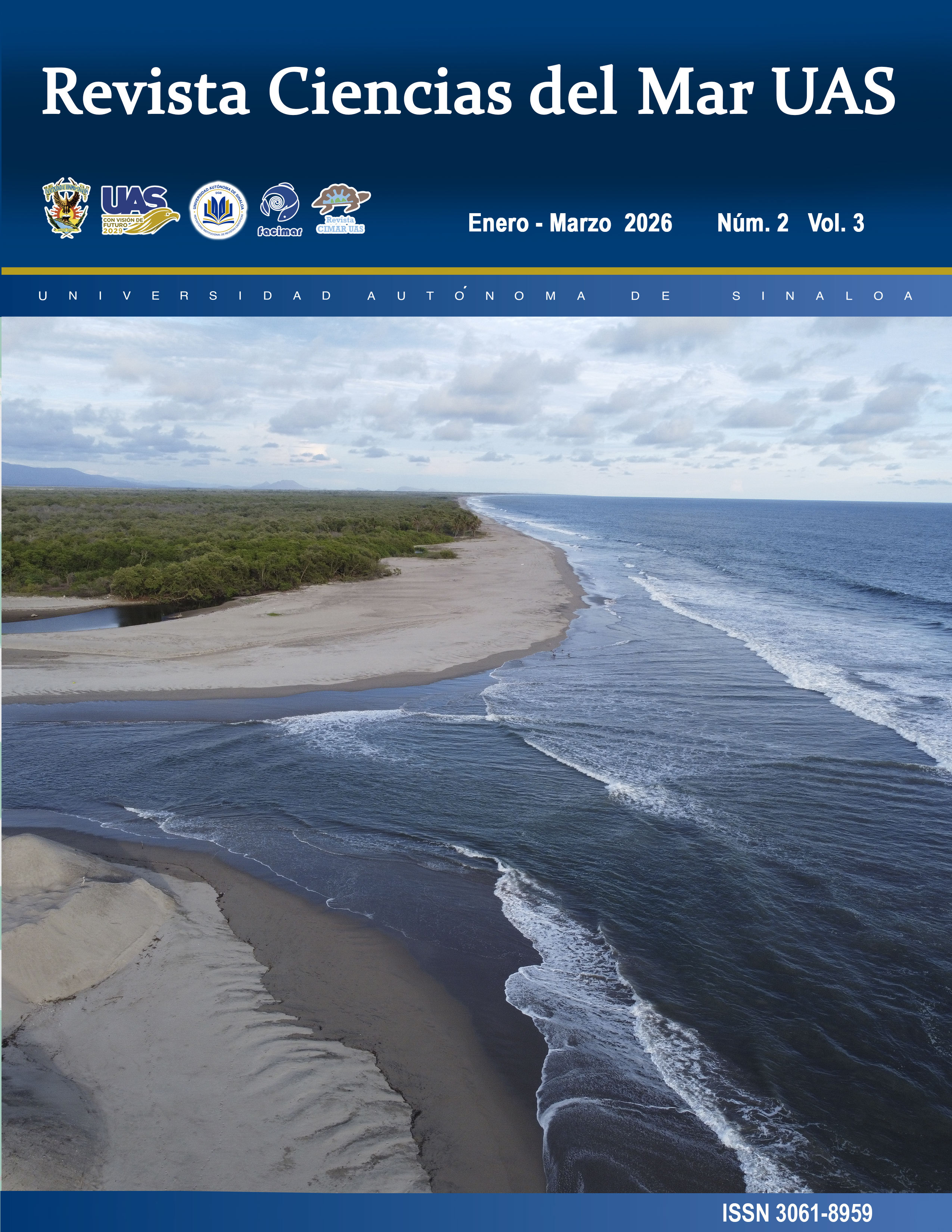
Journal Ciencias del Mar UAS
CIMAR UAS | Journal of Marine Sciences
Published by: Faculty of Marine Sciences, Autonomous University of Sinaloa, Mexico.
Editor-in-Chief: Dr. José Adán Félix Ortiz. ISSN: 3061-8959 | Rights Reservation (INDAUTOR): No. 04-2024-110712440500-102
CIMAR UAS is an international open-access scientific journal managed under the Open Journal Systems y Public Knowledge Project. platform. Our mission is to disseminate original and unpublished research within the marine and aquaculture fields.
- Frequency: Quarterly (March, June, September, and December).
- Languages: Spanish and English.
- Format: PDF.
- Indexing: Google Scholar, Latindex, ROAD Y LACLI.
- Recognized by the National System of Public Science and Technology Journals (SNPCyT) of Mexico’s Secretariat of Science, Humanities, Technology and Innovation (SECIHTI).
Focus and Scope
The objective is to publish scientific articles, notes, and reviews on:
- Fisheries Sciences and Aquaculture (marine and freshwater).
- Environmental Conservation and Biodiversity.
- Oceanography, Public Policy, and the Social Dimension of the sea.
Editorial Quality and Ethics (Plagiarism Detection)
The journal guarantees academic integrity through:
- Double-Blind Peer Review: An anonymous process that ensures impartiality and scientific rigor in every decision.
- Plagiarism Prevention: CIMAR UAS uses Turnitin software to analyze the originality of all received contributions. Manuscripts that do not meet originality standards or demonstrate redundant publication practices will be automatically rejected.
Author Information
The submission of papers is handled exclusively through this OJS system. Submission implies that the manuscript is unpublished and is not under simultaneous evaluation by another journal. Registration and login are required to begin the five-step submission process.
-
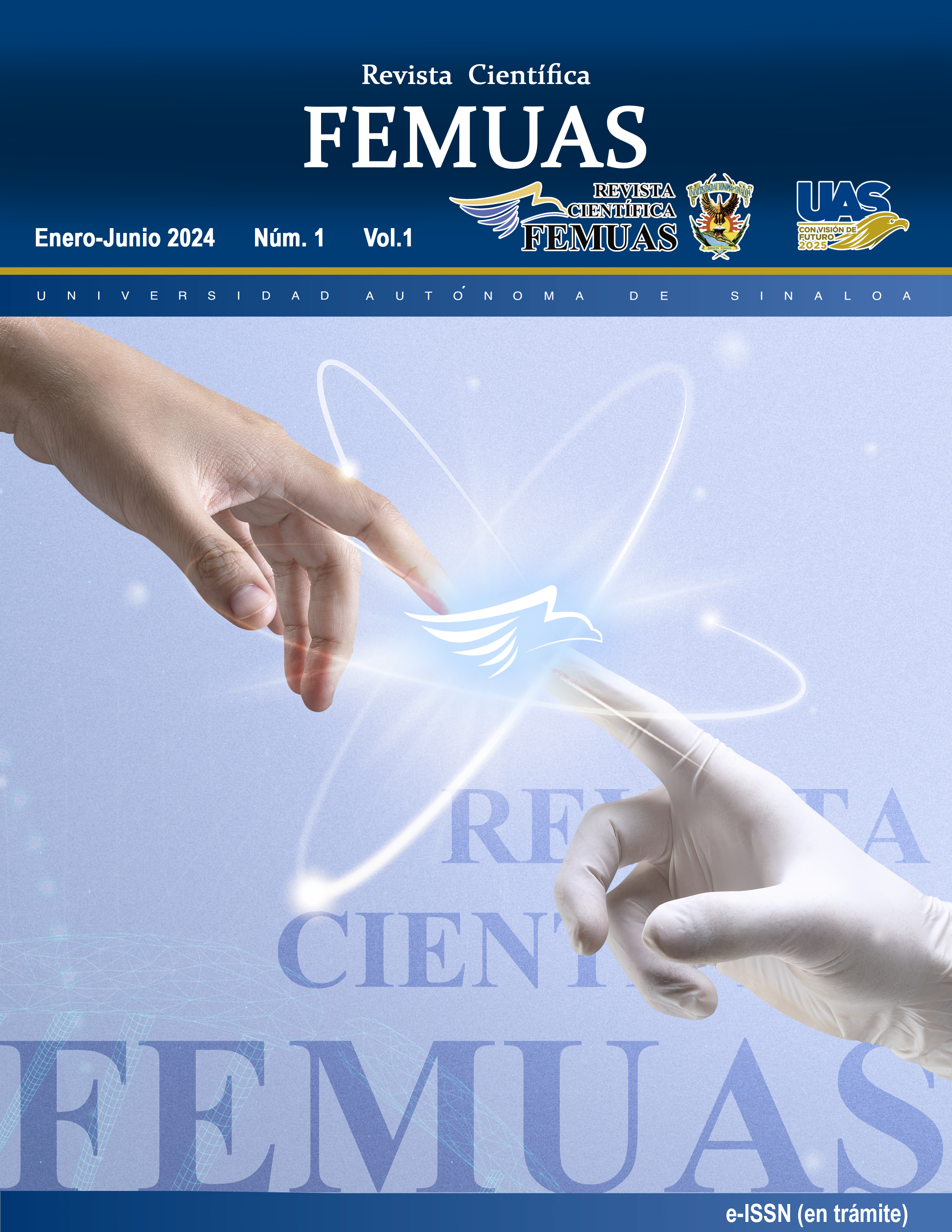
Revista Científica FEMUAS
Published by: Facultad de Enfermería Mochis
Editor-in-Chief: Dr. Gustavo Alfredo Gómez Rodríguez, Universidad Autónoma de Sinaloa, México. https://orcid.org/0000-0002-3034-5443
Description: Scientific journal
Objective: To disseminate research findings, literature reviews, and innovations for practice in nursing and related disciplines.
Thematic Scope: Covers the various fields of nursing and health sciences, including research, clinical practice, and community-based care, promoting an interdisciplinary and evidence-based approach.
Target Audience: Researchers, academics, healthcare professionals, and students interested in the generation and application of scientific knowledge.
Sections: Letter from the Editor, Original Article, Review Article, and Innovation for Practice Contribution
Publication Frequency: Semiannual (January–June and July–December).
Country: México
Focus: Encourages the active participation of students, researchers, and professionals from various disciplines to enrich the fields of health and science.
Review Criteria: Peer review (double-blind)
Access Model: Diamond Open Access (Diamond OA)
Publication fees: No charges for ASC (Article Submission Charge) or APC (Article Processing Charge).
Exclusive rights reserved: 04-2024-110614145300-102
ISSN: 3061-8967
Publication medium: Online only
Publication format: PDF
Indexed in: Latindex, LatinREV, ROAD, LACLI, Google Scholar
The FEMUAS Scientific Journal is a biannual journal published by Facultad de Enfermería Mochis, Universidad Autonoma de Sinaloa. Its primary purpose is to disseminate scientific research in nursing and related fields, with the aim of advancing knowledge, providing quality care, strengthening professional profiles, and fostering multidisciplinary collaboration.
This journal is intended for scientists, academics, professionals, and students interested in contributing as authors through letters to the editor, original articles, review articles, and innovative contributions to professional practice.
-
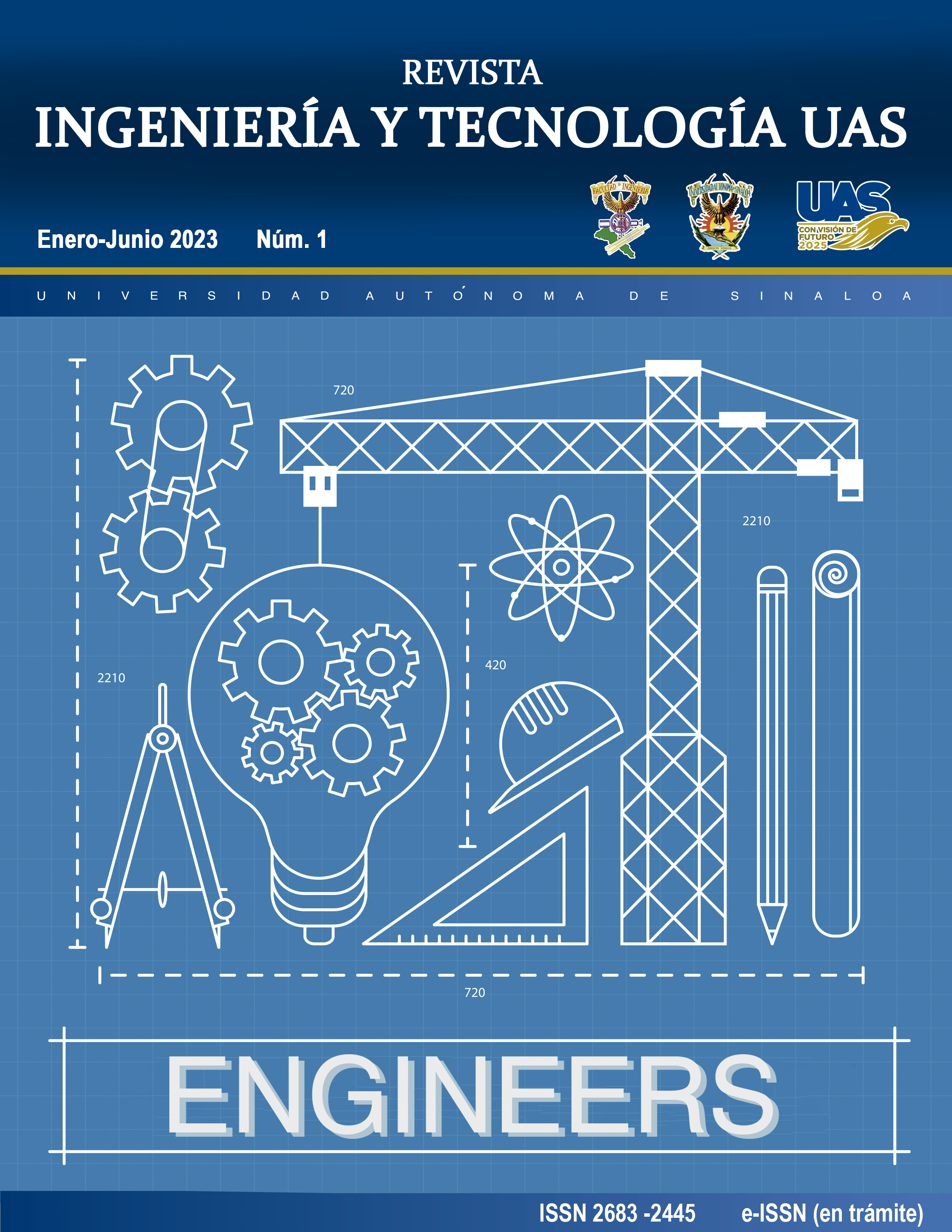
Revista Ingeniería y Tecnología UAS
Edition: Facultad de Ingeniería Culiacán
Editor-in-Chief: Dr. Edén Bojórquez Mora
Description: The Revista Ingeniería y Tecnología UAS of the Universidad Autonoma de Sinaloa (RIT-UAS) was established to disseminate findings from original research and advances in the scientific and technological fields. It primarily targets the academic community, including researchers, faculty, professionals, and students involved in various engineering and technology disciplines, such as Civil, Mechanical, Industrial, Electronics, Aerospace, Environmental, Systems, Mechatronics, Chemical Engineering, and others.
Objective: To disseminate findings from original research and advances in the scientific and technological fields.
Frequency: Biannual
Country: Mexico
Focus: Research
Review Criteria: Peer-reviewed
Format: Electronic
Exclusive Usage Rights Reserved:
e-ISSN: 2683-2445
Publication Format: PDF
Indexed In: Google Scholar, LACLI and ROAD.
-
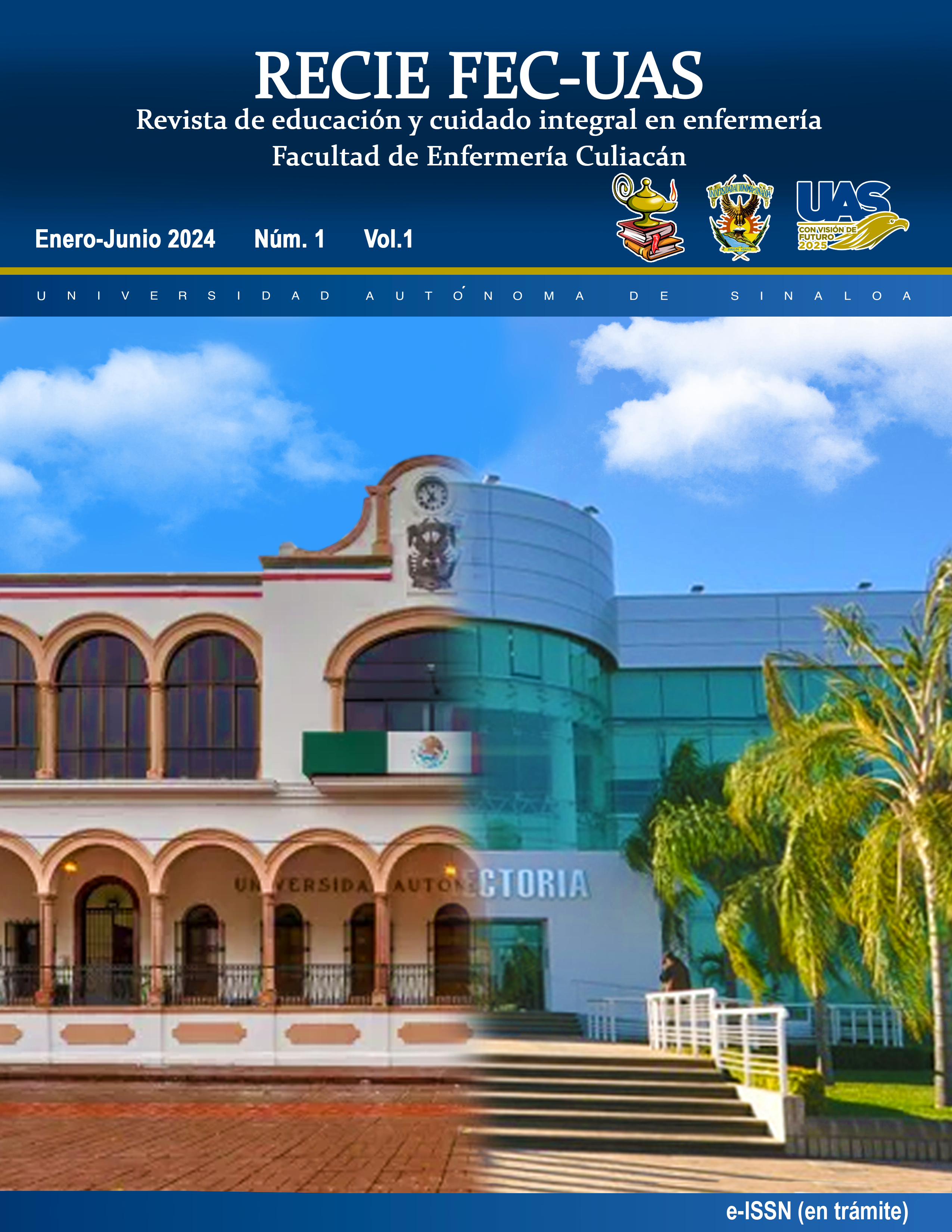
RECIE FEC-UAS Revista de educación y cuidado integral en enfermería Facultad Enfermería Culiacán
Edition: Facultad de Enfermería de Cuiacán
Editor-in-Chief: Dr. Roberto Joel Tirado Reyes
Description: Scientific journal
Objective: To disseminate scientific knowledge through the publication of research, reviews, and innovations in nursing and related sciences, promoting knowledge exchange and contributing to scientific, humanistic, and technological development.
Thematic Scope: Addresses topics related to nursing and health sciences, including research, clinical practice, education, management, innovation and technological development, as well as interdisciplinary studies that contribute to the scientific, humanistic, and social advancement of health.
Target Audience: Researchers, academics, professionals, and students interested in the generation and application of scientific knowledge.
Sections: Editorial, Original Article, Review Article, Theoretical Reflections and Essays, Clinical Cases and Nursing Processes, Research Progress, Nursing Narratives.
Frequency: Biannual Country: Mexico Focus: Promotes the participation of students, researchers, and professionals from diverse fields of knowledge, fostering the exchange of knowledge and the generation of contributions that strengthen science and the health sector.
Review Criteria: Peer review (double-blind).
Modality: Diamond Open Access
Publication Fee: No ASC (Article Submission Charge) or APC (Article Processing Charge).
Copyright Registration Number: 04-2026-050414560500-102
ISSN: 3122-4628
Publication Medium: Exclusively online Publication
Format: PDF
Indexed: Google Scholar, Latindex
RECIE FEC-UAS Revista de educación y cuidado integral en enfermería Facultad Enfermería Culiacán, is a scientific publication dedicated to disseminating scientific knowledge in nursing and related fields. Its purpose is to contribute to strengthening research, professional practice, academic training, and interdisciplinary collaboration in the health sector.
It is aimed at researchers, academics, professionals, and students interested in sharing knowledge and experiences through the publication of editorials, original articles, review articles, theoretical reflections and essays, clinical cases and nursing processes, research progress reports, and Nursing Narratives.
-
REVOUAS Revista Odontológica UAS
Publishing Institution: Facultad de Odontología
Editor-in-Chief: Dra. Violeta Isabel Quintero Salazar
Description: It is a biannual journal, published by Universidad Autónoma de Sinaloa through Facultad de Odontología, aimed at disseminating unpublished works and addressed to researchers, faculty members, undergraduate and graduate students, as well as to the national and international scientific community interested in sharing the results derived from their research, in compliance with the editorial standards established by the committee.
Objective: REVOUAS Revista Odontológica UAS is the journal of Facultad de Odontología, whose objective is to create a space for the dissemination of scientific articles based on original research in the basic, clinical, epidemiological, and educational sciences. It is an open-access scientific publication, with ISSN (pending) and reservation of rights for exclusive use (pending) before INDAutor.
Publication Frequency: Biannual
Country: Mexico
REVOUAS receives manuscripts to be reviewed by its editorial committee, which must be accompanied by the copyright transfer letter. This will allow the material to be shared, copied, and redistributed for non-commercial purposes in any medium.
Review Criteria: Double-blind peer review
Modality: Electronic
Reservation Number of Rights for Exclusive Use: 04-2025-120510213300-102
ISSN: 3122-4210
Publication Format: PDF
Indexed in: Google Scholar.
It is a biannual magazine, edited by the Autonomous University of Sinaloa through the Faculty of Dentistry, to publicize unpublished works and aimed at researchers, teachers and undergraduate and graduate students, as well as the national and international scientific community with the aim of interest in sharing the results of their research, complying with the editorial standards established by the committee.
REVOUAS Revista Odontológica UAS, receives manuscripts to be reviewed by its editorial committee, which must be accompanied by the copyright transfer letter. Which will allow you to share, copy and redistribute this material for non-commercial purposes in any medium.
-
Revista de Ciencias Económico Administrativas-UAS RECEA
Edición: Facultad de Ciencias Económico Administrativas de Mazatlán
Editor en jefe: Dr. Jesús Alberto Somoza Ríos
Descripción: Revista científica multidisciplinaria.
Objetivo: Es la difusión de investigaciones científicas inéditas nacionales e internacionales de estudiantes, docentes, investigadores y profesionales en el campo de las Ciencias Económico Administrativas, a fin de presentar resultados, propuestas y modelos alternativos emergentes, promoviendo y divulgando el pensamiento crítico plural.
Periodicidad: Semestral.
País: México
Enfoque: Fomenta la participación de estudiantes, docentes, investigadores y profesionales en el campo de las Ciencias Económico Administrativas.
Criterios de revisión: Revisión por pares (Doble ciego).
Modalidad: Acceso Abierto
Reserva de derechos al uso exclusivo: En trámite
ISSN: En trámite
Formato de publicación: PDF
Indexada: Google Scholar y Latindex
La Revista de Ciencias Económico Administrativas-UAS RECEA, es una revista de acceso abierto cuyo objetivo es la difusión de investigaciones científicas inéditas nacionales e internacionales de estudiantes, docentes, investigadores y profesionales en el campo de las Ciencias Económico Administrativas, a fin de presentar resultados, propuestas y modelos alternativos emergentes, promoviendo y divulgando el pensamiento crítico plural.
La revista RECEA UAS es de publicación semestral, utiliza el sistema de revisión por pares doble ciego y es administrada con Open Journal Systems (OJS); su edición corresponde a la Facultad de Ciencias Económico Administrativas de Mazatlán (FACEAM), perteneciente a la Universidad Autónoma de Sinaloa (UAS), México.
-
CIENCIA Y UNIVERSIDAD
Edition: Faculty of Economic and Social Sciences
Editor-in-chief: Maria Valeria Garcia Verdugo, M.Sc.
Description: Scientific Publication
Objective: Disseminate scientific research in the area of social sciences, guaranteeing quality and scientific rigor.
Frequency: Semi-annual
Country: Mexico
Focus: Promotes and drives economic and social science research, through the active participation of students, researchers and professionals.
Review Criteria: Peer Review (Double Blind)
Modality: Open Access
Reservation of rights to exclusive use: In process
ISSN: In process
Publication format: PDF
Indexed: Latindex and Google Scholar
CIENCIA Y UNIVERSIDAD is a biannual scientific publication, aimed at researchers, teachers and members of the scientific community interested in the subject of the magazine.
-
ARENAS Revista Sinaloense de Ciencias Sociales
Edición: Facultad de Ciencias Sociales Mazatlán.
Editor en jefe: Dr. Roberto Carlos López López.
Descripción: Revista científica de Ciencias Sociales.
Objetivo: Difundir y divulgar el conocimiento.
Periodicidad: Semestral.
País: México.
Enfoque: Académico-científico de investigadores, estudiantes y profesionales en el área de las Ciencias Sociales y las Humanidades.
Criterios de revisión: Revisión por pares (Doble ciego).
Modalidad: Acceso Abierto.
Reserva de derechos al uso exclusivo: En trámite.
ISSN: En trámite.
Formato de publicación: PDF.
Indexada: No.
Descripción de la revista: ARENAS Revista Sinaloense de Ciencias Sociales es una publicación científica editada por la Facultad de Ciencias Sociales Mazatlán de la Universidad Autónoma de Sinaloa. Y acepta artículos científicos, ensayos científicos, y reseñas de libros, del área de las Ciencias Sociales. Es una publicación semestral, de acceso abierto y gratuita.
En esta Tercera Época de la revista, se publica de manera digital y administrada con Open Journal Systems (OJS, por sus siglas en inglés, que es Sistemas de Revistas Abiertas), y por Diamond Open Access (DOA, por sus siglas en inglés, y que significa Acceso Abierto Diamante, de la UNESCO), y cuya revisión es por pares a doble ciego. Es decir, los nombres de los autores y coautores no son revelados a los revisores y los nombres de revisores no son compartidos a los autores. Se busca con este tipo de revisión, disminuir los sesgos y eliminar los prejuicios de la recepción y de la evaluación.
-
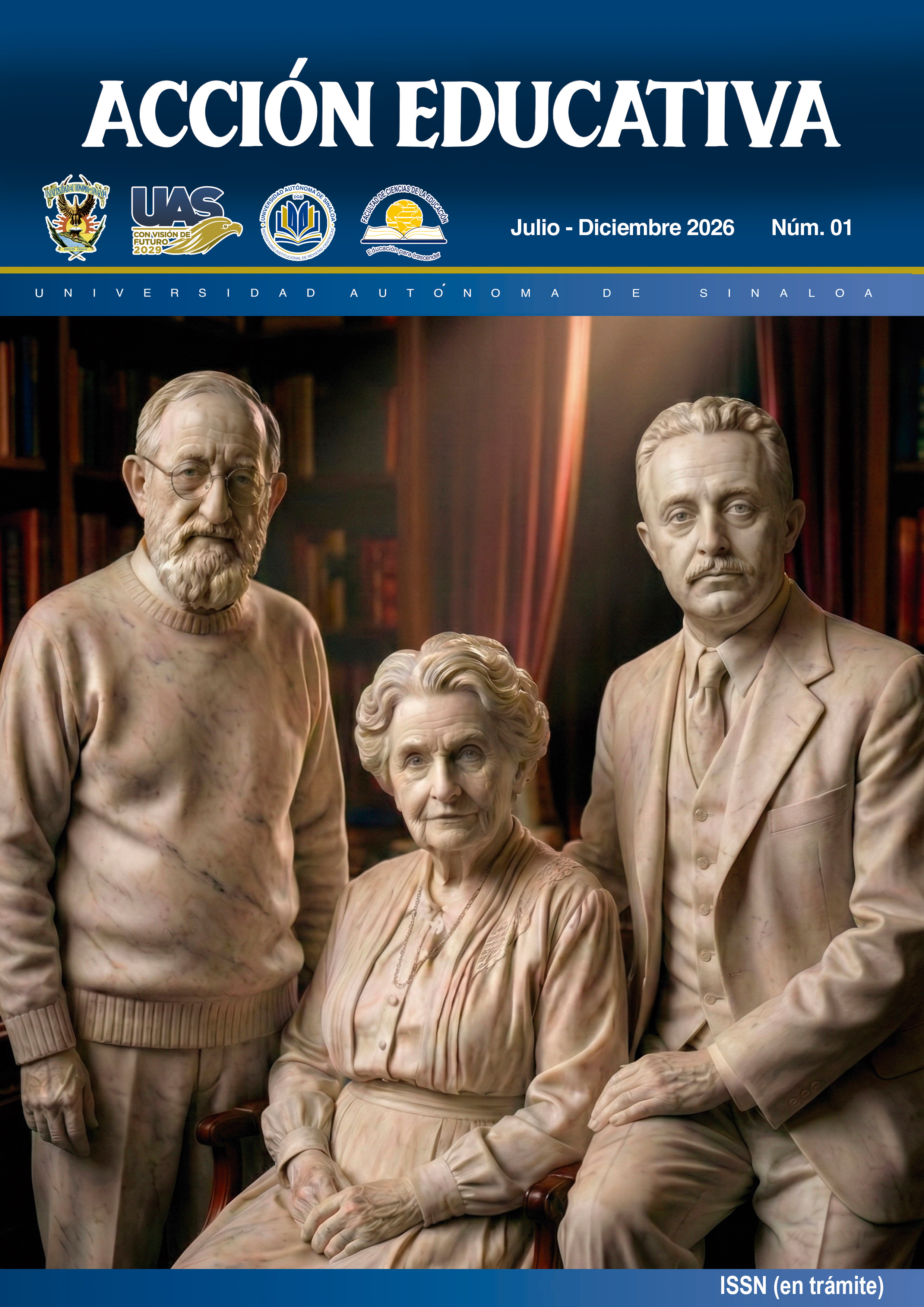
Acción Educativa
Edition: Faculty of Education Sciences
Editor-in-Chief: Dr. Jorge Basilio Rodríguez López
Description: ACCIÓN EDUCATIVA is a biannual academic publication of the Faculty of Education Sciences at the Autonomous University of Sinaloa (UAS). Its main objective is to serve as a plural space for the dissemination and outreach of diverse theoretical perspectives and methodologies in the field of educational research.
Objective: To disseminate and share advancements in education and serve as a bridge connecting authors and readers.
Frequency: Biannual
Country: Mexico
Focus: Educational Research. It encourages the participation of students, researchers, and education professionals.
Review Criteria: Peer review (Double-blind)
Format: Open access online
Reservation of exclusive use rights: Pending
ISSN: Pending
Publication format: PDF
Indexed: Pending.
-
Psico-Logos
Edición: Facultad de Psicología
Editor en jefe: Dra. Marisol Martínez Miramontes
Objetivo: Dar un espacio de divulgación y difusión de investigaciones en el área de la psicología, donde se aborden problemáticas actuales y emergentes.
Periodicidad: Semestral.
País: México
Criterios de revisión: Revisión por pares (Doble ciego)
Modalidad: Acceso Abierto
Reserva de derechos al uso exclusivo: En trámite
ISSN: En trámite
Formato de publicación: PDF
Indexada: En trámite
La Revista Psico-Logos surge como un espacio para promover y difundir la investigación en el campo de la Psicología, a través de la publicación de artículos empíricos, teóricos, de revisión, de revisión, de estudios de casos, reseñas, entre otros.
Está dirigida a estudiantes, profesionales de la psicología y sectores públicos y privados en general que tengan interés en la ciencia psicológica.
En esta revista se abordarán los distintos temas relacionados con la psicología y sectores públicos y privados que tengan interés en las ciencias psicológicas. Se abordaran los distintos temas relacionados con la psicología como bienestar psicológico, calidad de vida, infancias, envejecimiento, procesos psicosociales, abordando problemáticas actuales y emergentes.
Psico-Logos buscar ser un espacio de reflexión y critica para promover la generación de conocimiento alto grado de implicación social.
El contenido de los artículos es responsabilidad de los autores y no compromete la opinión de los editores. Las contribuciones que se presentan para su publicación serán de carácter académico y se ajustarán a los lineamientos de la Revista.
-
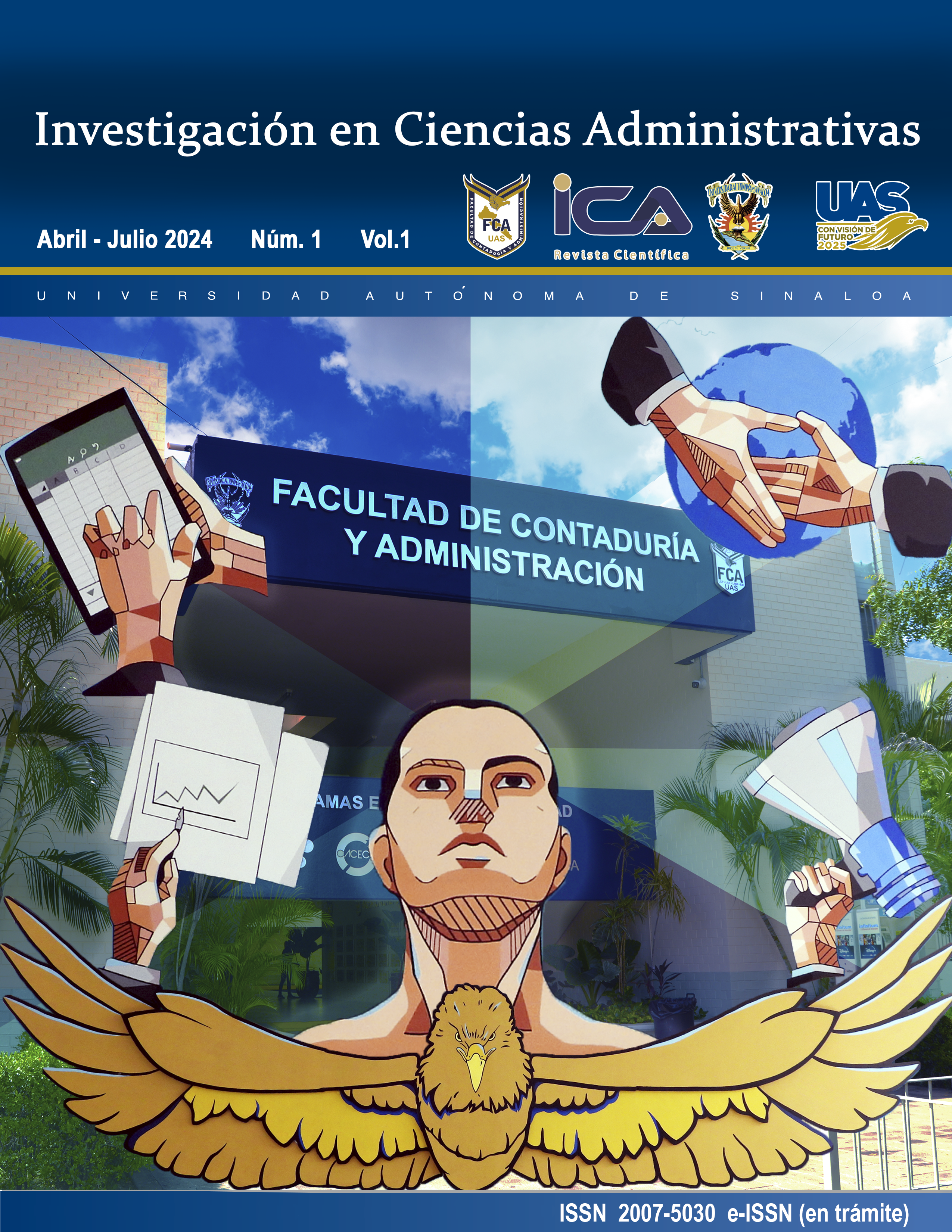
Research in Administrative Sciences
Research in Administrative Sciences
Publisher: Faculty of Accounting and Administration
Editor-in-Chief: Dr. Gregorio Guzman Lares
C
Description: Scientific journal
Frequency: Biannual
Country: Mexico
Review Criteria: Peer review (Double-blind)
Modality: Open Access
Reservation of rights for exclusive use: Pending
ISSN: Pending
Publication Format: PDF
Indexed: Pending
The Research in Administrative Sciences (ICA) Journal was founded in 2011. It is peer-reviewed and published biannually on March 30 and September 30 of each year. It is open access online and is aimed at researchers, academics, and scholars who contribute to the development of the broad and diverse field of social issues.
The journal ICA addresses topics related to the social sciences in general and their specific areas (political theory, sociological theory, political communication, political economy, public opinion, public management and policy, fiscal studies, and international relations, among others). As a platform for scientific production in the social sciences, it is committed to theoretical, methodological, and epistemological pluralism. Therefore, it adheres to the methodology recommended by indexing systems such as Redalyc (https://www.redalyc.org/) to continuously improve and become a journal of high scientific and editorial quality in the region, highlighting its essential qualities as a multiplier of the generation and communication of new, articulated, and integrated disciplinary knowledge, in accordance with the current epistemological, scientific-technological, and communicational (re)evolution.
-
RIIBIOS-UAS Revista en Investigación e Innovación en Biociencias y Salud Global
Edition: Faculty of Biology
Editor-in-Chief: Dr. Indira Rojo Báez
Description: To promote and spread interdisciplinary and collaborative research in the field of biosciences and global health, with a focus on the One Health perspective. This approach recognizes the interconnection between environmental health, human health, and animal health. The journal focuses on the analysis and characterization of biomolecules and the identification of potentially pathogenic microorganisms, thus contributing to the understanding and prevention of infectious diseases. Additionally, the journal seeks to boost research and educational intervention in health, aiming to improve the health and well-being of communities worldwide. Through these lines of knowledge generation and application, the journal aspires to be a platform for innovation and advancement in the field of global health.
Objective: Encourage scientific research in biosciences and global health. Facilitate interdisciplinary collaboration among researchers. Promote the One Health perspective. Contribute to advances in the prevention and treatment of infectious diseases.
Frequency: Ongoing
Country: Mexico
Focus: Encourage the participation of researchers, students, and professionals from various fields. Molecular and cellular biology, Epidemiology and public health, Phytopathology, Microbiology and virology, Veterinary medicine and zoonoses, Innovation in medical technologies, Health sciences education.
Review criteria: Peer review (Double-blind)
Articles must be original and not previously published.
Citation and formatting rules of the journal must be followed.
Authors must declare any potential conflicts of interest.
Mode: Open access
Exclusive usage rights: In process
ISSN: In process
Publication format: PDF and HTML
Indexed: Not applicable
-
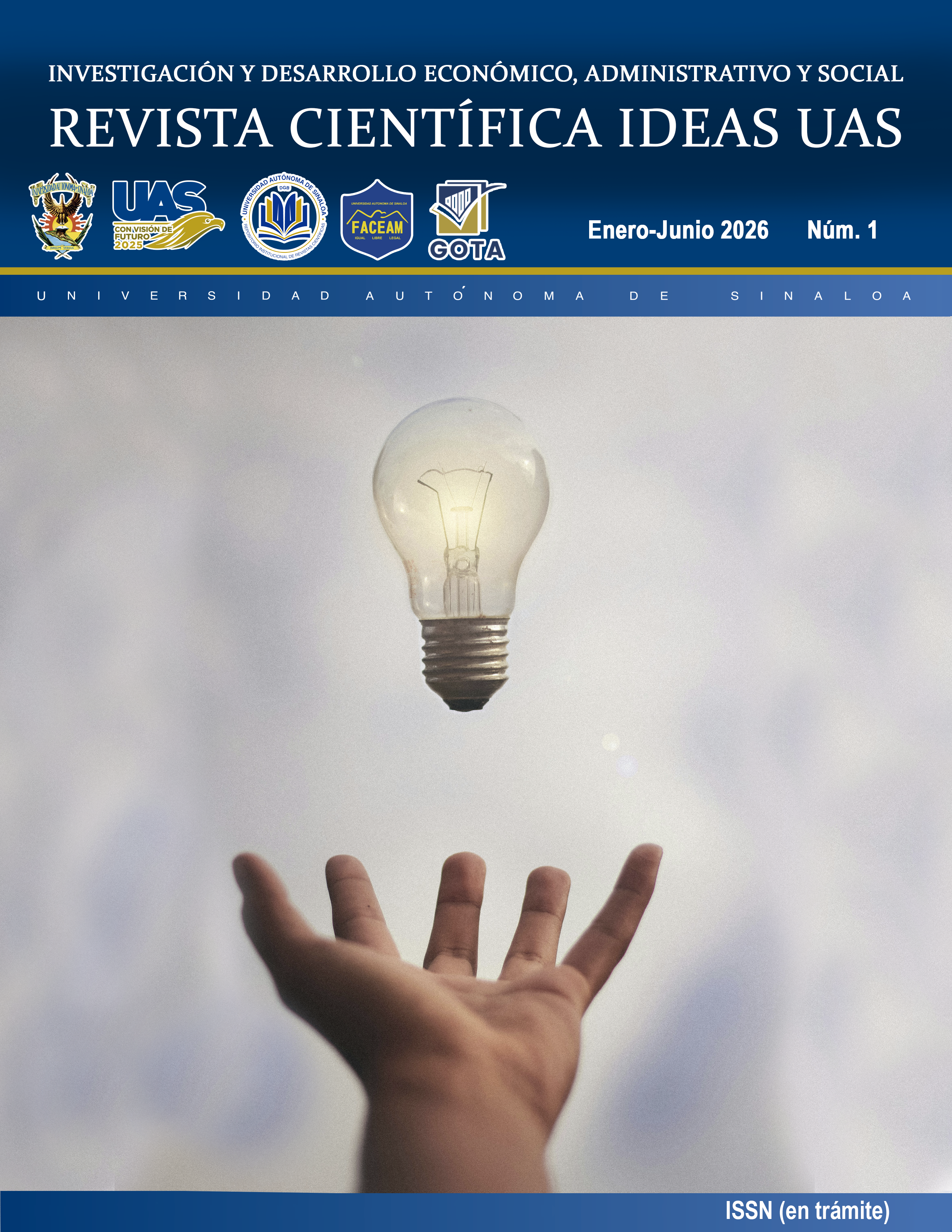
Revista Científica IDEAS UAS
About the Journal
Revista Científica IDEAS UAS
Publisher: Faculty of Economic and Administrative Sciences of Mazatlán
Editor-in-Chief: Dr. Andrés Ultreras Rodríguez
Description:
Revista Científica IDEAS UAS, promoted by the Academic Body “Organizational Management and Administrative Trends” (GOTA, UAS-CA-340) of the Faculty of Economic and Administrative Sciences of Mazatlán (FACEAM), Autonomous University of Sinaloa. Its purpose is to serve as an editorial platform for the dissemination of research findings, analyses, and proposals related to administration and organizational management, management systems, and their relationship with the economic and social environment.The journal receives contributions in the fields of Administration, Accounting, Finance, Economics, Tourism, Business, and related areas, aligned with the Academic Body’s Line of Generation and Application of Knowledge (LGAC): “Business management and trends in economic sectors within organizations,” as well as with the research lines developed by its members:
- Management of administrative, economic, and accounting projects;
- Knowledge generation and management in organizations, tourism, and economic sectors;
- Management of administrative and marketing projects, and analysis of marketing trends.
Revista Científica IDEAS UAS encourages submissions employing quantitative, qualitative, and mixed-method approaches, as well as applied, comparative, and organizational innovation studies, prioritizing originality, social relevance, and methodological rigor.
Objective:
The Scientific Journal Research and Development in Economic, Administrative, and Social Studies (IDEAS UAS) aims to disseminate original, relevant, and methodologically rigorous scientific knowledge that contributes to the understanding, improvement, and innovation of organizational management and trends in economic sectors, integrating perspectives from the economic-administrative and social sciences. It seeks to provide evidence and applicable proposals to support decision-making in public, private, and social organizations, considering their interaction with internal and external factors.Publication Frequency: Semiannual, Continuous Publication
Country: Mexico
Focus: Economic, Administrative, and Social Sciences
Peer Review Process: Double-Blind Peer Review
Publication Mode: Continuous publication
Copyright and Exclusive Use Rights: Pending
ISSN: Pending
Publication Format: PDF
Indexed in: Pending
-
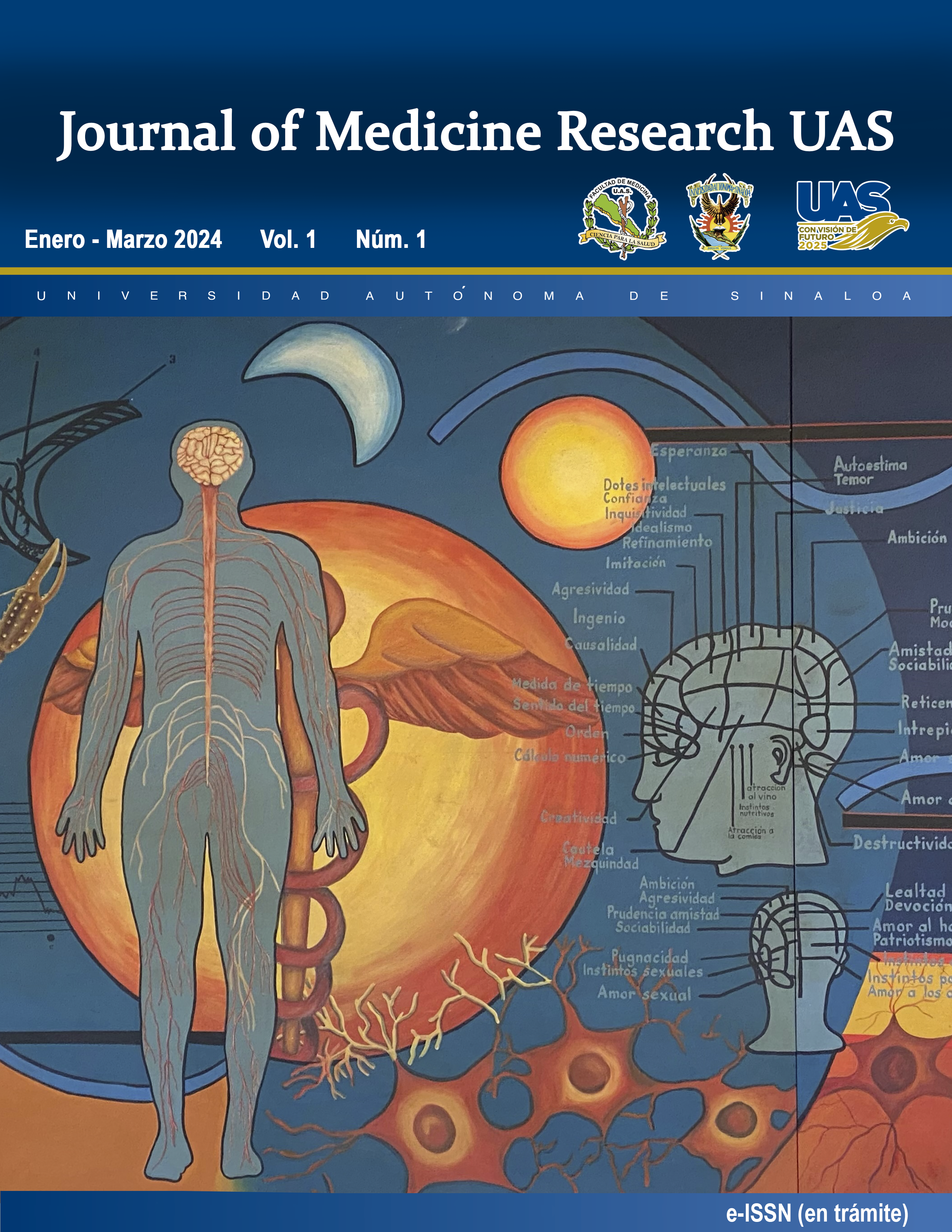
UAS Journal of Medicine Research
UAS JOURNAL OF MEDICINE RESEARCH is the first health research journal of the Faculty of Medicine of the Autonomous University of Sinaloa (FMUAS) and is edited by the Postgraduate Coordination. It is an open-access online scientific journal that publishes original, unpublished research from the entire medical and scientific community interested in the various fields of medicine, from clinical practice to molecular or translational medicine.
We aim to publish original and relevant research on current topics for the local and international scientific community that provides new knowledge. Also, it will be considered content of interest to our region developed by the university community in training, which has been applied to our population. The vision of the UAS Journal of Medicine Research is to be a reference and the best journal in the northwest of the country in useful scientific publications in the medical and biomedical areas.
We are convinced of the importance of the dissemination of science in the development of our region, and that is why we intend to be an editorial group close and committed to the medical community. As an objective, we will contribute to the development of any research group emerging or consolidated, providing the inclusion of competent scientists and ethical values in the peer review of the articles received. In addition, we offer a review service and fast and efficient publication that includes global indexing of published articles for more significant impact and scope. Authors and national and international readers can read or download immediately from our web platform free of charge.
-
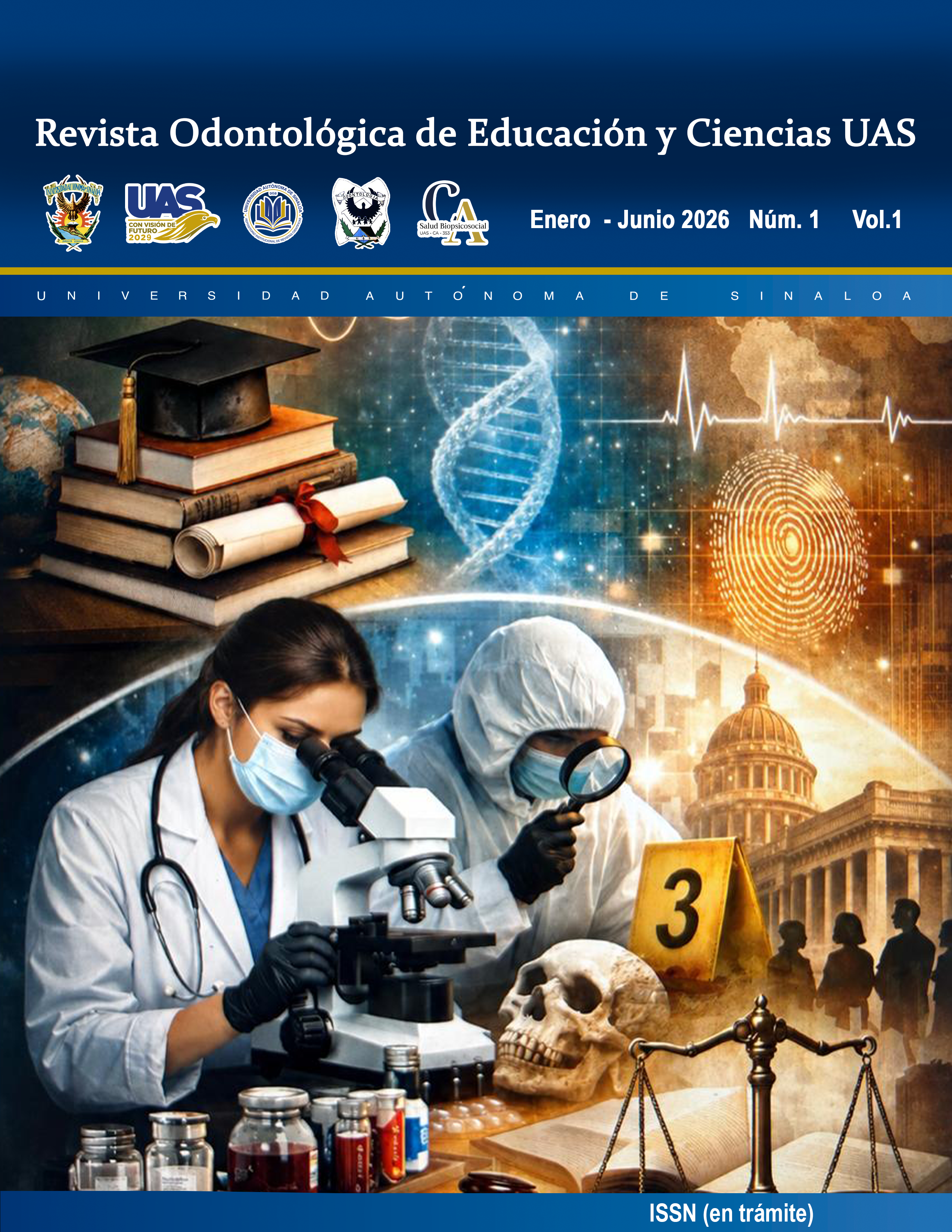
Revista Odontológica de Educación y Ciencias UAS
Journal Name: UAS Journal of Dental Education and Sciences
Abbreviated Title: REVOECI-UAS
Published by: UAS-CA-353 Biopsychosocial Health Academic Group, School of Dentistry
Editor-in-Chief: Dr. Enedina Duarte Quintero
Description: The UAS Journal of Dental Education and Sciences is a peer-reviewed, scientific, multidisciplinary publication promoted by the UAS-CA-353 Biopsychosocial Health Academic Group of the School of Dentistry at the Autonomous University of Sinaloa. Its mission is to provide a platform for the dissemination of scientific knowledge among academics, researchers, professionals, and undergraduate and graduate students, thereby strengthening and promoting the production, circulation, and transfer of knowledge.
The journal publishes manuscripts presenting original and relevant findings in basic science, clinical science, education, systematic reviews, and epidemiological studies within the fields of dentistry, education, and forensic sciences. It has scientific and editorial committees composed of researchers with extensive experience in their respective areas of expertise.
Objective: To provide a platform for the publication and dissemination of scientific and humanistic research conducted regionally, nationally, and internationally.
Subject Areas: Dentistry, education, and forensic sciences.
Publication Frequency: Semiannual (January-June / July-December)
Country: Mexico
Focus: Scientific
Publication Fees: No Article Submission Charges (ASCs) or Article Processing Charges (APCs).
Peer-Review Process: Double-blind peer review.
Access Model: Diamond Open Access (Diamond OA).
Exclusive Rights Registration: Pending.
ISSN: Pending.
Publication Format: PDF
Indexing: Pending.
-
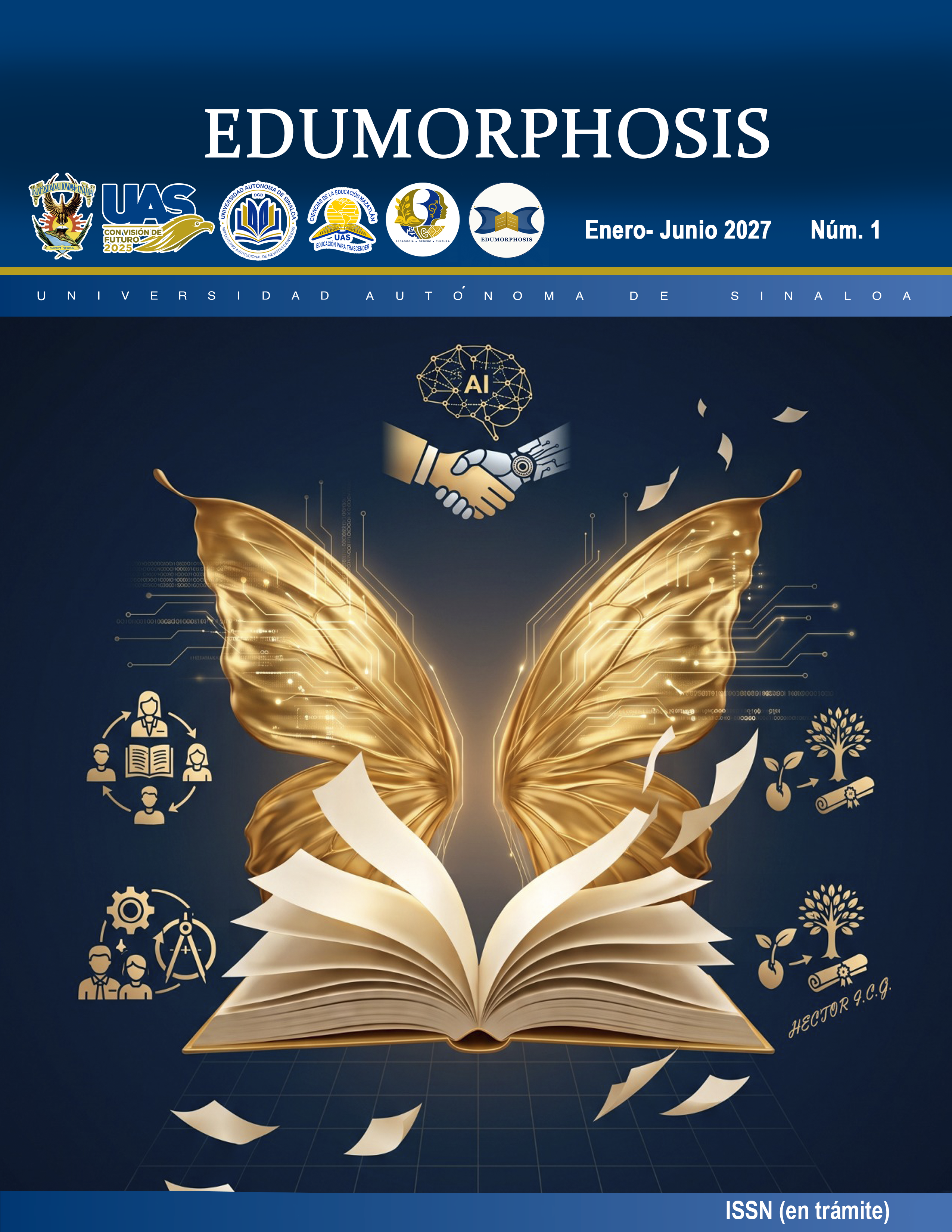
EDUMORPHOSIS
Nombre de la revista: EDUMORPHOSIS
Edición: Unidad Académica de Ciencias de la Educación Mazatlán
Editor en jefe: Flérida Moreno Alcaraz
Descripción:
EDUMORPHOSIS es una revista científica semestral de la Unidad Académica de Ciencias de la Educación Mazatlán, de la Universidad Autónoma de Sinaloa. Su objetivo principal es promover el conocimiento de las investigaciones educativas en el campo de las Ciencias de la Educación, a partir de estudios cualitativos, cuantitativos y mixtos, fortaleciendo el vínculo entre la investigación y su aplicación en contextos educativos reales.
Objetivo: Contribuir al avance del conocimiento en el campo de las Ciencias de la Educación mediante la publicación de artículos originales, reflexiones y reseñas críticas que analizan y problematiza los fenómenos educativos desde perspectivas cualitativas, cuantitativas y mixtas.
Periodicidad: Semestral
País: México
Enfoque: Investigación educativa en el campo de las Ciencias de la Educación. Fomenta la publicación de contribuciones originales —artículos de investigación, reflexiones y reseñas críticas— que representen un aporte al debate y al conocimiento académico sobre los fenómenos educativos, con la participación de estudiantes, investigadores y profesionales de la educación.
Criterios de revisión: Revisión por pares (doble ciego)
Modalidad: Acceso Abierto Diamante (Diamond OA)
Reserva de derechos al uso exclusivo: En trámite
ISSN: En trámite
Formato de publicación: Electrónica (HTML/PDF)
Indexada: En trámite