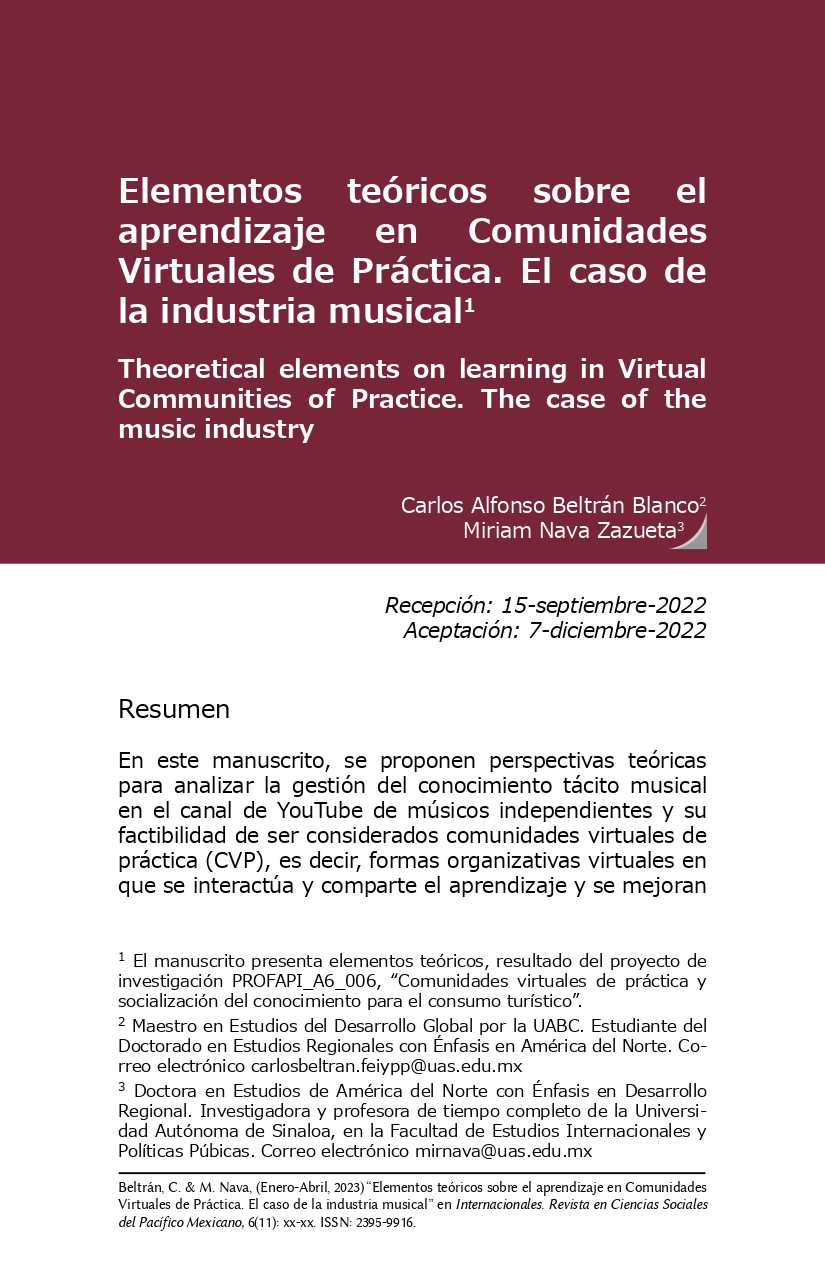
Theoretical Elements of Learning in Virtual Communities of Practice: The Case of the Music Industry
Theoretical Elements on Learning in Virtual Communities of Practice. The Case of the Music Industry
Keywords:
Learning Virtual Communities, Music industri, SinaloaAbstract
This paper explains the theoretical framework analyze the management of musical tacit knowledge in independent musicians’ YouTube channels, describes how they operate, and explores whether they could be regarded as virtual communities of practice (VCoPs), or virtual organizational forms, where learning derived from the paths and experiences of community members and the improvement of practices within their areas of specialization. This theoretical treatise is presented in three steps. First, this paper provides an overview of knowledge management in community of practice (CoP). Then, we review theoretical and empirical works to determine the core components of communities of practice and virtual communities of practice. Finally, virtual communities in social neetworks are discussed after the CoP has been conceptualized, allowing conclusions to be drawn about the examination
of musical learning in YouTube’s VCoPs.
Downloads
References
Alavi, S. (2013). Collaborative customer relationship management-co-creation and collaboration through online communities. International Journal of Virtual Communities and Social Networking, 5(1):1–18.
Allen, S.; Ure, D. & S. Evans. (2003). Virtual communities of practice as learning networks. Executive summary. Provo, UT: Brigham Young University Instructional Psychology and Technology.
Amin, A. & J. Roberts. (2008). Knowing in action: Beyond communities of practice. Research policy, 37(2):353-369 [En línea] Disponible en: https://doi.org/10.1016/j.respol.2007.11.003
Bolisani, E. & E. Scarso. (2014). “The place of communities of practice in knowledge management studies: a critical review”, Journal of Knowledge Management, 18 (2): 366-381 [En línea] Disponible en: https://doi.org/10.1108/JKM-07-2013-0277
Burgess, J. & J. Green. (2009). YouTube: Online video and participatory culture, Cambridge, UK: Polity Press. [En línea] Disponible en: https://www.amazon.com.mx/dp/0745644791 /?coliid=INJJ9G2B5VTI2&colid=VFAJCSRHDD5E&psc=1&ref_= lv_ov_lig_dp_it
Cayari, C. (2011). “The YouTube Effect: How YouTube Has Provided New Ways to Consume, Create, and Share Music” en International Journal of Education & the Arts, 12(6) [En línea] Disponible en: http://www.ijea.org/v12n6/
_______. (2015). Participatory culture and informal music learning through video creation in the curriculum. International Journal of Community Music, 8(1): 41-57 [En línea] Disponible en: DOI: https://doi.org/10.1386/ijcm.8.1.41_1
_______. (2017). “Connecting music education and virtual performance practices from YouTube” en Music Education Research, 20(3): 360-376 [En línea] Disponible en: https://doi. org/10.1080/14613808.2017.1383374
Chiu, C. M.; Hsu, M. H. & E. T. Wang. (2006). “Understanding knowledge sharing in virtual communities: An integration of social capital and social cognitive theories” en Decision support systems, 42(3): 1872-1888 [En línea] Disponible en: https:// doi.org/10.1016/j.dss.2006.04.001
Dalkir, K. (2013). “What Is Knowledge Management?” en
Knowledge management in theory and practice. Routledge.
[En línea] Disponible en: https://www.routledge.com/ Knowledge-Management-in-Theory-and-Practice/Dalkir/p/ book/9780750678643#
Dube, L.; Bourhis, A. & R. Jacob. (2006). Toward a typology of virtual community of practice. Inter- disciplinary Journal of Information, Knowledge and Management, [En línea] Disponible en: https://doi.org/10.28945/115
Fitzgerald, B. (2006). The transformation of open source software. MIS quarterly [En línea] 587-598 [En línea] Disponible en: https://doi.org/10.2307/25148740
Fontaine, M. A. & D. R. Millen. (2004). “Understanding the benefits and impact of communities of practice” en Knowledge networks: Innovation through communities of practice, pp. 1-13, IGI Global [En línea] Disponible en: Doi: 10.4018/978-1-59140- 200-8.ch001
Froehlich, H. (2009). Music Education and Community: Reflections On. Action, Criticism, and Theory for Music Education, 8(1):85-107.
Gilbert, S. (2016). Learning in a Twitter-based community of practice: an exploration of knowledge exchange as a motivation for participation in# hcsmca. Information, Communication & Society, 19(9): 214-1232 [En línea] Disponible en: https://doi.or g/10.1080/1369118X.2016.1186715
Gruenhagen, L. M. (2008). Investigating professional development: Early childhood music teacher learning in a community of practice. University of Rochester, Eastman School of Music [En línea] Disponible en: http://hdl.handle.net/1802/5630
Hartnell-Young, E. (2006). “Roles de los maestros y aprendizaje profesional en comunidades de práctica apoyadas por la tecnología en las escuelas” en Revista de tecnología y formación docente, 14(3): 461-480.
Hine, C. (2017). “Ethnographies of Online Communities and Social Media: Modes, Varieties, Affordances” en The SAGE Handbook of Online Research Methods, edited by Nigel G. Fielding, Raymond M. Lee, and Grant Blank. Los Angeles: SAGE Publications
Iverson, J. O. & R. D. McPhee. (2002). “Knowledge management in communities of practice: Being true to the communicative character of knowledge” en Management Communication Quarterly, 16(2): 259-266. Doi: 10.1177/089331802237239
Joseph, D. & L. Lennox. (2021). “Twists, turns and thrills during COVID-19: music teaching and practice in Australia en Music Education Research, 23(2): 241-255 [En línea] Disponible en: https://doi.org/10.1080/14613808.2021.1906852
Kimble, C.; Hildreth, P. & P. Wright. (2001). “Communities of practice: going virtual” en Knowledge management and business model innovation, pp. 216-230. IGI Global. Doi: 10.4018/978-1- 878289-98-8.ch013
Komorowski, M.; Do Huu, T. & N. Deligiannis. (2018). “Twitter data analysis for studying communities of practice in the media industry” en Telematics and Informatics, 35(1): 195-212 [En línea] Disponible en: https://doi.org/10.1016/j.tele.2017.11.001
Kozinets, R. V.. (2002). “The field behind the screen: Using netnography for marketing research in online communities” en Journal of marketing research, 39(1): 61-72 [En línea] Disponible en: https://doi.org/10.1509/jmkr.39.1.61.18935
Lave, J. & E. Wenger. (1991). Situated learning: legitimate peripheral participation (Learnign in Doing: social, Congnitive and Computational Perspectices). Cambridge: Cambridge University Press. Doi:10.1017/CBO9780511815355
Leimeister, J. M. & B. Rajagopalan. (2015). “Virtual Communities: An Introduction” en Virtual Communities: 2014, pp. 17-28, Routledge [En línea] Disponible en: https://doi. org/10.4324/9781315698359
Licklider, J. C. R. (1968). “The Computer as a Communication Device” en Science and Technology. Reprinted in. In Memoriam: J.C.R. Licklider. Systems Research Center.
Nie, H. (2012). “Harmonious management pattern of knowledge management” en Management Science and Engineering, 6(4):42–46.
Partti, H. & S. Karlsen. (2010). “Reconceptualising musical learning: New media, identity and community in music education” en Music Education Research [En línea] 12(4), 369-382 [En línea] Disponible en: https://doi.org/10.1080/14613808.2010.519381
Preece, J. (2000). Online Communities: Designing Usability, Supporting Sociability. Chichester, UK: John Wiley & Sons. [En línea] Disponible en: https://doi.org/10.1108/imds.2000.100.9.459.3
Prensky, M. (2006). Don’t bother me, mom, I’m learning!: How computer and video games are preparing your kids for 21st century success and how you can help! St. Paul, MN Paragon House. [En línea] Disponible en: https://www.uoc.edu/ uocpapers/5/dt/eng/prensky.html
Ramalho, A. M.; Paulos, A. & A. Mesquita. (2010). “Virtual communities of practice: Investigating motivations and constraints in the processes of knowledge creation and transfer” en Electronic Journal of Knowledge Management, 8(1): 11–20.
Rheingold, H. (1993). The Virtual Community: Homesteading on the Electronic Frontier. Reading, MA: Addison Wesley. [En línea] Disponible en: https://doi.org/10.16997/wpcc.206
Rodríguez, J.L. (2007). How virtual communities of practice and learning communities can change our vision of education. Sísifo Educational Sciences Journal Educational Sciences R & D Unit of the University of Lisbon.
Salavuo, M. (2008). “Social media as an opportunity for pedagogical change in music education” en Journal of Music, Technology & Education, 1(2-3): 121-136 [En línea] Disponible en: https://doi.org/10.1386/jmte.1.2and3.121_1
Sibbald, S. L. et al. (2022). “Building a virtual community of practice: experience from the Canadian foundation for healthcare improvement’s policy circle” en Health research policy and systems, 20(1): 1-11.
Sloan, L. & A. Quan-Haase (Eds.). (2017). The SAGE handbook of social media research methods. Sage. [En línea] Disponible en: https://doi.org/10.1002/asi.23957
Thomas, A. (2005). Children online: Learning in a virtual community of practice. E-learning, 2(1): 27-38 [En línea] Disponible en: https://doi.org/10.2304/elea.2005.2.1.27
Ünlüsoy, A.; Leander, K. M. & M. Haan. (2022). Rethinking sociocultural notions of learning in the digital era: Understanding the affordances of networked platforms. E-Learning and Digital Media, 19(1), 78-92 [En línea] Disponible en: https://doi. org/10.1177/20427530211032302
Waldron, J. (2009). “Exploring a Virtual Music Community of Practice: Informal Music Learning on the Internet” en Journal of Music, Technology and Education, 2 (2–3): 97–112, [En línea] Disponible en: https://doi.org/10.1386/jmte.2.2-3.97_1
_________. (2012). “Conceptual frameworks, theoretical models and the role of YouTube: Investigating informal music learning and teaching in online music community” en Journal of Music, Technology & Education, 4(2-3): 189-200 [En línea] Disponible en: https://doi.org/10.1386/jmte.4.2-3.189_1
Waldron, J. (2016). “An Alternative Model of Music Learning and ‘Last Night’s Fun2’: Participatory Music Making in/as Participatory Culture in Irish Traditional Music” en Action, Criticism, and Theory for Music Education 15:3.
Wenger, E. (1998). Communities of Practice: Learning, Meaning, and Identity (Learning in Doing: Social, Cognitive and Computational Perspectives). Cambridge University Press, [En línea] Disponible en: https://doi.org/10.1017/ CBO9780511803932
_________. (2011). Communities of practice: A brief introduction. 126
Beltrán, C. & M. Nava, (Enero-Abril, 2023) “Elementos teóricos sobre el aprendizaje en Comunidades Virtuales de Práctica. El caso de la industria musical” en Internacionales. Revista en Ciencias Sociales del Pacífico Mexicano, 6(11): 98-127. ISSN: 2395-9916.
_________. (2015). Comunidades de práctica: Una breve introducción [En línea] Disponible en: https://wenger-trayner. com/introduction-to-communities-of-practice/
Wenger, E.; McDermott, R. & W. M. Snyder. (2002). Cultivating communities of practice: a guide to managing knowledge, 1(1). Boston: Harvard Business School Press. ISBN 1-75851-330-8
Wenger, E.; White, N. & J. D. Smith. (2009). Digital habitats: Stewarding technology for communities. CPsquare.
Published
Issue
Section
Categories
License
Copyright (c) 2023 Internacionales. Revista en Ciencias Sociales del Pacífico Méxicano

This work is licensed under a Creative Commons Attribution-NoDerivatives 4.0 International License.