Structural vulnerability considering weathering and age of construction for publicschool buildings
Keywords:
Structural vulnerability, Reinforced concrete corrosion, School buildings, Seismic risk assessmentAbstract
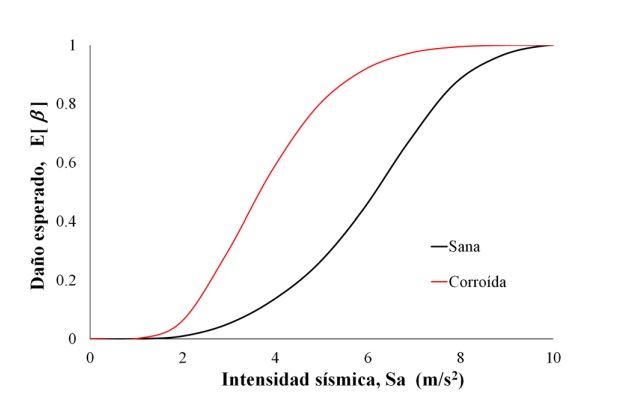
This research focuses efforts on demonstrating the importance of including the corrosion factor in long-term structural analyzes, based on various publications that parameterize values such as the corrosion rate index (icorr) and the equations that relate this sontoto parameter. with the loss of resistance in materials. To carry out the corresponding analyzes, a school designed with RC has been taken in Mexico City, built in 1980. The structural vulnerability curves of the current state are compared with the vulnerability curves when it first entered service, showing the variation in the expected damage and the potential impact this has on the computation of seismic risk.
Downloads
References
Belda Revert A., De Weerdt K., Hornbostel K. y Rica G. M. (2018), “Carbonation-induced corrosion: investigation of the corrosion onset”, Construction and Building Materials, vol. 162, Elsevier, January, pp. 847-856.
Bertolini L., Elsener B., Pedeferri P., Redaelli E. y Polder R. (2013), “Degradation of concrete. Corrosion of steel in concrete: prevention, diagnosis, repair”, Wiley-VCH, Weinheim, February, 434 pp.
Concrete Innovation Centre (2008), “Modelling of reinforcement corrosion in concrete - state of the art”, AIT AS, Oslo, 50 pp.
Celarec Daniel, Vamvatsikos D. y Dolšek M. (2011), “Simplified estimation of seismic risk for reinforced concrete buildings with consideration of corrosion over time”, Bull Earthquake Eng, vol. 9, Springer, February, pp. 1137-1155.
DDF, Departamento del Distrito Federal (1977), “Normas Técnicas Complementarias para el Diseño por Sismo”, Gaceta Oficial del Distrito Federal.
Di Sarno L. y Pugliese F. (2020), “Seismic fragility of existing RC buildings with corroded bars under earthquake sequences”, Soil Dynamics and Earthquake Engineering, vol. 134, Elsevier, April, art. 106169.
GCM, Gobierno de la Ciudad de México (2017), “Normas Técnicas Complementarias para Diseño y Construcción de Estructuras de Concreto”, Gaceta Oficial de la Ciudad de México.
Ghanooni-Bagha M., Shayanfar M.A., Shirzadi J. A. y Ziaadiny H (2016), “Corrosion-induced reduction in compressive strength of self-compacting concretes containing mineral admixtures”, Construction and Building Materials, vol. 113, Elsevier, June, pp. 221-228.
Gopal R. y Sangoju B. (2020), “Carbonation-Induced Corrosion: A Brief Review on Prediction Models”, J. Inst. Eng. India Ser., vol. 101, Springer, February, pp. 247-257.
Ibarra L. F., Medina, R. A. y Krawinkler H. (2005), “Hysteretic models that incorporate strength and stiffnes deterioration”, Earthquake Engineering and Structural Dynamics, pp. 1489-1511.
Kivell A., Palermo A., ASCE M., y Scott A (2015), “Complete Model of Corrosion-Degraded Cyclic Bond Performance in Reinforced Concrete”, Journal of Structural Engineering, vol. 141, ASCE, September, art. 04014222.
Lee H. y Cho Y. (2009), “Evaluation of mechanical properties of steel reinforcement embedded in concrete specimen as a function of the degree of reinforced corrosion”, International Journal of Fracture, vol. 157, ResearchGate, May, pp. 81-88.
Liu Y. (1996), “Modeling the time-to-corrosion cracking of the cover concrete in chloride contaminated reinforced concrete structures”, Virginia Polytechnic Institute and State University, Blacksburg, October, 128 pp.
Niño, M., Ayala, G. y Ordaz, M. (2018), “Ground-motion simulation by the empirical Green´s function method with a source defined by two corner frequencies and a two-stage summation scheme”, Bulletin of the Seismological Society of America 108, 901-912.
Pantazopoulou S. J. y Papoulia K. D. (2001), “Modeling cover-cracking due to reinforcement corrosion in RC structures”, Journal of Engineering Mechanics, vol. 127, ASCE, April, pp. 342-351.
Peixoto V. y Delgado J. M. (2013), “Corrosion of reinforcement in existing concrete façades. durability of building materials and components”, Springer, vol. 3, Porto, pp. 253-273.
Ramesh G. y Bhaskar S. (2020), “Carbonation-Induced Corrosion: A Brief Review on Prediction Models”, J. Inst. Eng. India Ser., vol. 101, Springer, February, pp. 247-257.
Rodriguez J., Ortega L.M. y Casal J. (1997), “Load carrying capacity of concrete structures with corroded reinforcement”, Construction and Building Materials, vol. 11, Elsevier, June, pp. 239-248.
Shamsoddini M. Z., Raissi D.M., Eghbali M., y Samadian D. (2020), “Evaluation of seismic resilience index for typical RC school buildings considering carbonate corrosion effects”, International Journal of Disaster Risk Reduction, vol. 46, Elsevier, June, art.101511.
Stefanoni M., Angst M. y Elsener B. (2017), “Corrosion rate of carbon steel in carbonated concrete”, Cement and Concrete Research, vol. 103, Elsevier, October, pp. 35-48.
Terán G. A. y Jirsa J. O. (2005), “A damage model for practical seismic design that accounts for low-cycle fatigue”, Earthquake Spectra 21, pp. 803-832.
Vamvatsikos, D., Cornell, C. A. (2001), “The incremental dynamic analysis and its application to performance-based earthquake engineering”, 12th European conference on earthquake engineering. Elsevier Science.
Downloads
Published
Versions
- 2026-08-07 (3)
- 2026-06-19 (2)
- 2025-12-31 (1)
Issue
Section
License
Copyright (c) 2025 Revista Ingeniería y Tecnología UAS

This work is licensed under a Creative Commons Attribution-NoDerivatives 4.0 International License.