Vulnerabilidad estructural considerando el intemperismo y edad de construcción para edificios escolares públicos
Palabras clave:
Vulnerabilidad estructural , Corrosión en concreto reforzado, Edificios escolares, Evaluación del riesgo sísmicoResumen
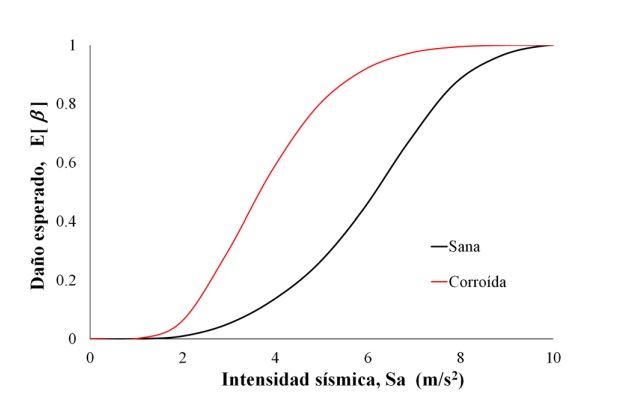
En este trabajo se demuestra la importancia de incluir en los análisis estructurales de estructuras existentes, el factor de la corrosión debido al intemperismo al que se ven sujetas las estructuras, tomando como base diversas publicaciones que parametrizan valores como el índice de la velocidad de corrosión (icorr) y las ecuaciones que relacionan este parámetro con la pérdida de resistencia en los materiales. Como ejemplo de aplicación se ha tomado una estructura de concreto reforzado de uso escolar ubicada en la Ciudad de México, construida en 1980. Las curvas de vulnerabilidad estructural del estado actual se comparan con las curvas de vulnerabilidad en el primer momento que entro en servicio donde se observa la variación del daño esperado y el potencial impacto que esto representa en el cálculo del riesgo por efectos sísmicos.
Descargas
Referencias
Belda Revert A., De Weerdt K., Hornbostel K. y Rica G. M. (2018), “Carbonation-induced corrosion: investigation of the corrosion onset”, Construction and Building Materials, vol. 162, Elsevier, January, pp. 847-856.
Bertolini L., Elsener B., Pedeferri P., Redaelli E. y Polder R. (2013), “Degradation of concrete. Corrosion of steel in concrete: prevention, diagnosis, repair”, Wiley-VCH, Weinheim, February, 434 pp.
Concrete Innovation Centre (2008), “Modelling of reinforcement corrosion in concrete - state of the art”, AIT AS, Oslo, 50 pp.
Celarec Daniel, Vamvatsikos D. y Dolšek M. (2011), “Simplified estimation of seismic risk for reinforced concrete buildings with consideration of corrosion over time”, Bull Earthquake Eng, vol. 9, Springer, February, pp. 1137-1155.
DDF, Departamento del Distrito Federal (1977), “Normas Técnicas Complementarias para el Diseño por Sismo”, Gaceta Oficial del Distrito Federal.
Di Sarno L. y Pugliese F. (2020), “Seismic fragility of existing RC buildings with corroded bars under earthquake sequences”, Soil Dynamics and Earthquake Engineering, vol. 134, Elsevier, April, art. 106169.
GCM, Gobierno de la Ciudad de México (2017), “Normas Técnicas Complementarias para Diseño y Construcción de Estructuras de Concreto”, Gaceta Oficial de la Ciudad de México.
Ghanooni-Bagha M., Shayanfar M.A., Shirzadi J. A. y Ziaadiny H (2016), “Corrosion-induced reduction in compressive strength of self-compacting concretes containing mineral admixtures”, Construction and Building Materials, vol. 113, Elsevier, June, pp. 221-228.
Gopal R. y Sangoju B. (2020), “Carbonation-Induced Corrosion: A Brief Review on Prediction Models”, J. Inst. Eng. India Ser., vol. 101, Springer, February, pp. 247-257.
Ibarra L. F., Medina, R. A. y Krawinkler H. (2005), “Hysteretic models that incorporate strength and stiffnes deterioration”, Earthquake Engineering and Structural Dynamics, pp. 1489-1511.
Kivell A., Palermo A., ASCE M., y Scott A (2015), “Complete Model of Corrosion-Degraded Cyclic Bond Performance in Reinforced Concrete”, Journal of Structural Engineering, vol. 141, ASCE, September, art. 04014222.
Lee H. y Cho Y. (2009), “Evaluation of mechanical properties of steel reinforcement embedded in concrete specimen as a function of the degree of reinforced corrosion”, International Journal of Fracture, vol. 157, ResearchGate, May, pp. 81-88.
Liu Y. (1996), “Modeling the time-to-corrosion cracking of the cover concrete in chloride contaminated reinforced concrete structures”, Virginia Polytechnic Institute and State University, Blacksburg, October, 128 pp.
Niño, M., Ayala, G. y Ordaz, M. (2018), “Ground-motion simulation by the empirical Green´s function method with a source defined by two corner frequencies and a two-stage summation scheme”, Bulletin of the Seismological Society of America 108, 901-912.
Pantazopoulou S. J. y Papoulia K. D. (2001), “Modeling cover-cracking due to reinforcement corrosion in RC structures”, Journal of Engineering Mechanics, vol. 127, ASCE, April, pp. 342-351.
Peixoto V. y Delgado J. M. (2013), “Corrosion of reinforcement in existing concrete façades. durability of building materials and components”, Springer, vol. 3, Porto, pp. 253-273.
Ramesh G. y Bhaskar S. (2020), “Carbonation-Induced Corrosion: A Brief Review on Prediction Models”, J. Inst. Eng. India Ser., vol. 101, Springer, February, pp. 247-257.
Rodriguez J., Ortega L.M. y Casal J. (1997), “Load carrying capacity of concrete structures with corroded reinforcement”, Construction and Building Materials, vol. 11, Elsevier, June, pp. 239-248.
Shamsoddini M. Z., Raissi D.M., Eghbali M., y Samadian D. (2020), “Evaluation of seismic resilience index for typical RC school buildings considering carbonate corrosion effects”, International Journal of Disaster Risk Reduction, vol. 46, Elsevier, June, art.101511.
Stefanoni M., Angst M. y Elsener B. (2017), “Corrosion rate of carbon steel in carbonated concrete”, Cement and Concrete Research, vol. 103, Elsevier, October, pp. 35-48.
Terán G. A. y Jirsa J. O. (2005), “A damage model for practical seismic design that accounts for low-cycle fatigue”, Earthquake Spectra 21, pp. 803-832.
Vamvatsikos, D., Cornell, C. A. (2001), “The incremental dynamic analysis and its application to performance-based earthquake engineering”, 12th European conference on earthquake engineering. Elsevier Science.
Descargas
Publicado
Versiones
- 2026-08-07 (3)
- 2026-06-19 (2)
- 2025-12-31 (1)
Número
Sección
Licencia
Derechos de autor 2025 Revista Ingeniería y Tecnología UAS

Esta obra está bajo una licencia internacional Creative Commons Atribución-SinDerivadas 4.0.