Molecular detection of Treponema pallidum by PCR of the tpn47 gene in peripheral blood of volunteers treated in clinical laboratories of Culiacan
Keywords:
Treponema pallidum, epidemiology, TpN47, molecular diagnosis, PCRAbstract
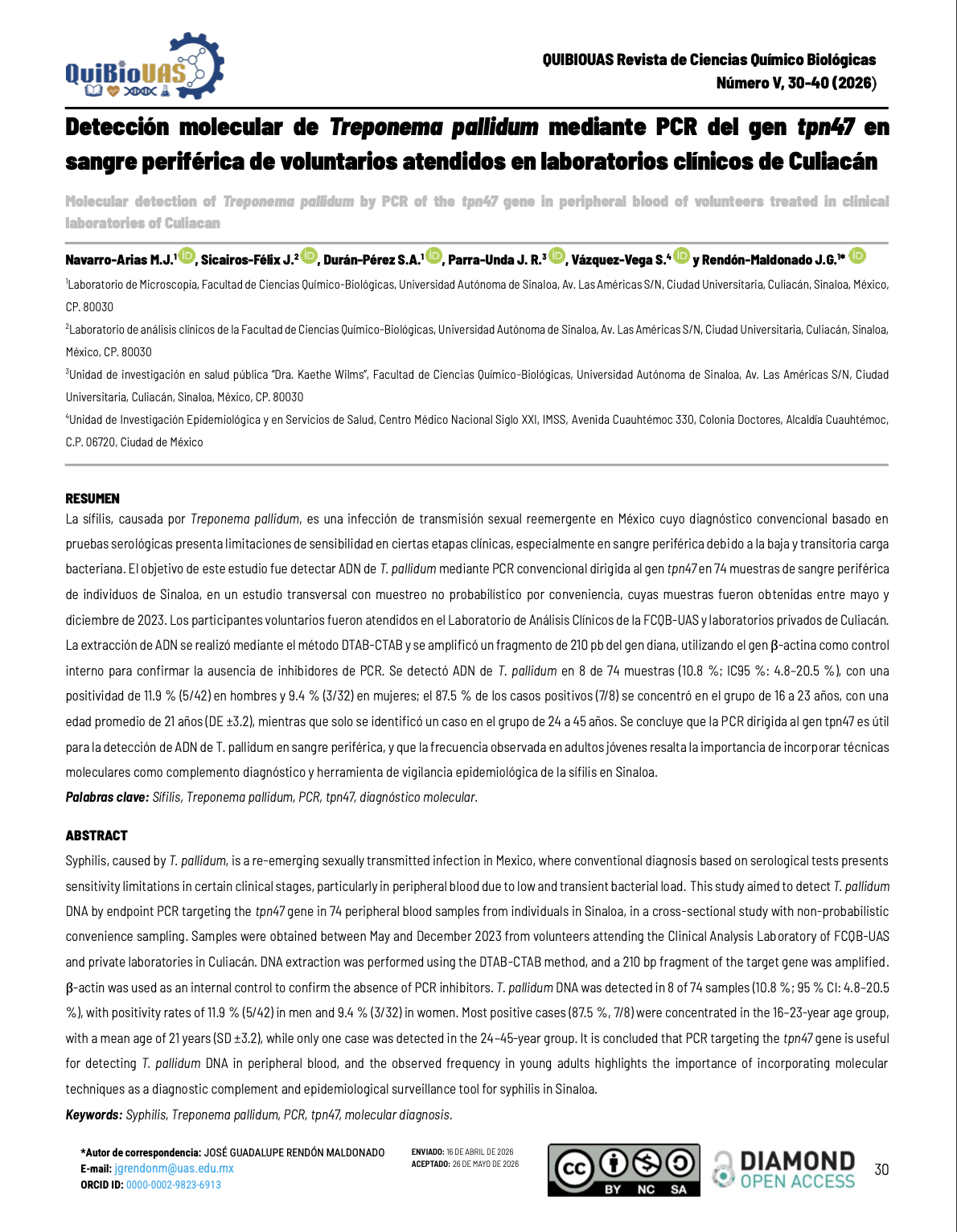
Syphilis, caused by T. pallidum, is a re-emerging sexually transmitted infection in Mexico, where conventional diagnosis based on serological tests presents sensitivity limitations in certain clinical stages, particularly in peripheral blood due to low and transient bacterial load. This study aimed to detect T. pallidum DNA by endpoint PCR targeting the tpn47 gene in 74 peripheral blood samples from individuals in Sinaloa, in a cross-sectional study with non-probabilistic convenience sampling. Samples were obtained between May and December 2023 from volunteers attending the Clinical Analysis Laboratory of FCQB-UAS and private laboratories in Culiacán. DNA extraction was performed using the DTAB-CTAB method, and a 210 bp fragment of the target gene was amplified. β-actin was used as an internal control to confirm the absence of PCR inhibitors. T. pallidum DNA was detected in 8 of 74 samples (10.8%; 95% CI: 4.8–20.5%), with positivity rates of 11.9% (5/42) in men and 9.4% (3/32) in women. Most positive cases (87.5%, 7/8) were concentrated in the 16–23-year age group, with a mean age of 21 years (SD ±3.2), while only one case was detected in the 24–45-year group. It is concluded that PCR targeting the tpn47 gene is useful for detecting T. pallidum DNA in peripheral blood, and the observed frequency in young adults highlights the importance of incorporating molecular techniques as a diagnostic complement and epidemiological surveillance tool for syphilis in Sinaloa.
Downloads
References
Avelino, M. E. de S., Silva, A. S. da, Figueiredo, L. G. C. P. de, Fonseca, R. R. de S., Menezes, C. R., Lima, S. S., Mendes, A. L., Silva, C. H. B. da, Reis, I. V. S. dos, Nunes, H. B. de F., Sequeira, B. J., & Machado, L. F. A. (2023). Exposure to Treponema pallidum Infection among Adolescent and Young Adult Women in Roraima, Amazon Region of Brazil. Microorganisms, 11(10). https://doi.org/10.3390/microorganisms11102382
Centers for Disease Control and Prevention. (2022). Sexually transmitted disease surveillance 2021. U.S. Department of Health and Human Services. https://stacks.cdc.gov/view/cdc/147167
Čejková, D., Strouhal, M., Norris, S. J., Weinstock, G. M., & Šmajs, D. (2015). A Retrospective Study on Genetic Heterogeneity within Treponema Strains: Subpopulations Are Genetically Distinct in a Limited Number of Positions. PLoS Neglected Tropical Diseases, 9(10). https://doi.org/10.1371/journal.pntd.0004110
Centurion-Lara, A., Castro, C., Shaffer, J. M., Van Voorhis, W. C., Marra, C. M., & Lukehart, S. A. (1997). Detection of Treponema pallidum by a sensitive reverse transcriptase PCR. Journal of Clinical Microbiology, 35(6). https://doi.org/10.1128/jcm.35.6.1348-1352.1997
Chen, W., Luo, H., Zeng, L., Pan, Y., Parr, J. B., Jiang, Y., Cunningham, C. H., Hawley, K. L., Radolf, J. D., Ke, W., Ou, J., Yang, J., Yang, B., & Zheng, H. (2022). A suite of PCR-LwCas13a assays for detection and genotyping of Treponema pallidum in clinical samples. Nature Communications, 13(1). https://doi.org/10.1038/s41467-022-32250-y
Clement, M. E., Okeke, N. L., & Hicks, C. B. (2014). Treatment of syphilis: A systematic review. JAMA - Journal of the American Medical Association, 312(18). https://doi.org/10.1001/jama.2014.13259
Costa-Silva, M., Coutinho, D., Sobrinho-Simões, J., Azevedo, F., & Lisboa, C. (2018). Cross-sectional study of Treponema pallidum PCR in diagnosis of primary and secondary syphilis. International Journal of Dermatology, 57(1). https://doi.org/10.1111/ijd.13823
Dehne, K. L., & Riedner, G. (2001). Sexually transmitted infections among adolescents: The need for adequate health services. Reproductive Health Matters, 9(17). https://doi.org/10.1016/S0968-8080(01)90021-7
Ferreira, S. C., De Almeida-Neto, C., Nishiya, A. S., Di-Lorenzo-Oliveira, C., Ferreira, J. E., Alencar, C. S., Levi, J. E., Salles, N. A., Mendrone-Junior, A., & Sabino, E. C. (2014). Prevalence of Treponema pallidum DNA among blood donors with two different serologic tests profiles for syphilis in São Paulo, Brazil. Vox Sanguinis, 106(4). https://doi.org/10.1111/vox.12111
Flipse, J., Niekamp, A. M., Dirks, A., Dukers-Muijrers, N. H. T. M., Hoebe, C. J. P. A., Wolffs, P., & van Loo, I. H. M. (2023). Refining Timely Diagnosis of Early Syphilis by Using Treponema pallidum PCR or IgM Immunoblotting Next to Conventional Serology for Syphilis. Journal of Clinical Microbiology, 61(6). https://doi.org/10.1128/jcm.00112-23
Gayet-Ageron, A., Ninet, B., Toutous-Trellu, L., Lautenschlager, S., Furrer, H., Piguet, V., Schrenzel, J., & Hirschel, B. (2009). Assessment of a real-time PCR test to diagnose syphilis from diverse biological samples. Sexually Transmitted Infections, 85(4). https://doi.org/10.1136/sti.2008.034314
Gayet-Ageron, A., Combescure, C., Lautenschlager, S., Ninet, B., & Perneger, T. V. (2015). Comparison of diagnostic accuracy of PCR targeting the 47-kilodalton protein membrane gene of Treponema pallidum and PCR targeting the DNA polymerase i gene: Systematic review and meta-analysis. In Journal of Clinical Microbiology (Vol. 53, Number 11). https://doi.org/10.1128/JCM.01619-15
Giacani, L., & Lukehart, S. A. (2014). The endemic treponematoses. In Clinical Microbiology Reviews (Vol. 27, Number 1). https://doi.org/10.1128/CMR.00070-13
Grange, P. A., Gressier, L., Dion, P. L., Farhi, D., Benhaddou, N., Gerhardt, P., Morini, J. P., Deleuze, J., Pantoja, C., Bianchi, A., Lassau, F., Avril, M. F., Janier, M., & Dupina, N. (2012). Evaluation of a PCR test for detection of Treponema pallidum in swabs and blood. Journal of Clinical Microbiology, 50(3). https://doi.org/10.1128/JCM.00702-11
Gustincich, S., Manfioletti, G., Del Sal, G., Schneider, C., & Carninci, P. (1991). A fast method for high-quality genomic DNA extraction from whole human blood. BioTechniques,11(3), 298–302. https://pubmed.ncbi.nlm.nih.gov/1931026/
Heymans, R., Van Der Helm, J. J., De Vries, H. J. C., Fennema, H. S. A., Coutinho, R. A., & Bruisten, S. M. (2010). Clinical value of Treponema pallidum real-time PCR for diagnosis of syphilis. Journal of Clinical Microbiology, 48(2). https://doi.org/10.1128/JCM.00720-09
Hook, E. W., & Peeling, R. W. (2004). Syphilis Control — A Continuing Challenge. New England Journal of Medicine, 351(2). https://doi.org/10.1056/nejmp048126
Houston, S., Schovanek, E., Conway, K. M. E., Mustafa, S., Gomez, A., Ramaswamy, R., Haimour, A., Boulanger, M. J., Reynolds, L. A., & Cameron, C. E. (2022). Identification and Functional Characterization of Peptides ith Antimicrobial Activity From the Syphilis Spirochete, Treponema pallidum. Frontiers in Microbiology, 13. https://doi.org/10.3389/fmicb.2022.888525
Ibáñez-Cervantes, G., León-García, G., Vargas-De-León, C., Castro-Escarpulli, G., Bandala, C., Sosa-Hernández, O., Mancilla-Ramírez, J., Rojas-Bernabé, A., Cureño-Díaz, M. A., Durán-Manuel, E. M., Cruz-Cruz, C., Bravata-Alcántara, J. C., Juárez-Ascencio, D., & Bello-López, J. M. (2020). Epidemiological behavior and current forecast of syphilis in Mexico: increase in male population. Public Health, 185. https://doi.org/10.1016/j.puhe.2020.05.057
Koek, A. G., Bruisten, S. M., Dierdorp, M., van Dam, A. P., & Templeton, K. (2006). Specific and sensitive diagnosis of syphilis using a real-time PCR for Treponema pallidum. Clinical Microbiology and Infection, 12(12). https://doi.org/10.1111/j.1469-0691.2006.01566.x
Lee, K. H., Choi, H. J., Lee, M. G., & Lee, J. B. (2000). Virulent Treponema pallidum 47 kDa Antigen Regulates the Expression of Cell Adhesion Molecules and Binding of T-Lymphocytes to Cultured Human Dermal Microvascular Endothelial Cells. Yonsei Medical Journal, 41(5). https://doi.org/10.3349/ymj.2000.41.5.623
Lin Kim, H., Wha Ha, A., & Kyoung Kim, W. (2020). Effect of saccharin on inflammation in 3T3-L1 adipocytes and the related mechanism. Nutrition Research and Practice, 14(2), 1976–1457. https://doi.org/10.4162/nrp.2020.14.2.109&domain=pdf&date_stamp=2020-04-01
Liu, H., Rodes, B., Chen, C. Y., & Steiner, B. (2001). New tests for syphilis: Rational design of a PCR method for detection of Treponema pallidum in clinical specimens using unique regions of the DNA polymerase I gene. Journal of Clinical Microbiology, 39(5). https://doi.org/10.1128/JCM.39.5.1941-1946.2001
Lorenz, Z. W., Nijhar, S., Caufield-Noll, C., Ghanem, K. G., & Hamill, M. M. (2023). The Utility of Biomarkers in the Clinical Management of Syphilis: A Systematic Review. In Sexually Transmitted Diseases (Vol. 50, Number 8). https://doi.org/10.1097/OLQ.0000000000001813
Lukehart, S. A., Godornes, C., Molini, B. J., Sonnett, P., Hopkins, S., Mulcahy, F., Engelman, J., Mitchell, S. J., Rompalo, A. M., Marra, C. M., & Klausner, J. D. (2004). Macrolide Resistance in Treponema pallidum in the United States and Ireland. New England Journal of Medicine, 351(2). https://doi.org/10.1056/nejmoa040216
Marks, M., Lawrence, D., Kositz, C., & Mabey, D. (2018). Diagnostic performance of PCR assays for the diagnosis of neurosyphilis: A systematic review. In Sexually Transmitted Infections (Vol. 94, Number 8). https://doi.org/10.1136/sextrans-2018-053666
Mejía-Aguirre, B., Luna-Vargas, A. K., & Benítez-Arvizu, G. (2025). Seroprevalencia de agentes infecciosos en donadores de sangre y sus componentes. Revista Médica Del Instituto Mexicano Del Seguro Social, 63(2). http:// do.org/10.5281/zenodo.14616969
Newman, L., Rowley, J., Hoorn, S. Vander, Wijesooriya, N. S., Unemo, M., Low, N., Stevens, G., Gottlieb, S., Kiarie, J., & Temmerman, M. (2015). Global Estimates of the Prevalence and Incidence of Four Curable Sexually Transmitted Infections in 2012 Based on Systematic Review and Global Reporting. In PLoS ONE (Vol. 10, Number 12). https://doi.org/10.1371/journal.pone.0143304
Norgard, M. V., Chamberlain, N. R., Swancutt, M. A., & Goldberg, M. S. (1986). Cloning and expression of the major 47-kilodalton surface immunogen of Treponema pallidum in Escherichia coli. Infection and Immunity, 54(2). https://doi.org/10.1128/iai.54.2.500-506.1986
Organización Mundial de la Salud. (2023). Estadísticas globales. https://www.who.int/news-room/fact-sheets/detail/sexually-transmitted-infections-(stis).
Palmer, H. M., Higgins, S. P., Herring, A. J., & Kingston, M. A. (2003). Use of PCR in the diagnosis of early syphilis in the United Kingdom. Sexually Transmitted Infections, 79(6). https://doi.org/10.1136/sti.79.6.479
Peeling, R. W., Mabey, D., Chen, X. S., & Garcia, P. J. (2023). Syphilis. In The Lancet (Vol. 402, Number 10398). https://doi.org/10.1016/S0140-6736(22)02348-0
Peng, R. R., Wang, A. L., Li, J., Tucker, J. D., Yin, Y. P., & Chen, X. S. (2011). Molecular typing of Treponema pallidum: A systematic review and meta-analysis. In PLoS Neglected Tropical Diseases (Vol. 5, Number 11). https://doi.org/10.1371/journal.pntd.0001273
Pillay, A., Liu, H., Chen, C. Y., Holloway, B., Willem Sturm, A., Steiner, B., & Morse, S. A. (1998). Molecular subtyping of Treponema pallidum subspecies pallidum. Sexually Transmitted Diseases, 25(8). https://doi.org/10.1097/00007435-199809000-00004
Pinilla, G., Cuervo, B., Martínez, N., Navas, J., & Mora, L. (2015). Determinación de los genes 16S ADNr, polA y TpN47 en la detección de Treponema pallidum subsp. pallidum para el diagnóstico de sífilis congénita. NOVA, 17–25. http://www.scielo.org.co/pdf/nova/v13n24/v13n24a02.pdf
Radolf, J. D., Chamberlain, N. R., Clausell, A., & Norgard, M. V. (1988). Identification and localization of integral membrane proteins of virulent Treponema pallidum subsp. pallidum by phase partitioning with the nonionic detergent Triton X-114. Infection and Immunity, 56(2). https://doi.org/10.1128/iai.56.2.490-498.1988
Refugio, O. N., & Klausner, J. D. (2018). Syphilis incidence in men who have sex with men with human immunodeficiency virus comorbidity and the importance of integrating sexually transmitted infection prevention into HIV care. In Expert Review of Anti-Infective Therapy (Vol. 16, Number 4). https://doi.org/10.1080/14787210.2018.1446828
Rochel-Perez, E. A., Martin-Dorantes, M. A., & Mendez-Dominguez, N. (2024). Estimation of the Incidence of Congenital Syphilis in Mexico Between 2019 and 2023. Cureus. https://doi.org/10.7759/cureus.63913
Rowley, J., Hoorn, S. Vander, Korenromp, E., Low, N., Unemo, M., Abu-Raddad, L. J., Chico, R. M., Smolak, A., Newman, L., Gottlieb, S., Thwin, S. S., Broutet, N., & Taylor, M. M. (2019). Chlamydia, gonorrhoea, trichomoniasis and syphilis: Global prevalence and incidence estimates, 2016. Bulletin of the World Health Organization, 97(8). https://doi.org/10.2471/BLT.18.228486
Salazar, J. C., Vargas-Cely, F., García-Luna, J. A., Ramirez, L. G., Bettin, E. B., Romero-Rosas, N., Amórtegui, M. F., Silva, S., Oviedo, O., Vigil, J., La Vake, C. J., Galindo, X., Ramirez, J. D., Martínez-Valencia, A. J., Caimano, M. J., Hennelly, C. M., Aghakhanian, F., Anthony Moody, M., Seña, A. C., … Redoll, J. D. (2024). Treponema pallidum genetic diversity and its implications for targeted vaccine development: A cross-sectional study of early syphilis cases in Southwestern Colombia. PLoS ONE, 19(7 July). https://doi.org/10.1371/journal.pone.0307600
Satyaputra, F., Hendry, S., Braddick, M., Sivabalan, P., & Norton, R. (2021). The Laboratory Diagnosis of Syphilis. In Journal of Clinical Microbiology (Vol. 59, Number 10). https://doi.org/10.1128/JCM.00100-21
Secretaría de Salud. (2015). Norma Oficial Mexicana NOM-039-SSA2-2014, para la prevención y control de las infecciones de transmisión sexual. México: Secretaría de Salud; 2015. https://www.dof.gob.mx
Shields, M., Guy, R. J., Jeoffreys, N. J., Finlayson, R. J., & Donovan, B. (2012). A longitudinal evaluation of Treponema pallidum PCR testing in early syphilis. BMC Infectious Diseases, 12. https://doi.org/10.1186/1471-2334-12-353
Soreng, K., Levy, R., & Fakile, Y. (2014). Serologic testing for syphilis: Benefits and challenges of a reverse algorithm. Clinical Microbiology Newsletter, 36(24). https://doi.org/10.1016/j.clinmicnews.2014.12.001
Stamm, L. V. (2010). Global challenge of antibiotic-resistant Treponema pallidum. In Antimicrobial Agents and Chemotherapy (Vol. 54, Number 2). https://doi.org/10.1128/AAC.01095-09
Stoltey, J. E., & Cohen, S. E. (2015). Syphilis transmission: A review of the current evidence. In Sexual Health (Vol. 12, Number 2). https://doi.org/10.1071/SH14174
Theel, E. S., Katz, S. S., & Pillay, A. (2020). Molecular and Direct Detection Tests for Treponema pallidum Subspecies pallidum: A Review of the Literature, 1964-2017. Clinical Infectious Diseases, 71. https://doi.org/10.1093/cid/ciaa176
Treger, R. S., Menza, T. W., Truong, T. T., & Lieberman, J. A. (2025). Advances in Syphilis Diagnostics to Address the 21st-Century Epidemic. In Clinical Chemistry (Vol. 71, Number 9). https://doi.org/10.1093/clinchem/hvaf072
Tsuboi, M., Evans, J., Davies, E. P., Rowley, J., Korenromp, E. L., Clayton, T., Taylor, M. M., Mabey, D., & Chico, R. M. (2021). Prevalence of syphilis among men who have sex with men: a global systematic review and meta-analysis from 2000–20. The Lancet Global Health, 9(8). https://doi.org/10.1016/S2214-109X(21)00221-7
Unemo, M., Bradshaw, C. S., Hocking, J. S., de Vries, H. J. C., Francis, S. C., Mabey, D., Marrazzo, J. M., Sonder, G. J. B., Schwebke, J. R., Hoornenborg, E., Peeling, R. W., Philip, S. S., Low, N., & Fairley, C. K. (2017). Sexually transmitted infections: challenges ahead. In The Lancet Infectious Diseases (Vol. 17, Number 8). https://doi.org/10.1016/S1473-3099(17)30310-9
Yokota, M., Tatsumi, N., Nathalang, O., Yamada, T., & Tsuda, I. (1999). Effects of heparin on polymerase chain reaction for blood white cells. Journal of Clinical Laboratory Analysis, 13(3). https://doi.org/10.1002/(SICI)1098-2825(1999)13:3<133:AID-JCLA8>3.0.CO;2-0
Downloads
Published
Data Availability Statement
The data will always beavailable when required.
Issue
Section
Categories
License
Copyright (c) 2026 QUIBIOUAS Revista de Ciencias Químico Biológicas

This work is licensed under a Creative Commons Attribution-NonCommercial-ShareAlike 4.0 International License.